
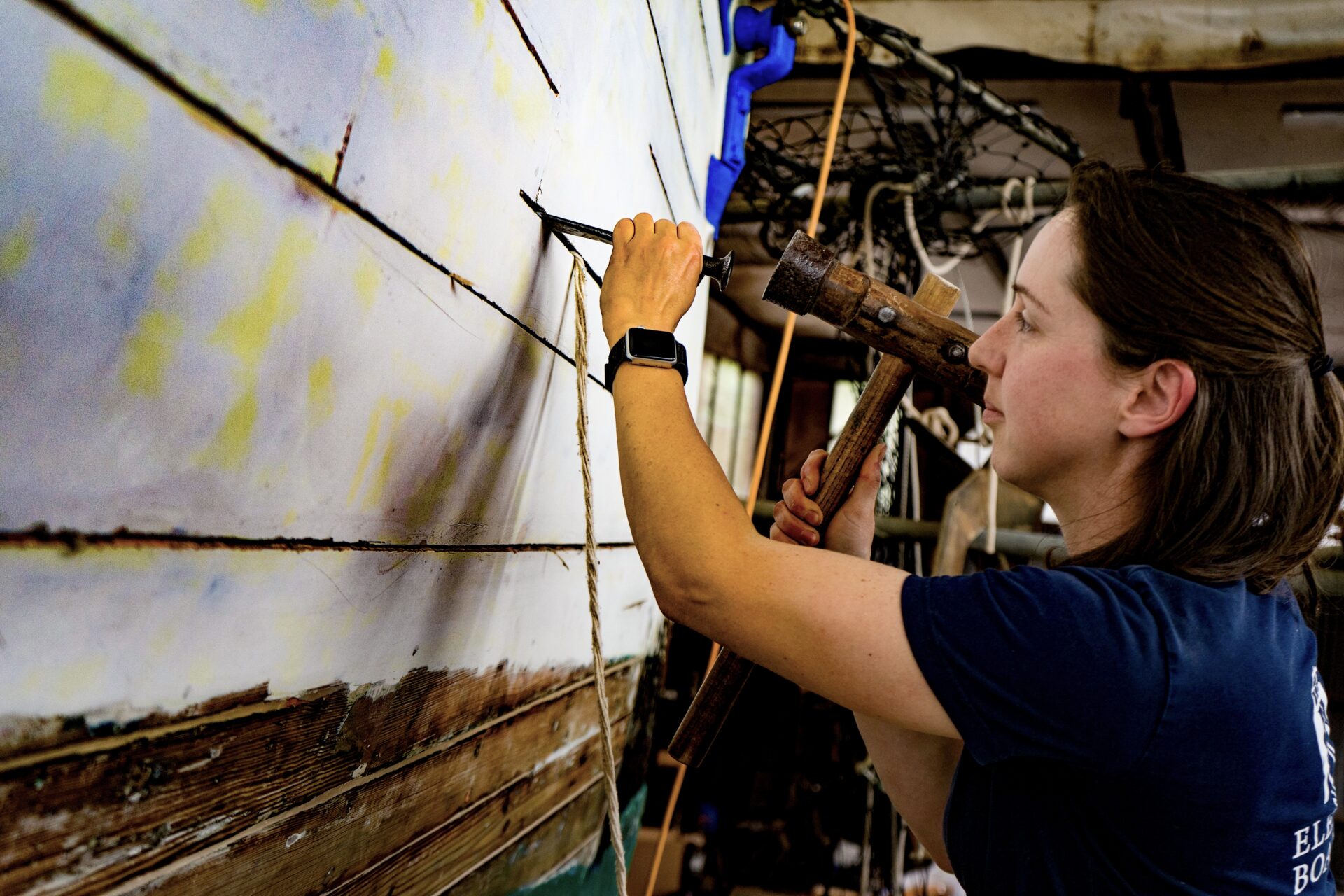

The Pacific Northwest boasts a storied history of passionate women mariners, from Thea Foss, the Tacoma-based founder of Foss Maritime, to the Sail Like a Girl team that made history when they won the 2018 Race to Alaska.
Whether behind the helm or behind the scenes, women have always been a part of the tapestry of marine history. Despite such inspirational figures, however, the number of women and gender diverse individuals in our maritime sector remains low.
The International Maritime Organization (IMO) estimates that worldwide, only two percent of mariners identify as women. Numbers in the Pacific Northwest don’t fare much better. All of which begs the question: Why aren’t there more women in the industry and how do we get them here?
WHILE MANY ORGANIZATIONS continue to scratch their heads over this issue, a woman across the pond has developed practical solutions to promote and bolster women in England’s boatbuilding sector. Her efforts offer a worthwhile blueprint as to how we can encourage more women to join our shipyards, sail lofts and other marine-related trades.
Once a month, Belinda Joslin can be found grinning from behind a Zoom screen. As the founder of the Women in Boat Building Network, she hosts regular online socials where female boatbuilders from around the UK can discuss issues and projects important to them. These Zoom socials are just one part of Women in Boat Building’s broader campaign to recruit and retain more women in England’s boatbuilding industry.
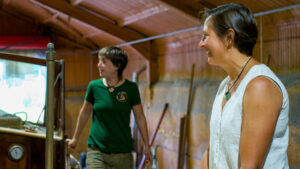
 Belinda Joslin (right) sitting down with local boatbuilder and business owner Abbey Molyneux.
The Women in Boat Building Network (WIBB) is a homegrown community interest company devoted to uplifting and supporting women in boatbuilding and related industries. In a male-dominated field grappling with an international labour shortage, networks like WIBB are not just about bringing more women on board, but harmonizing diverse voices in the maritime sector.
In 2021, Joslin worked as a finisher in one of the UK’s luxury shipyards, while simultaneously restoring her own 23-foot keelboat. “I was spending all my time, up to my eyeballs in boat work, surrounded mostly by men,” says Belinda.
EAGER TO CONNECT with women in similar positions and unimpressed with the lack of female representation around her, Joslin started posting about her experience on social media. From there, she began to connect with like-minded women in the sector, all of them similarly fed up with a lack of community space for women.
While numerous gendered barriers persist in the marine industry, including a lack of flexible childcare scheduling, inadequately sized personal protective equipment (PPE), and a shortage of private spaces for restrooms or nursing, one of the foremost issues is the lack of visibility.
Over time, Joslin began to feature and share profiles of the women she connected with on her social platforms, effectively creating representation where there hadn’t been any. Her account swelled to a following of 2,400 individuals. Both the BBC and The Guardian ran pieces on this newly founded network of shipwrights. She reached audiences as far away as South Africa and New Zealand. “It just took on a life of its own,” said Joslin, “you couldn’t have done this years ago, pre-social media.”
 Sydney Fassum is an electrical engineering apprentice and one of the youngest members of the WIBB program.
These online narratives empower women and non-binary workers, fostering a sense of support and acknowledgment within the industry. They act as a catalyst for those joining the sector and reinforce, for those already involved, that they are not alone.
HOWEVER, JOSLIN RECOGNIZED that social media was only one piece of the puzzle. “Attracting women to boat building is one thing; keeping them there is another,” she emphasized. That’s where WIBB’s mentoring program comes in. After offering informal online advice and coaching to women in the maritime trades for years, in 2023, Joslin and her co-directors founded a formal mentoring program.
“Mentoring is another way of supporting people to take their careers seriously and develop their professional trajectory,” said Joslin. Mentors can also play a major role in whether someone chooses to remain in or leave the industry. That was surely the case for Clementine Mollier, a French shipwright and mentee in the WIBB network.
After spending nearly two years as the only woman in her boatyard, Mollier felt a deep sense of disconnection from her colleagues and had considered quitting. Then she discovered WIBB and enrolled in their mentorship program. “When I heard about all these other female boatbuilders facing the same struggles but sharing the same love for the job, it inspired me and allowed me to carry on in the industry.” Today, Mollier is a mentor to other WIBB shipwrights and a shipwright on the prestigious HMS Victory project.
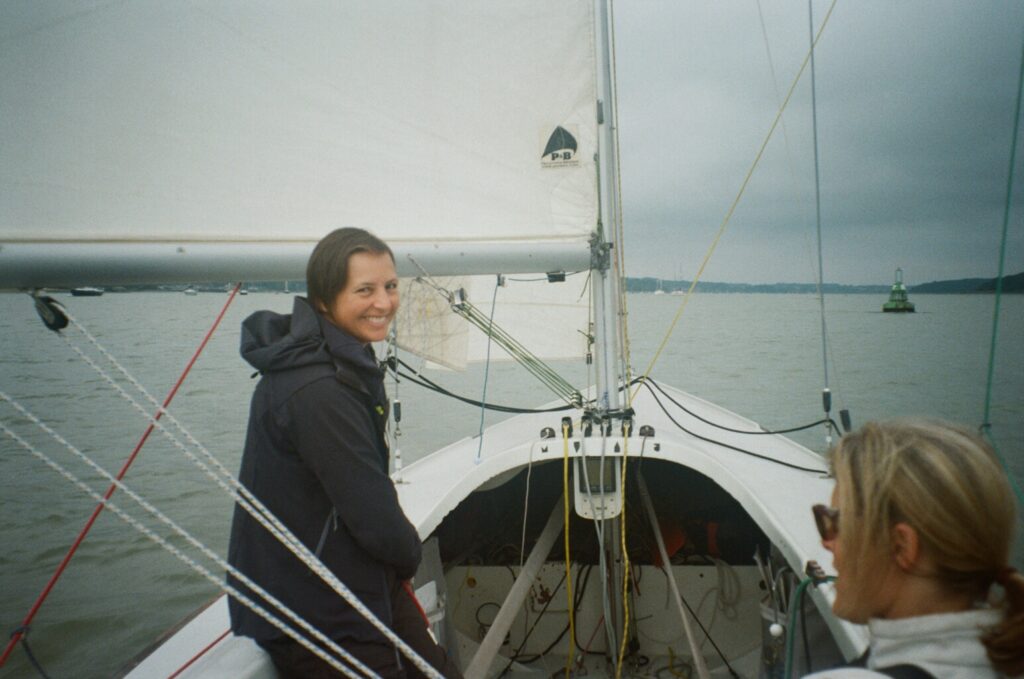
In addition to social media and mentoring, the WIBB network provides women-only trades workshops, and DEI (Diversity, Equity, Inclusion) consulting, and it even produced a successful three-part web series interviewing female boat builders throughout England. The videos have garnered positive feedback globally, with boatbuilders in Italy expressing interest in replicating the series internationally.
WIBB HAS CLEARLY filled a valuable and much-needed niche. However, this is not to say that the Pacific Northwest lacks marine programming and workshops tailored for women. The Northwest Maritime Center in Port Townsend offers a variety of sailing/skipper training classes for women and girls. They have initiated the Girls Boat Project, a year-long woodworking, sailing, and nautical trades class for middle school girls. Additionally, they host the annual She Tells Sea Tales, a live storytelling event for those connected to the women’s community and water.
Informal and much-loved community networks (online and in person) already exist here in the PNW. Strong women leadership abounds. Femme-specific scholarships are becoming more common in marine education and trades. BCIT, a leading marine trade authority in Vancouver, provides a fully subsidized 17-week associate certificate in the Enhanced Bridge Watch Rating program for women and Indigenous individuals. WCMRC, Canada’s first marine spill response organization, offers a paid four-month internship exclusively for women mariners. Port Townsend even boasts its own short documentary on female boatbuilders, titled “Women Shipwrights of Port Townsend.” Operating at a national level in the USA, Women Offshore likewise offers a myriad of professional training and other resources. The fact remains, however, no centralized entity offers the same scale, abundance, and frequency of women-catered maritime material as WIBB.
Visibility demands vigilance. WIBB’s continuous flow of stories, opportunities, and community networking maintains a prominent profile for women and gender diverse people in the maritime industry. Upon visiting the WIBB platform, whether on its website or social media, visitors know they can receive encouragement, support and chances to advance their careers. Effectively, it serves as a one-stop shop. If support is elusive in one’s workplace, it can be found at their fingertips with just a click of their smartphone.
Luckily, we live in the age of technology, as Joslin well knows, “This is not an organization that has been created at the top level. This is an organization that’s been created on the shop floor.” WIBB carved out a niche for women in England, and perhaps with a little gumption, we can do the same, right from our own rain-soaked shores and trusty workbenches.