
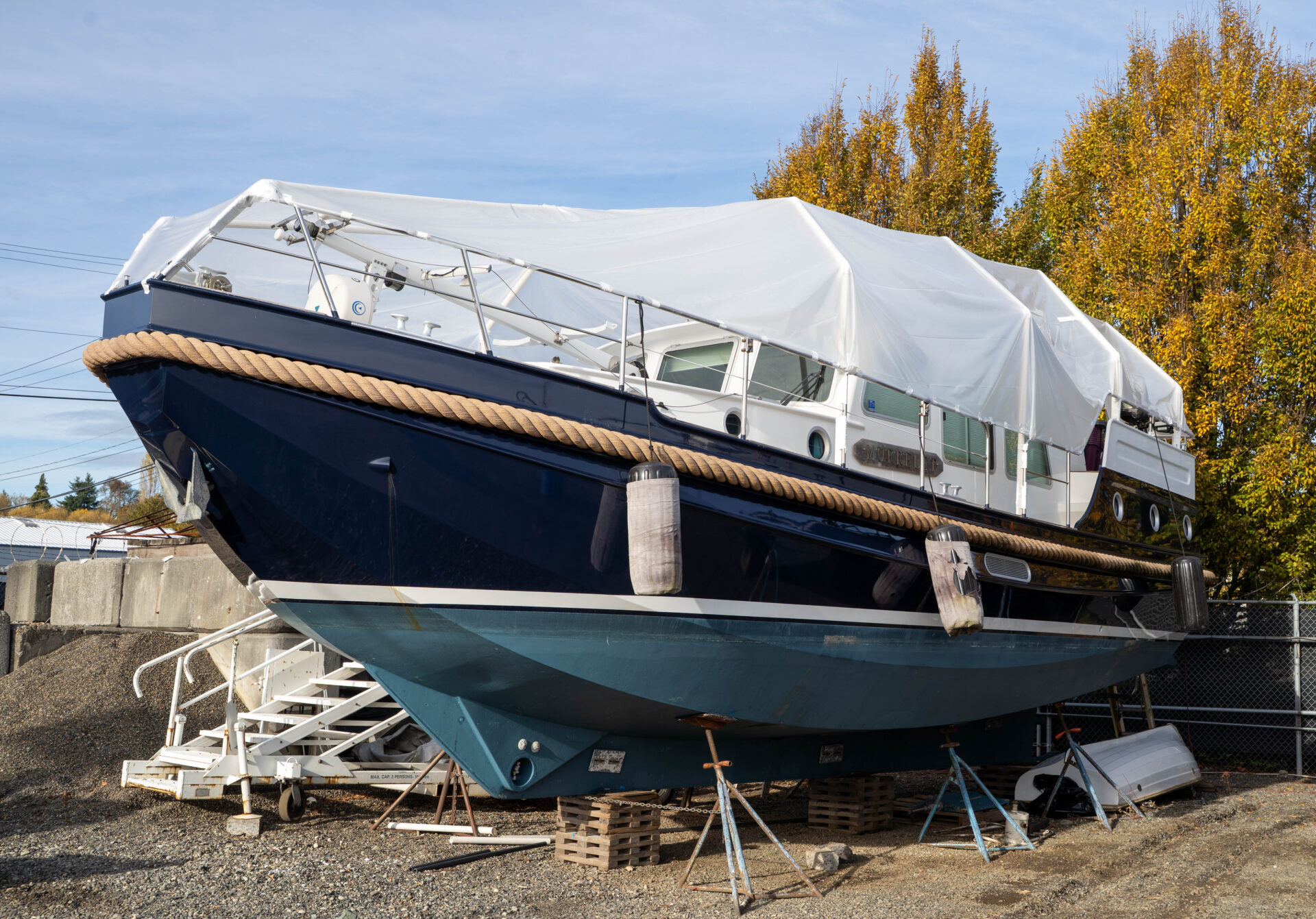

Boat owners retrofit their vessels for a variety of reasons: to meet charter requirements, to accommodate growing children, to upgrade aging equipment. Rarely does anyone undertake such a project in service of science. Rarer still: retrofitting a pleasure boat specifically to study orcas.
Audrey Benedict is doing exactly that. An author, naturalist and owner of Murrelet, a 1996 steel-hulled Linssen motor yacht, Benedict launched an ambitious project last September to transform her vessel into a cetacean-friendly research platform for the Salish Sea.
Working together with project manager Kim Smith—a marine professional with nearly 50 years in the industry and owner of Tanbark Marine Services on Lopez Island—the two are creating a vessel with the smallest ecological footprint possible.
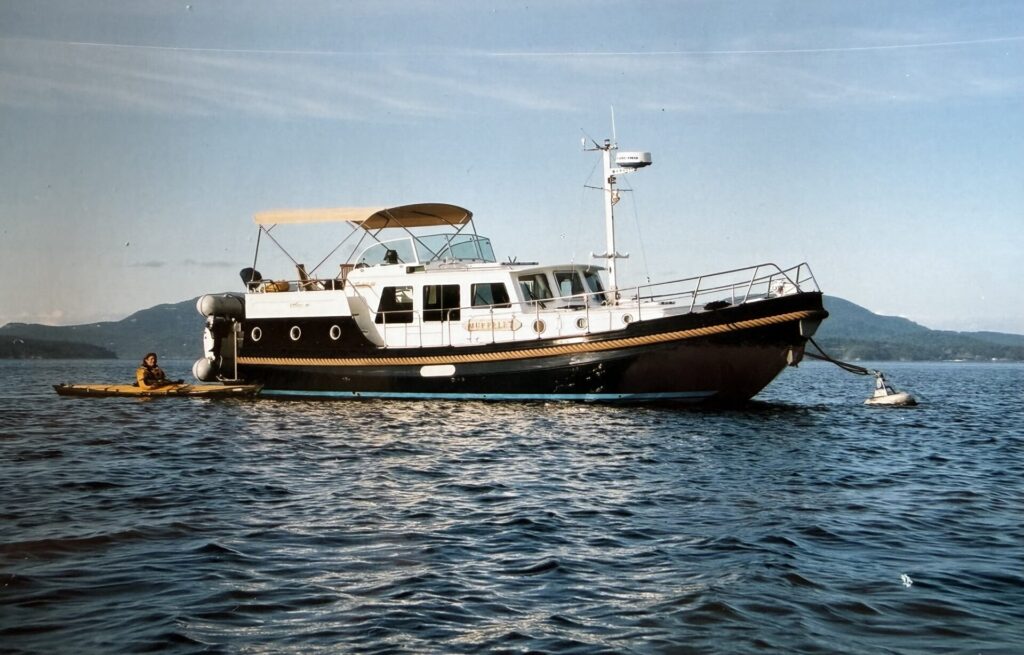
“These are extremely challenging times for global marine ecosystems,” Benedict says. “Human impacts on marine environments are profound.”
Upon completing this green retrofit, which includes a dual hybrid-electric engine, greywater system and composting toilet, she plans to make the vessel available free of charge to the SeaDoc Society and other Salish Sea marine NGOs.
THE CHALLENGE
The SeaDoc Society, a scientific research organization based in the San Juan Islands, studies the endangered southern resident orca population, whose numbers are in steep decline. As a recent Scientific American piece, “These Orcas Are on the Brink—And So is the Science That Could Save Them,” made clear, funding for SeaDoc and other American marine research agencies is plummeting just as precipitously.
As of 2025, federal funding for American science agencies has rapidly shrunk, leaving marine NGOs that rely on the National Oceanic and Atmospheric Administration, the National Science Foundation and the Office of Naval Research with increasingly smaller budgets to conduct research—research that is particularly vital at this moment to understand and save a declining southern resident orca population.
 Murrelet is a steel-hulled Linssen motor yacht launched in 1996.
Southern resident killer whales are a distinct population of orcas that inhabit the waters of the Pacific Northwest. Unlike their transient cousins who hunt marine mammals, these orcas feed almost exclusively on chinook salmon and travel in tight-knit family groups across the coastal waters of Washington State and British Columbia. Their numbers are in steep decline: as of recent counts, fewer than 75 individuals remain.
In 2006, the National Oceanic and Atmospheric Administration designated Puget Sound and the Salish Sea as critical habitat for southern resident orcas. In 2021, that habitat was expanded to encompass large swaths of water from the US-Canada border to Point Sur, California.
Critical habitat designation hinges on a straightforward premise: identify the physical and biological features a species needs to survive, then protect them. For southern resident orcas, the calculus is deceptively simple. They eat chinook salmon—almost exclusively. Which means they need waters teeming with chinook salmon.
But the Salish Sea is no pristine refuge. More than nine million people, Canadians and Americans alike, press against its shoreline. The continent’s largest shipping ports thrust vessels through these waters in quick procession. In the span of a single human century, the sea has become noisier and more contaminated than this millennia-old species has ever known. The orcas, exquisitely adapted to a world that no longer exists, now navigate waters transformed beyond recognition.
THE PROJECT
So, Audrey Benedict is adapting her boat to the orcas and the scientists that study them.
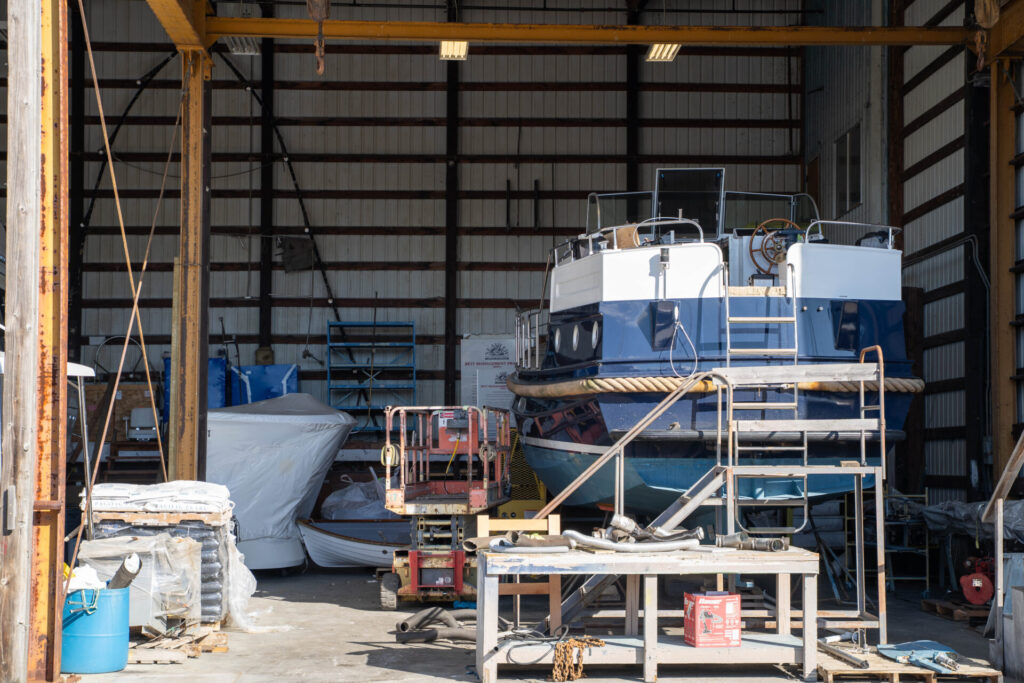
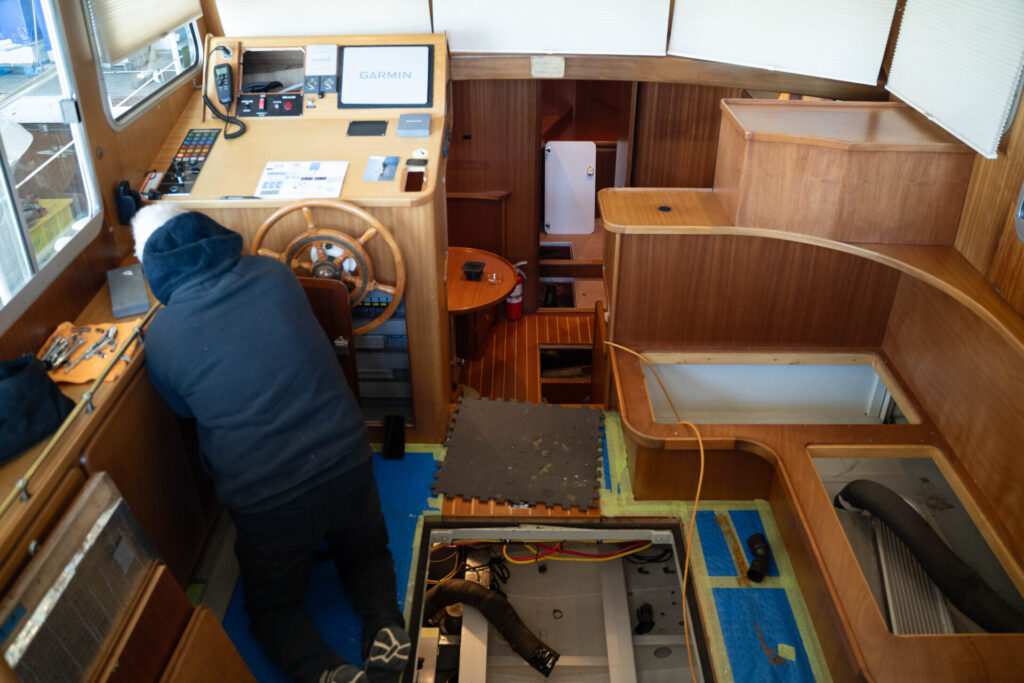 With the engine out, the process has begun to transform Murrelet into a cetacean-friendly research platform.
Noise is first and foremost a major concern. “For southern resident killer whales, underwater noise results in lost foraging time, a reduction in food intake and limits their ability to communicate,” says Benedict.
To get close to the whales without disrupting their feeding and echolocation, Audrey and Kim are retrofitting Murrelet with a parallel power system featuring a Yanmar 4LV150 engine. This tier 3 EPA compliant setup enables the boat to move quickly while burning diesel, then switches to a nearly soundless electric system when whales are near.
The boat itself is likewise greener than most. Murrelet has a steel hull. Steel can be fully recycled after 50 years and repurposed as raw material for new products. The steel design also correlates with lower fuel consumption. “Steel boats tend to be heavier and slower, but they’re very fuel efficient,” says Michael Locatell, owner of Discovery Yachts, the only Linssen distributor in the US.
In Canadian waters, discharging untreated sewage is banned in all inland waters and within three miles of land for vessels under 400 tons. Since the Murrelet is intended as an all-purpose research vessel with uncertain range while offering scientific services, relying on marina pump-outs isn’t practical. Instead, Murrelet’s design takes sustainability a step further. For the blackwater system (the boat’s head), Kim and Audrey settled on an Airhead Tejo composting toilet.
Untreated greywater is another issue. To prevent chemicals from galley sinks, showers and washing machines from entering the southern residents’ critical habitat, Audrey and Kim are installing a marine grey-water filtration system from Wave International.
Pair the hull and engine system with the new greywater and composting head system and the vessel begins to resemble a closed system, one that seeks to limit as many pollutants from entering the water as possible. This is crucial, given that chemicals and pollutants concentrate in orca blubber. Because the whales sit atop the food chain and absorb contaminants from every animal they consume, their blubber has particularly high levels of pollutants.
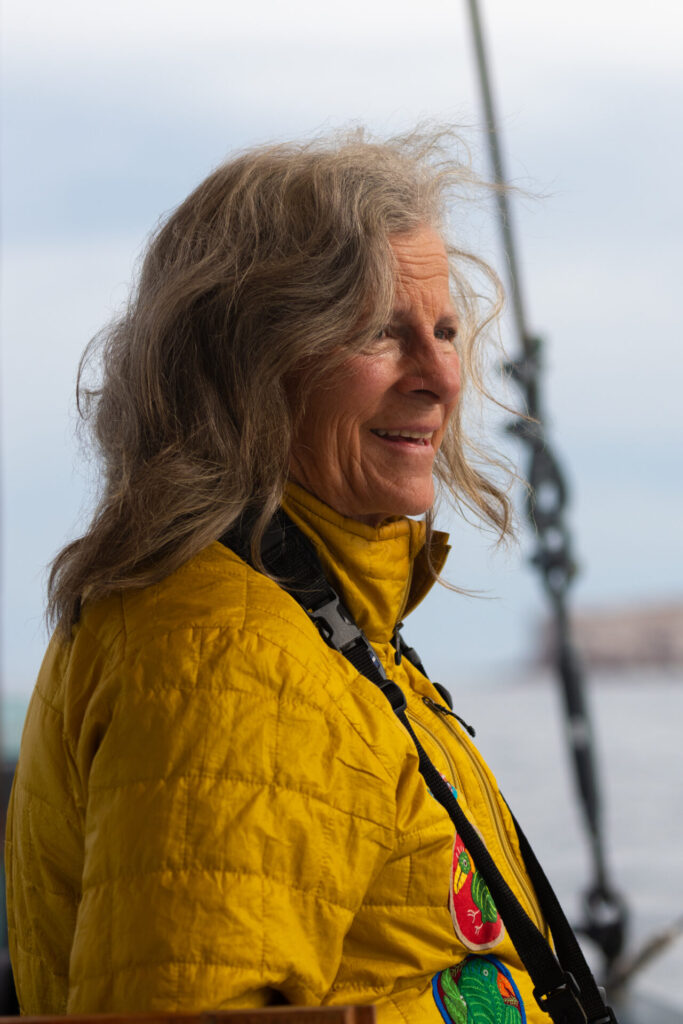 Audrey Benedict hopes this project inspires other boat owners.
In a time when federal funding for marine research is drying up, Benedict’s project offers an unexpected solution from the recreational boating community. By transforming Murrelet into a research platform available free of charge to scientists, she’s proving that pleasure yachts can do more than cruise—they can also contribute.
Moreover, Benedict hopes this project inspires other boat owners, not necessarily to transform their boats into research vessels, but to take a hard look at how they can minimize their marine impact. “By integrating sustainability upgrades, owners of older yachts can improve performance, reduce fuel consumption and extend their beloved vessel’s lifespan, all while minimizing their ecological footprint.”
If even a fraction followed Audrey Benedict’s lead, the southern resident orcas might gain an unlikely fleet of allies, boaters doing their small part to make the Salish Sea cleaner and quieter.