
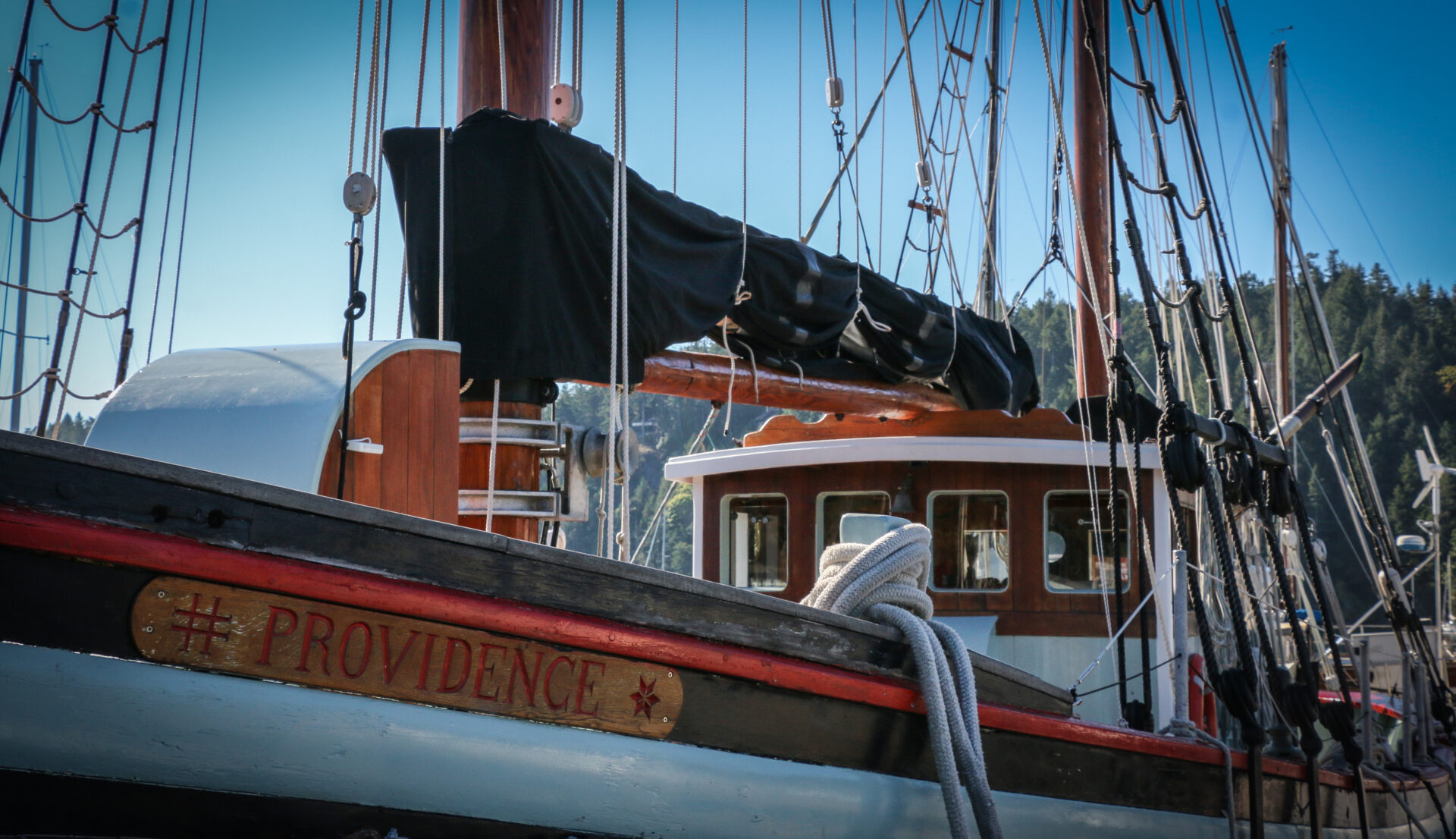

My heart beats fast and my hands cling desperately to the rope ladder, as the gentle rolling of the ship is magnified into large—and terrifying—arcs high in the rigging. I’m aboard the venerable tall ship, Providence, watching nearby islands swing wildly back and forth. Providence is a beautiful, wooden, 80-foot (including the bow sprit), gaff rigged ketch (two masts; the front one is larger), which, with all her seven sails full of wind, is like a butterfly floating elegantly in the breeze. Everywhere we go, people turn to look at her and point their cameras. But I’m high in the rigging, and very nervous.
Providence had come to Pender Island to deliver apples from Denman Island to Twin Island Cider during CRISP, the annual apple festival. All my life I’ve been obsessed with the wooden sailing ships from yesteryear, so I begged and pleaded until the captain kindly allowed me to come aboard on its voyage through Active Pass, across the Strait of Georgia and back to her home port of Steveston.
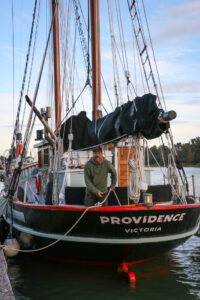 Down from the rigging, my heart rate slows and I sit in the wheelhouse listening to Captain Simon Fawkes give an insight into the long history of this ship. She was built in Denmark in 1903 as a fishing vessel named Valkyrien. Having sailed the seas for longer than a century, she has had her share of adventures. She was captured during the Second World War and served in the German Navy. In 1952, she was sunk in a collision with a Danish car ferry, but was raised and repaired. All nine crew were saved.
She continued to serve in Europe until she was bought in 1978 by Peter-Thor Watson, a Canadian, and was renamed Providence (her sixth name). Watson sailed Providence through the Panama Canal to the BC’s West Coast, where she worked as a fishboat, retrieving salmon and herring from gillnet fishing boats. In 2017, Simon Fawkes and Danny Robertson purchased the boat; Terry McPhail joined as a partner in 2019. The new owners initiated a major refit, lasting eight months including certification with Transport Canada to carry passengers.
As Fawkes tells me the history, my eye wanders to a number of little plaques attached to the console next to the big steering wheel that attest to the reverence in which Providence is held. Awarded by the Vancouver Wooden Boat Society, they read: Oldest Boat in 2008; Boat of Greatest Interest in 1998; Best Restored Sailing Vessel in 1988 and so on.
I go outside to watch as first mate Barry Collins and crew raise the mainsail. As a traditionally rigged ship, all the work is done by hand by pulling on lines. The large white sail rises slowly as Collins tugs, and almost magically, the wind fills it and transforms it into a curved elegant shape. I can feel Providence increase its speed as it heels slightly over to one side in the breeze. “Because it’s such a short trip today, we’re only flying one sail,” says first mate Collins. “Too bad you can’t see us put up the top sail, because for that I have to climb up the rigging.” I look up in awe at the very high spar on which he must work.
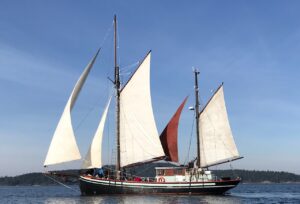 Captain Fawkes was drawn to the mystique of wooden ships like Providence.
Back inside the wheelhouse, Fawkes continues his description of the boat. Providence is made primarily from Danish oak. Since arriving in Canada, replacement woods have been primarily Douglas fir and yellow cedar. The taller mast is 80 feet (24.4 metres) high. She is 80 feet in length including the bowsprit, and 17 feet (5.2 metres) wide. She is registered at 47 tons. When not under sail, she is powered by a 160-horsepower Volvo Penta MD 120A marine diesel engine, which consumes 20 litres of diesel per hour. Today, she is the oldest operating sailing passenger ship in Canada and can carry 24 day passengers and 12 overnight passengers. In good weather, people also sleep in hammocks strung up on the deck.
After jotting his hourly notes in the pilot’s log, Fawkes explains a big part of the mystique of wooden boats, in addition to the beauty of natural wood, is the need for traditional woodworking skills. The carpentry is complex for much of the ship is curved, rather than linear and at right angles. He describes the shop in Vancouver that several wooden boat owners share with its smell of wood shavings and multitude of tools. I ask about maintenance. “Its ongoing and never ending,” says Fawkes, “with annual haulouts that can be very expensive. We put a new coat of bottom paint on annually.” He notes that there are five bilge pumps aboard. I had not even noticed, as everything appears dry.
Near the entrance to Active Pass, Rhinegold, a sleek 36-foot wooden powerboat built in 1911 and piloted by Simon’s brother, Adam, joins us. Providence’s Noble Eagle rigid dinghy with its 30-horsepower Yamaha engine races over to the Rhinegold to deliver a latté from our espresso machine. A generous maritime gesture, I think.
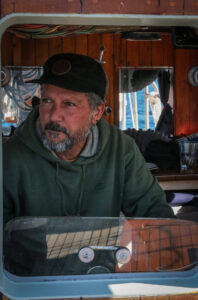 In 1990, Simon Fawkes received his Master, Limited license, for sailing ships up to 60 tons and has worked as a captain on a variety of boats from 75 passenger whale watching boats to other locally famous sailing vessels. Simon is an old salt and has been sailing since he was a teenager, logging more than 25,000 miles in ocean crossings including two trips to Hawaii and one to New Zealand and Australia.
Captain Simon explains that Providence operates mostly around the Salish Sea, and can be chartered for adventure and team building; she also carries cargo. Later, I speak with Nicole Straughan of Ocean Wise, an ocean conservation organization, who recently returned from a 10-day voyage on the ship. She says, “I love the sense of calm when the sails go up and the motor is turned off. It’s like a wave of silence washes over the boat and it always leads me to fall into a state of relaxation, even when the seas are quite rough.” She relates how the crew told seafaring stories and taught her group how to tie knots and raise and lower sails.
Rolling with the waves and gazing up at the spars, I embrace the interaction with nature that Straughan describes. “There is something very special about being at the mercy of the waves and wind; the environment determines where we go, how quickly we get there and how comfortable the sail is going to be—and on those days that are particularly rough I am in awe of the power of the ocean. It’s a physical and emotional reminder of the respect we should hold for the ocean.”
Captain Simon has timed our entry into the sinuous Active Pass that separates Mayne and Galiano islands to coincide with the tide, so we are aided by the turbulent current. A large white ferry bears toward us, heading to Victoria’s terminal at Swartz Bay. The ship emits a loud bass toot, warning us smaller vessels to stay clear. We pass Village Bay on Mayne Island, the site of wild scenes during BC’s early gold rush days. The water around us roils and eddies. Seagulls gather in large numbers, drawn by the fish. Then the historic 40-foot high (13.7-metre) Georgina Lighthouse winks at us from the eastern entrance to the Pass and we enter the Strait of Georgia.
A long stretch follows as we cross the strait heading for Vancouver. The wind is calm, and I’m glad that the Volvo motor, aided by the lone mainsail, powers us along at about seven knots.
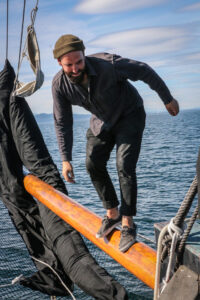
Approaching the mainland, we meet the Fraser River and fight against its current, slowing down to about five knots. Beside us, a powerful tug pulls a barge loaded high with logs. We slowly gain and then leave it behind. Captain Fawkes explains that the channel, marked by red buoys on the south side and green buoys on the north, has to be constantly dredged to remove the silt carried down by the Fraser.
As the sun creeps close to the horizon, we reach Steveston passing dozens of fishing boats at the dock and moor at Britannia Shipyards next to the Seine Net Loft. How appropriate, I think, that the venerable old Providence rests at this National Historic Site, where the Phoenix Cannery, once operated. The only other boat here is the last steam driven tug in BC, the Master. Built in 1931, she is, sadly, falling into disrepair.
Tied up beside the wharf, the crew takes down the mainsail and puts up a plastic canopy over the foredeck. This is to minimize rainwater on the deck for, as the first mate explains, freshwater is damaging to wood, whereas saltwater pickles the wood, causing swelling and, thus, preventing leakage.
A problem has arisen: I missed the last ferry back to Pender Island. Captain Fawkes kindly allows me to sleep overnight on the ship, pointing to a narrow bunk in the saloon. The crew departs, soon the sun drops below the horizon and I’m left alone. The old boat creaks and groans around me. Lying in the pitch black, below the waterline I imagine Providence’s long lifetime. For most of her existence the area where I’m sleeping was a fish hold often crammed with salmon and herring. This ship has also witnessed the flash of guns, and possibly even death, while serving in two world wars. The creaking around me sounds like departed spirits, and lying in the dark, narrow bunk, I feel like the Ancient Mariner. The throbbing reverberations of a powerboat passing makes me feel like I’m in a womb, listening to a heartbeat. I’m comforted and finally fall asleep.
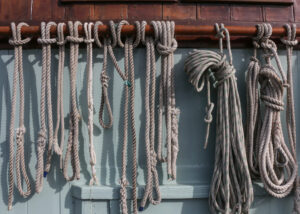
Awaking in the morning, I find the daylight has chased all ghosts away. The sky is grey and rain has wetted the wooden decking, giving the ship a shiny, modern appearance. But I’m not fooled. Providence, as I’ve learned on this voyage, has lived a long, rich life. She’s full of character and I’m confident she will continue having adventures long into the future.