

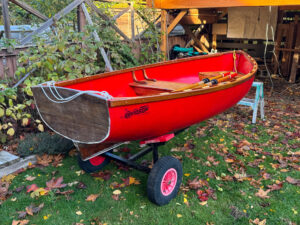
Pat Winram leads me into the backyard of her Oak Bay home where her most recent boat restoration rests on its trailer near a shelter: it’s a cheerful, red-hulled, beautifully restored nine-footer, #3832, constructed by the Davidson MFG. CO. LTD of 1872 West Georgia Street, Vancouver, BC. The dinghy was built in the 1950s. The original mahogany stern is well integrated with the fibreglass hull, making it one of the earliest examples of composite boat work.
Shiny varnish brings out the grain of the new sapele (an African hardwood) gunwales with yellow-cedar spacers topping the refurbished hull. The dinghy’s interior is embellished by a new red cedar, tongue-and-groove thwart braced by laminated elbows. Red cedar bow and stern seats invite additional passengers. This is Pat’s 13th Davidson boat restoration—saving these influential, BC-built rowing, sailing and racing boats from age, rot and neglect is her passion and pastime.
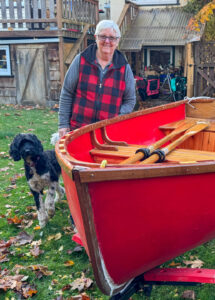 Pat Winram with her latest Davidson dinghy restoration in her Victoria backyard.
So why does a 77-year-old, former special-ed teacher spend her time restoring a baker’s dozen Davidson rowboats and sailboats? “I was born in Vancouver, the youngest of three,” Pat explained, “but my parents built a cottage on Gambier Island where we spent much time on the water.” A photo of a five-year-old, swimsuit clad girl shows Pat climbing into a nine-foot Davidson dinghy at a Gambier beach; a second photo positions Pat—wearing shorts this time—in the same location climbing into another Davidson 72 years later. Her love for this boat is bred in the bone, and she is committed to highlighting the importance of the Davidsons’ influence on 20th century boats by keeping alive as many as possible.
Pat keeps in touch with Hamish Davidson’s second-of-three sons, Michael, who himself is restoring some of his dad’s designs. Sharing her restoration success with him, Pat wrote: “In this age of instant answers, using the internet etc., I really enjoy taking a boat that is in a sorry state and getting it so that being useful and rowable is possible—that is the best entertainment.”
THE DAVIDSON MFG. CO. LTD—as the company registered its name—did not open shop as a boatbuilding company. Hamish Davidson launched the business fabricating his newly invented laminated skis, which he patented at the young age of 23.
Hamish was born in 1905 in the west end of Vancouver, shortly after his parents (from Glasgow and Belfast) emigrated to Canada. When the economy took a nosedive in the early 1910s, the family retreated to Gambier Island’s Long Harbour and raised chickens, an enterprise that didn’t flourish. But living on an island stimulated water adventures for the kids as Hamish and his sisters rowed to school. The Davidsons made friends with another Scottish family, the Bell-Irvings—owners of canneries and pulp mills—who visited in their yacht.
The family moved to Steveston when Hamish’s father took a job at the Bell-Irving cannery. He died at an early age, and Hamish began working in the same Bell-Irving canneries and pulp mills to help support the family.
Hamish disliked the then available one-piece, plank-like skis. Drawing on carpentry skills he’d learned, he began fabricating skis out of thin strips of wood and glue with a built-in camber and curved tip—an early version of today’s ski designs. Nicknamed “banana skis,” they were faster and more flexible than the older models. Wood glues invented during the 1930s were waterproof and durable and allowed Hamish to build these unique skis. When sales took off, Hamish adapted this stronger, laminated version to include cross-country and jumping skis, and then larger airplane skis capable of landing on snow.
In the history section of Grouse Mountain Tyee Ski Club’s website, a photo of Hamish skiing downhill at daring speeds includes the caption, Hamish Davidson, powder hound and ski manufacturer. An explanation follows: “Among Grouse Mountain’s fervent adepts was Hamish Davidson, a ski manufacturer whose business was based on W. Georgia Street. He made laminated skis…. In the late 1930s, you could buy a pair of skis for $10 to $25, while ski repairs set you back $2.50.”
Hamish applied the lamination techniques he’d developed to improve the strength and flexibility of hockey sticks and obtained a patent for them too, which he eventually sold to CCM, one of Canada’s leading hockey gear companies.
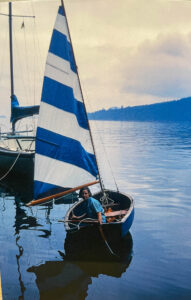 Pat Winram sailing her Davidson in 1963.
Unable to join the armed forces during the Second World War due to poor eyesight, he instead took a position as foreman at Boeing, which built a Vancouver plant in 1929. In 1939, that firm opened a larger facility at Sea Island, Richmond (today’s Vancouver Airport) to build planes for the war effort. They manufactured 362 Cansos (as the RCAF called them), planes used for antisubmarine patrol and coastal reconnaissance.
MIKE DAVIDSON TOLD me that Hamish met commercial artist Beatrice in the early 1940s. “Together they admired a locally made rowing dinghy built by Andy Linton,” Mike recalled. “This boat was built using the carvel technique, with a smooth surface, as opposed to a clinker (method) with overlapping shaped and usually steamed planks.”
The couple married and soon designed their own version, starting in the proverbial garage. Hamish first worked with Chuck Hourston until the latter opted to start his own fibreglass boat company. Beatrice provided the lofting while Hamish transferred his extensive lamination experience to build a lightweight, nine-foot dinghy, laying three layers of mahogany veneers diagonally. These plywood layers were lathered with UF-109 synthetic glue, fitted around a plug and vacuum sealed. The air pressure bound the layers into a hull.
Although hull lamination had taken place in earlier decades, the layers of wood were usually nailed or riveted together. The new method of fusing glue—and later epoxy resins—with strips of wood became known as “cold moulding” as the glues and epoxies cure at room temperature.
Each nine-footer was fitted with an I-beam gunwale of oak or ash with yellow cedar blocks fastened with rivets; laminated knees affixed the seats and transom to the hull (visible in Pat Winram’s restoration). This marriage of wood and glue resulted in the first less-than-50-pound rowboat on the coast. “It was big enough for a small family and dog,” said Mike. The boat was supplemented with BC spruce oars made by Lister Bros Oars, a well-known oarbuilding company. A branding iron burned the boat’s origin on the inner transom: “Moulded Plywood Boats by Davidson Ski Factory, Vancouver BC,” followed by a serial number.
Ever entrepreneurial and practical, Hamish developed a roof rack with suction cups to carry the boat atop a car so that it could easily be brought to water anywhere. “I remember how Hamish often dragged two or three boats behind the car when he went on holiday,” said Mike. “It was his version of direct marketing and usually he’d sold these dinghies by the time the vacation was over.”
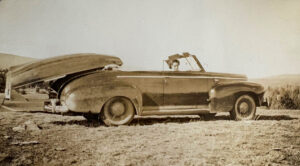 Beatrice Davidson on her 1944 honeymoon with Hamish in a Nash convertible with a dinghy supported by a rack.
THE COLD-MOULDED version of the Davidson dinghies was soon eclipsed. On February 7, 1958, the Vancouver Sun reported, “Hamish Davidson was an early pioneer in fibreglass boats, first building a fibreglass sailing dinghy in 1949. He introduced the Frostbite-class of sailing dinghies which became popular in the Vancouver area.”
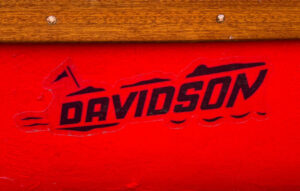 Hamish appreciated the advantages of a fibreglass boat: lighter, longer lifespan and greater resistance to rot, decay and other forms of damage. The wood in the trademark nine-footer’s hull was replaced by fibreglass layers and again infused with glue and resin. The hull was finished with a wooden transom, seats and gunwale. Starting as rowboats, these vessels gained popularity as planing dinghies with the introduction of lightweight outboard motors. Davidson MFG became dealers for Johnson Outboards and Austin Marine Engines.
An added centreboard along with a spruce mast converted Davidson’s dinghies into sailboats. The single, Egyptian cotton, striped sail added to the appeal. Hamish specifically designed the nine-footer for challenging winter conditions making it more suitable for cold weather sailing than other boats like the Sabot.
The Frostbites introduced a new era of sailing and racing. The local yacht clubs engaged in fierce competitions. Some regattas included more than 100 boats. A newspaper report describes how larger yachts would carry stacks of Frostbites to Vancouver Island for yet another race. Royal Vancouver Commodore W.S. Day offered a trophy for Snipe racers in 1935, but by 1955 Frostbite racing had become so ubiquitous the trophy was rededicated “to become symbolic of Club Championships in the Davidson Frostbite Dinghy Class.”
Hamish didn’t stop with the nine-foot D9s. His versions of the International 14, Flying Dutchman and Flying Junior were fast and fun and used in sailing schools around the world. The D12, 14 and 17-foot sailing dinghies also took their place in the Davidson line-up. He added speedboats of which many became launches on government vessels. Lifeboats measuring 12, 14 and 17 feet (later 21 and 26 feet) with heavier hulls than recreational vessels passed DOT regulations and found their place on commercial boats and ships, including BC Ferries. His life-saving products also included a patented fibreglassed plywood box with rope handles for boaters to survive a sinking, while also serving as swimming rafts. Later, when introduced to inflatable liferafts, Hamish became a Beaufort Liferafts dealer and the major service provider for their required updates. An ad the Davidson Co. put out shows how the company grew and diversified.
Hamish died in 1975, aged 69. Without his vision and drive, the company slowed. Newer small boat racers like Lasers, Optimists, 470s and Nacras provided stiff competition. In 1977, to the dismay of the many owners and sailors who fondly remembered their first skis, the company shut down.
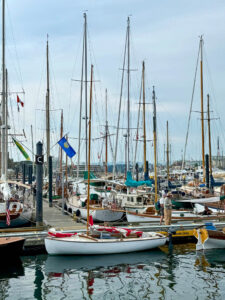 Jeremy and Tara Smith’s D17 won the prize for “Best Open Sailboat.” at Victoria’s Classic Boat Festival.
OF THE APPROXIMATELY 7,000 Davidsons built at the West Georgia address many have perished, but some, as shown by Pat Winram’s work, are being revived. Mike Davidson owns and has restored several, and he gifted one to Gabriola’s wooden boat restorer and artist Tony Grove. There are mentions on Facebook, Instagram and even a Google group of Davidson afficionados.
Jeremy and Tara Smith, who live on De Courcy Island and both race and cruise, found a D9 in excellent condition. “This boat is what got us interested in the boatbuilder,” said Jeremy. “We weren’t really aware of this influential BC boat. We started to find out more about the D12s and D17s, then found a D17 in Powell River. The hull was structurally sound but the rest needed refurbishment.”
The Smiths are veteran sailors and racers, with Tara having raced Martin 242s for years. “We like the simple joy of small boat sailing,” said Tara. “The D17 fits the bill. A really neat size. She has the original wooden mast, main and jib and comes with a steel centreboard.”
The mast had split in two, but with hard work and epoxy saw new life. With input from Mike Davidson, they remade her as original as possible, replacing the wood trim and mast step, refinishing all the wood interior and the deck. The couple then entered her into Victoria’s Classic Boat Festival where it won the prize for “Best Open Sailboat.” “Even though she wasn’t all wood, the D17 is classic, and Davidson was so important to coastal sailing,” said Jeremy. “There is a lot of interest now and we think there are quite a few hidden in garage rafters.”
“The D9s did much to promote sailing for yacht and sailing clubs,” Tara added. “They were a lot of fun. Now we are so serious about our races. But here on De Courcy, with our D17 and other boat varieties, we are encouraging small boat racing. It’s a great community-builder and tons of fun.”
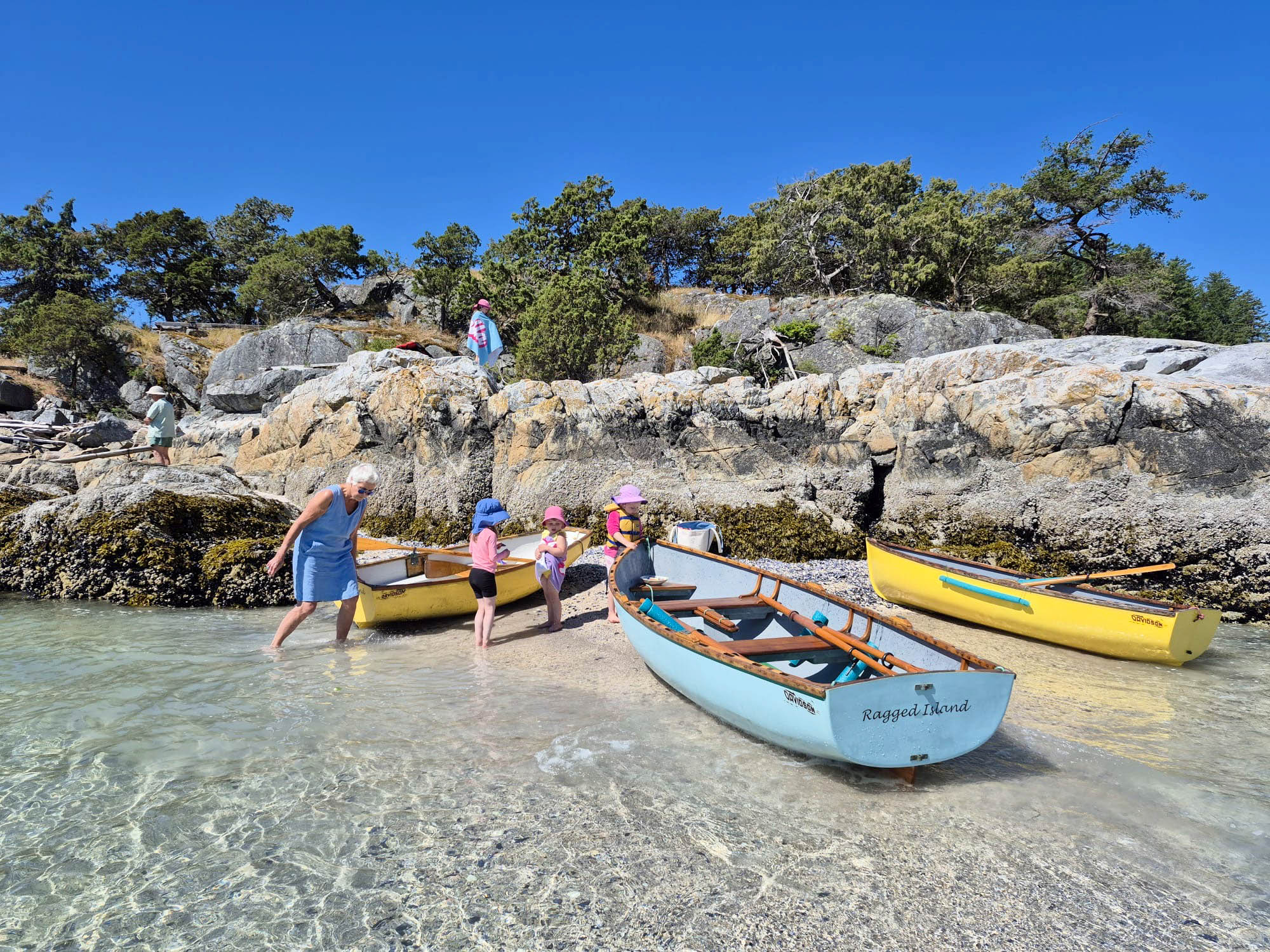
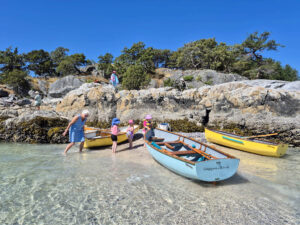 Jo Davidson and grandkids with an eight-foot pram and nine and 12-foot Davidsons on Ragged Island beach.
TONY GROVE, WHO often features dories and dinghies in his paintings has fond memories of the Davidson boats. “Growing up in Vancouver and getting into the boat world, I often heard about the Davidson boats and the praise they received,” he said in an email. “Eventually, when I was able to recognize them, I started seeing them everywhere. They’ve long been a coveted boat, used by the fishing and logging industries, sail training programs, summer camps and more.
I recently took a trip up to Comox for a couple of nights, and every time I went for a walk on the beach, there was another little Davidson boat at a dock or tucked into the trees—proof of how well they were built at a time when fibreglass boats were still in their infancy.”