

There is a special sort of bad luck that I’ve come to notice during my relatively short time sailing. Perhaps the universe has a particularly evil sense of humour or perhaps Neptune enjoys humbling sailors every now and again, but whenever something goes wrong, it invariably seems to happen at night. On this particular night, everything went wrong remarkably quickly.
THE SET UP
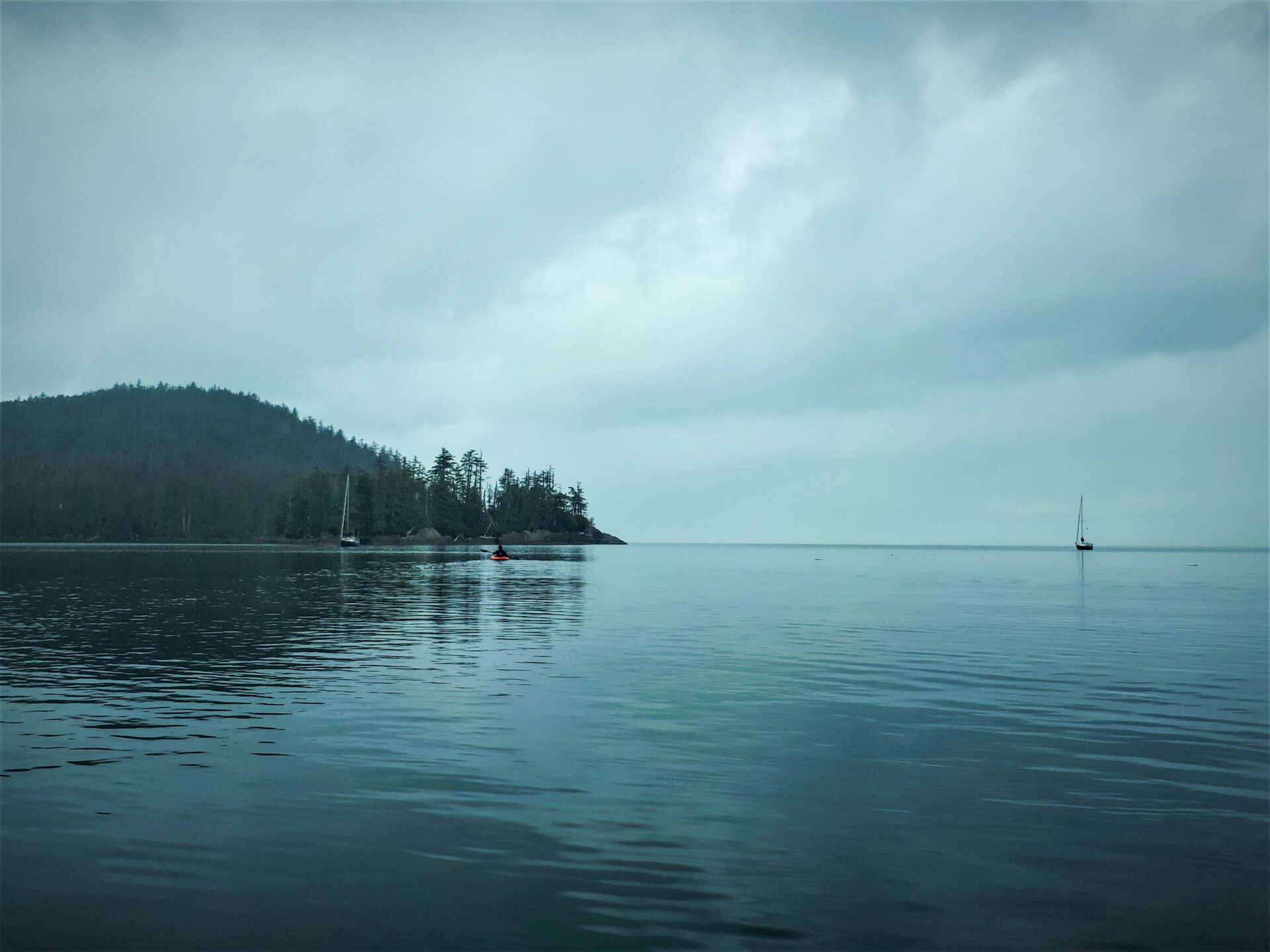
We were one week into a trip through the Gwaii Haanas National Park Reserve in Haida Gwaii. The weather forecast warned of an impending southeasterly gale, so a few days earlier my partner Liam and I had staked out a spot in a well-protected anchorage with some friends in their sailboat, SV Skua. Echo Harbour, our anchorage of choice, was a small, cosy bay tucked into the east side of Moresby Island. The reviews that we had read called it “the best anchorage in the area” and several locals had confirmed that it was usually a good spot in a blow. The bay was accessed through a narrow, north facing channel and surrounded on three sides by steep, substantial hills. The forested peaks towering above us exuded a feeling of strength and security. As the gale began to build, with weather buoys reporting high winds and seven-metre seas in Hecate Strait, we sat comfortably at anchor. The two little boats swung one way and the other as gusts rippled through, but the wind that howled fiercely outside of the bay never reached us with its full strength.
For a day and a half we curled up in the cabin, listening to the relentless rain as it pounded down from the heavens. Every few hours one of us would scramble out through the companionway—naked except for a rain slicker, to avoid saturating our limited clothing—to bail out the fully laden dinghy. By the second day of the gale we felt reasonably confident in our situation. In a calm period between gusts I rowed to shore to check on some very soggy kayakers that were camped near a dangerously full creek; their tent looked soaked through, and the creek threatened to overstep its bounds at any time, so I invited them to come back to Wild Rye and stay on the boat with us for the night. Four people is a tight squeeze in our little 32-foot floating home, but we managed to tuck ourselves in reasonably comfortably and the four of us drifted off to sleep early.
 Why is it that accidents invariably seem to happen at night?
THE GALE
Liam and I awoke in the middle of the night; the wind was building and Wild Rye was heeling hard to port through each gust. I checked our GPS position and confirmed that we had dragged a short distance. The anchor appeared to have reset, so Liam let out more rode and sent me back to bed. An hour later he was shaking me awake as Wild Rye began to drag again.
It seemed likely that the anchor had been fouled by the chain sometime in the night as we got pushed in circles by the gusty winds; we decided to lift the hook and reset it properly. I started the engine and steered us toward the trip line float that marked our anchor position and Liam went forward to haul in the anchor line. The task was far from easy: the lashing rain and pitch dark made it impossible. for me to see properly, and the building wind buffeted Wild Rye violently from side to side. Eventually the inevitable happened: a gust pushed Wild Rye across the trip line, instantly fouling the propeller. This was extremely unfortunate, as we had essentially managed to pick the anchor up by the trip line. Instead of dragging slowly, we were now dragging very fast—right toward our friends in Skua and the rocky shore beyond.
This could have been the end for Wild Rye, but we experienced two strokes of luck. First, as we approached the far shore we dragged onto a shallow shelf; the reduced depth helped to set the anchor temporarily. Second, by that time we were quite close to our friends in Skua; I woke them up by flashing a spotlight in their direction, and they leapt out of bed to throw us a line. Tethered to Skua and safe, for the moment, from the ominously close and rocky shore, Liam turned to the task of freeing the propeller. He called one of the kayakers—a tall, serious man named Flavio—up on deck to hold a light for him, stripped down and dove into the frigid water to cut the trip line free.
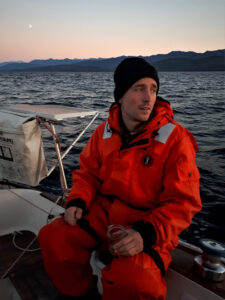 WANTING TO REDUCE the risk we were posing to Skua, we detached the tow line as soon as we were able to start the engine, and we began motoring away. Within seconds, the prop had fouled again: in the dark and the chaos, we had missed one small piece of trip line that was snagged halfway down the anchor chain. Close to the rocks, still too close to Skua for comfort, we did the only thing we could: We raised the reefed main (we always pre-emptively tuck the third reef when we’re anchored in stormy conditions) and sailed out of the harbour into the more spacious waters of the channel. With the heavily reefed mainsail and a metre or so of jib out, I was able to steer us somewhat; Wild Rye would put her toe rail in the water with each howling gust, but between gusts our motion felt controlled.
As we were sailing out of the harbour, we heard Skua’s foghorn. Our friend’s frantic voice came over the VHF: they too had started to drag, and were about to crash into the rocks. Desperate to get back into the harbour to help them, we acted as fast as we could.
Liam stripped down again, tied a rope around his waist and braved the freezing water one more time. I steered while Flavio held the light for him. I was terrified that a gust would come while Liam was underwater and he would get dragged helplessly behind the boat, but we were lucky. It only took him a second to free the propeller and then he was back on board. I breathed a little easier. We cleared all the unused lines and other items off the deck, stuffing everything down into the galley. After fouling the propeller twice in the span of an hour, every line looked like a threat. Once the deck was free of clutter, Flavio and I furled the sails and we started motoring back into the harbour.
THE WIND HAD picked up significantly by this point: we estimated the gusts between 35 and 45 knots and it was almost impossible to keep Wild Rye’s bow into the wind. Heading back into the narrow harbour entrance was terrifying: each gust threatened to push us onto the rocks. A few times I was sure we came within a couple boat lengths of total wreckage. The kayaks were starting to fill with water and drag dangerously. At one point the wind picked up the dinghy and slammed it into the lifelines with enough force to crack the transom. After trying and failing twice to enter the harbour, we decided to cut the kayaks and dinghy loose.

Without them hampering our movement, we were finally able to make it through the narrow harbour entrance. The wind continued to push our bow toward the rocks, but at Liam’s suggestion I threw the engine into reverse and held it there; Wild Rye was more stable with her stern to the wind, and I was able to reverse the rest of the way into the harbour. The harbour was terrifying: whitecaps were lit with eerie phosphorescence, and wind whipped the tops of the waves off in white sheets of spindrift. The spindrift and rain stung our eyes and made it impossible to see. The sound of the driving wind and water went beyond anything I had heard before, a deafening, constant rush of noise. I tried to steer using our GPS, but the white screen blinded me and made the darkness all the more disorienting. Time seemed to stop—I was singularly focused on steering through the gusts and keeping us away from the shore.
We tried to drop anchor again, hoping to get a line to our friends on Skua and winch them back out into safer water, but we weren’t in the right spot: the wind was still pushing us too close to the rocks. Liam quickly saw the futility of our plan, so he put a float on the end of the anchor line and dropped the whole thing overboard. By this point there was nothing we could do for them. Skua was only a boat length or two from the rocks, with both their anchors out and barely holding. Unable to do anything more, unsure whether the storm would continue to build, they decided to put out a distress call. Flavio relayed information to the Coast Guard while Liam and I concentrated on keeping Wild Rye in place.
Amazingly, help was only minutes away. A powerful zodiac from a local kayak tour company and a large research vessel, the Gwaii Haanas II, arrived after a quarter of an hour. The zodiac cut through the waves like a knife through hot butter and had our friends safely evacuated in short order. Luckily for our poor kayakers, the zodiac was able to collect them as well and return them to their base camp. Sick with worry for Skua, shaking with adrenaline and fatigue, we motored slowly out of the harbour. We couldn’t wait to leave that place behind us.
THE CONCLUSION
The folks on Gwaii Haanas II directed us to a dock some two miles south of our location. We had seen it listed on our park map, but assumed it was a small water dock for kayakers. In reality, it was 120 feet long and looked rock solid—if only we had known! Feeling extremely foolish, we tied up and waited anxiously for news. We didn’t have to wait long: soon The Gwaii Haanas II appeared around the corner with our friends on board and Skua in tow. The wind had died shortly after we left the harbour, so they had decided to go back and try to tow Skua out. When they went back for the sailboat, there was not a breath of wind left in Echo Harbour: the water was as calm and flat as a mirror.
 Morning brings with it a sense of relief after a stormy night at anchor.
We heard, over the next few days, that the weather had been unusual for the time of year: an autumn gale come early. Apparently, the wind at the water dock, just two miles south, had been light. The ferocious gusts in Echo Harbour had been caused by the wind funnelling down over the very same mountains that had made the anchorage feel so safe at first. Against all odds, no boats were damaged on that wild night. Skua never did end up on the rocks. Both kayaks were found and returned to their owners. We even found our dinghy, floating serenely upside down in outside Echo Harbour.
The four of us spent the next few days in the safe haven of the water dock, waiting out the rain, playing cards and slowly recovering from the ordeal, before beginning the long journey south and home. Our confidence was deeply shaken and for several months afterward the sound of wind in the rigging kept me awake at night.
Liam and I purchased a much bigger anchor at the first opportunity and we haven’t dragged since. When I think of that awful night it’s with an odd sense of fondness, as I remember how much we learned about working together and trusting each other through a crisis. More than anything else, I’m grateful for the opportunity it gave me to learn to trust myself as a sailor, decision-maker and partner. While I know enough now not to go looking for adventure, I won’t deny that I love the cruising life for its persistent ability to test me. I like to think that we came out the other side of that particular test stronger, smarter and maybe a little bit better equipped for next time.