
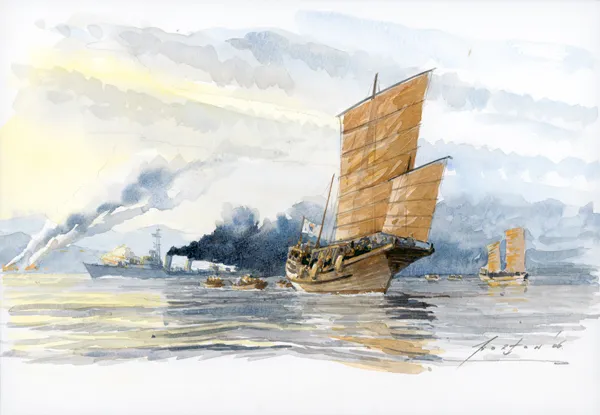

Last year, marine artist John Horton attended the opening of his latest exhibition at the Maritime Museum of British Columbia. Titled “From Nine to Ninety,” it included paintings of vessels ranging from dinghies to historic sailing ships, ferries, workboats and one of Horton’s favourites, HMCS Harry DeWolf, the first of a new class of Arctic patrol ships.
A good crowd came to see the 54 luminous paintings, architectural renderings and drawings that festooned the Museum’s walls. John, his jacket displaying the Royal Naval Sailing Association crest and his Order of British Columbia pin, stood proud behind the mic and told his well-honed story of a childhood accident at age four. He’d darted across the road and a car ambushed him, forcing a year-long recovery in hospital. Subsequently, his parents forbade him to engage in rough sports. Sailing, however, was allowed, as was art and music.
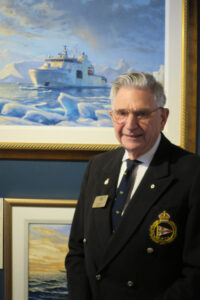 John Horton with his painting of HMCS Harry DeWolf, the first of a new class of arctic patrol ships.
“I was quite protected,” John told me later. “But my favourite uncle, Geoff gave me navy ship models, and I devoured the youthful sailing adventures in Swallows and Amazons by Arthur Ransome.”
The Horton family lived in Poole, a Dorset coastal town and yachting centre, home to a large natural harbour surrounded by broad beaches. It’s where John became enamored with the sea, a love that has never left him. One day, at age 10, John met a new teacher on the beach who offered him a sailboat ride into the harbour; later, that teacher taught John to sail a 14-foot dinghy.
John was also drawing and painting. “My parents encouraged me,” he said. “It kept me out of trouble. I had early dreams of being a naval architect, but didn’t have the math.”
THE EXHIBITION DISPLAYED an original watercolour he painted at age nine. It depicts a gaff-rigged sailboat, sliding down big waves in following winds, towing a nearly submerged dinghy. The sails are well set. It’s a remarkable painting for a child and foreshadows the observational powers and accurate depictions of vessels that later brought him fame. “How did you manage to save that painting for 81 years?” I asked John. “Oh, it was my mum who kept it in a drawer,” he said.
“I grew up during the Second World War,” John continued. “We slept in an air raid shelter for four years. It was located in the living room, a double bed with steel supports. Poole Harbour was full of warships and landing craft. They fascinated me.”
Later, John and his dad raced model International 12s in the days before radio controls. “How did you control your boat?” I asked. “We set the sails and used a pole to tack them,” John said. A photo of a youthful John shows him on the beach with a model sailboat under his arm. He was hooked.
His teen years were busy after the family had moved to London. John attended the Poole & Bournemouth Schools of Art, where he won prizes while also starting a five-year shopfitting apprenticeship (shopfitters design, build and install fixtures and fittings in offices and shops). “It was a terrific learning-on-the-job program,” he said. “I was 16, learning about design, perspective and drafting. And what I discovered while apprenticing translated to my painting too.”
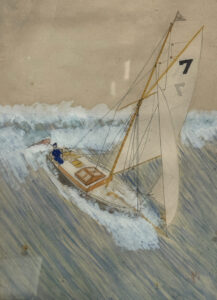 Horton’s first watercolour, age nine.
ON HIS 16TH birthday John enlisted as a volunteer reservist aboard HMS Wessex, serving evenings and weekends. Five years later, he joined the Navy fulltime. “It was during the Cold War,” he explained. “I was on a minesweeper patrol. We went to Scotland and, using the latest equipment, floated dummy mines and then retrieved them.” He also served stints in the Pacific, Atlantic and Arctic oceans.
While in Buenos Aires, he visited Sage & Company, a British shopfitting firm based in London with practices across Europe and South America. A designer invited John home and their animated conversation led to John receiving a letter of introduction to the London Sage & Company headquarters.
After completing his two-year naval service, John took the letter to Sage in London and was hired. “My mentor was Vic Barber,” he said. “He was the firm’s chief designer and a brilliant artist.” Barber was an expert in creating architectural renderings (creating images that give views of a building, yacht or an interior design) and showed John the details of the art.
John painted “on the side,” producing about two canvasses annually and submitting them to the Royal Academy and the Royal Society of Marine Artists.
SOME YEARS LATER, John received a book of Vancouver in photos. It enticed him, his then wife and three offspring to emigrate to Canada, arriving in 1966. He set up a practice in the Marine Building, then hosted an exhibit of his architectural renderings at the Bayshore Hotel and invited regional architects. “That evening I received my first commission,” John said. “They kept coming.” He also submitted paintings to a local gallery. They sold fast and the gallery asked for more.
“I ended up making architectural renderings and marine paintings, side by side,” John said. “It was enough to make a living. And I liked the Vancouver area as the maritime environment and the sea have always turned my crank.”
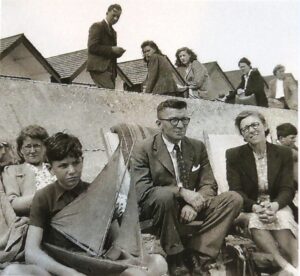 John at the beach with Mom and Dad.
John continually expanded his repertoire of marine paintings, ranging from HMS Roberts shooting its guns on D-Day to the historic sailing ships of Dutch traders.
To ensure the historic ships were depicted accurately, he studied models, visited museums and dove into archives and ships logs. His wife Mary is an internet whiz and often researches facts and images of maritime subjects. She manages the business side of John’s artistic life providing John the time he needs to design and paint.
His work became so well known that in 2002 he was invited to become the Canadian Naval War Artist. “I joined HMCS Algonquin whose mission was to interdict terrorists. We patrolled the Gulf of Oman, searching for the 100 most wanted. I painted six major works that now hang in Ottawa’s War Museum.”
THE COUPLE HAVE done their own cruising, first in a converted gill-netter, then in the 51-foot Admiral Nimitz’ Pearl Harbor launch. They travelled to Alaska four times, with John keeping an eye out for the landscapes, workboats, tugs and yachts that have since translated into paintings. Their boats did double-duty as studios.
The treks north were also inspired by John’s deep interest in Captain George Vancouver, who he believes never received the recognition the explorer deserved for his intrepid voyages and charting (his 1791-95 charts covering the main waters from Cape Flattery to Alaska still inform today’s high-tech charts). British class divisions and a disgruntled aristocratic midshipman sullied Vancouver’s reputation. The cruises inspired John to paint 54 oil works of the West Coast documenting places Captain Vancouver charted and named. “It’s my duty to restore his reputation,” he said emphatically.
John, who excels at multitasking, has designed eight coins for the Royal Canadian Mint’s “Tall Ship Collection” among others honouring ships. He has also received the King Charles III Coronation Medal. And then there’s his long devotion to Delta Lifeboat. Although reaching his four-score-and-ten, he still skippers this vessel while teaching new recruits about search and rescue.
John has no intention of slowing down. He always has a new painting on the easel. Perhaps that accident at age four, devastating though it was, had a silver lining: it let him concentrate on art, sailing and the proper way to depict vessels on the sea. And that talent brings joy to us all.