


In November 2005, Pacific Yachting featured an article about a recreation of Joshua Slocum’s famous Spray, built by Winnipegger, Bill Hicks. We thought it would be interesting to catch up with him and see how he and his boat are faring.
THE STORY OF Joshua Slocum’s solo circumnavigation in 1895 has probably inspired more sailors than any other book, and his sloop, Spray, might well be the best known of all sailing vessels. Millions have read Slocum’s Sailing Alone Around the World since it was first published in 1900, and many have been inspired by it to find, charter or build their own boats. There are even those, like Bill Hicks, who wanted to sail a boat just like the original and were willing to put inthe years to make it happen.
IN 2005, BILL Hicks launched his re-creation of the Spray at Thunderbird Marina in West Vancouver. But his journey began 23 years earlier when he sold his motorcycle to buy a set of plans and set out to build a 43-foot version of Joshua Slocum’s iconic boat in his back yard in Winnipeg. Bill had never done much sailing and didn’t know enough woodworking to build a birdhouse but he assumed the drawings would contain the instructions he’d need to guide him through the process. When the bare-bones construction plans arrived in his mailbox he realized that they were for experienced boatbuilders, not for a graphic designer.
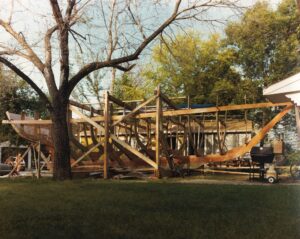
But a dreamer like Bill is hard to deter and instead of despairing he spent hours in the library reading books on woodworking and boatbuilding until he mustered up enough confidence to begin buying wood. “Luckily,” Bill now says, “the first parts you build of a boat are the biggest and simplest, so there’s more tolerance for error and by the time I got to the more complex stuff, I had an idea of what I was doing.”
The original Spray was a 33-foot oyster sloop that Joshua Slocum restored from a hulk he was given. The work was done with whatever wood Slocum could scrounge, including an oak tree that he found in a nearby lot. When he was done, he let go the lines and sailed alone around the world.
Bill Hicks’s recreation of the Spray is a bit bigger at 43 feet, with a hull slightly modified from that of the original Spray. The plans came from Bruce Roberts Design and were available for wood, fibreglass, steel and aluminum. Bill chose to build it in wood with oak frames and Philippine strip mahogany because it was tough, easy to work with and visually beautiful.
Over the next 23 years, Bill continued working and learning as he went. In the worst of the Winnipeg winters, when it was too cold to be outside, he spent his time back in the library, improving his knowledge of boatbuilding. Somehow, he survived the infamous Winnipeg mosquitoes in the warm weather, and kept working. For the final stages, he had the Wildwood II trucked to Vancouver, where she would eventually be launched.
WHEN YOU BUILD a boat like the Wildwood II you come out the other end as an expert woodworker and boatbuilder and Bill’s plan was to use those skills to support his new life. He’d been a successful photographer and graphic designer and he felt the eye that he’d developed would add to his marketability. Bill Hicks stayed in touch with Pacific Yachting for a while after the article appeared and then the last anyone had heard of him, he’d sailed off to Campbell River.

I wondered whether he’d emulated Slocum and sailed off alone around the world or whether he’d stayed put somewhere. With someone willing to put in 23 years building a boat, anything is possible.
Bill Hicks and his boat weren’t often on my mind in the intervening years until last summer when I spotted the distinctive shape of a replica of the Spray sailing in the Aegean. It was flying a Greek flag so it definitely wasn’t Bill’s Wildwood II, but it started me wondering what had happened to Bill and that beautiful boat.
WHEN I RETURNED to Vancouver, I phoned the marinas near Campbell River on the odd chance that Bill Hicks had settled there or at least someone would know where he’d gone. On the second call, I got lucky and found him moored at Discovery Harbour Marina.
It turned out that Bill had remained in Campbell River and was still living aboard the Wildwood II. After a quick phone conversation, I took the ferry across to Nanaimo a few days later and drove up the coast to see him in Campbell River. When I got to the marina, there was no mistaking the boat. It was still flawless and stood out in the crowded marina like a fine piece of furniture. Time, if anything, had only served to enrich the natural colour of the wood.
“She’s held up pretty well,” Bill told me when I came aboard. “I’ve sailed thousands of miles and nothing’s come loose.”
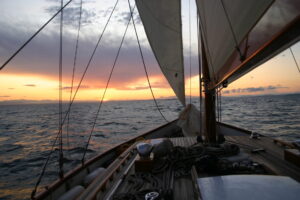 Sunset cruising in placid seas. Note the lack of modern lifelines.
Hicks originally sailed to Campbell River because he’d heard that they were looking for someone to renovate the interior of a tug. One project led to another and a business that has kept him busy ever since. “Whether it’s the interior for a new tug, or refitting an old one, owners and captains are very particular about the appearance of their boats so the work is always rewarding.”
EACH SUMMER HE takes off sailing for a few weeks, sometimes with crew but mostly alone. “Slocum was right,” he says, “It’s an easy boat to singlehand. I’ve never bothered adding self-steering gear because when I get it balanced, just like Slocum’s Spray, she’ll sail herself.”
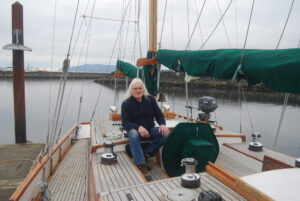 Bill Hicks and the Wildwood II in 2019.
Unlike Slocum, Bill had never intended to circle the globe with his boat, nor was he interested in bluewater sailing, although the Wildwood II is certainly capable of it. “There’s enough sailing to keep me happy in our own waters,” he says. “I’ve been up to Haida Gwaii, up to Kitimat and up one side of Princess Royal Island and then back the other side—up to Prince Rupert, across Hecate Strait to Queen Charlotte City.”
As Bill tells it, singlehanded sailing aboard his Wildwood II sounds as exciting as parts of Sailing Alone Around the World. Coming back from Haida Gwaii, he says that he left at 07:00. “The wind picked up, way up with wind and waves on the stern quarter, and there were dolphins jumping around and following the boat. I got her up to nine knots, which is where the boat performs the best. It was all dead reckoning until I finally got to my destination at the Estevan Islands where there was a lighthouse marking a little bay where I was able to pull in and drop the sails to motor into a little lagoon inside the islands. I started off at seven in the morning and it took until 01:30 the next morning to get there. It was totally thrilling, with a real sense of what it must have been like for Joshua Slocum.”
ASKED ABOUT THE slight modifications he’d made to the original Spray’s lines, Bill said, “Roberts made a slight change to the bow, pinching it in a bit and that makes it a drier boat. It’s really worked out well.”
“The toughest sail I ever had was on the way up here the first time. I’d never been in any real weather before and I hit a very heavy gale and instead of coming straight up to Campbell River I ended up in Heriot Bay on Quadra Island. The storm blew for about a week and then I was finally able to bring the boat to Campbell River.”
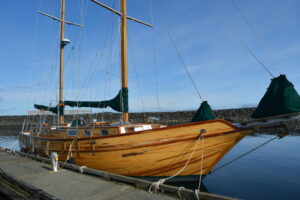 A lot of hard work has gone into keeping the Wildwood II in tip-top condition.
HICKS HAS BEEN living aboard the Wildwood II since her launch 14 years ago and wouldn’t change any of it. “What I like about living aboard,” Bill says, “is that it gives you the illusion of freedom. You could just let go the lines and leave at any time. Of course, you don’t because of a hundred reasons, but you always know you could.”
The plans Bill Hicks purchased came from Bruce Roberts Design, and in the intervening years since Bill built his boat, the plans have improved dramatically, and are now thoroughly annotated to make it far easier for the inexperienced boatbuilder to be successful. A complimentary copy of Build Your Own Spray can be downloaded on request from the Bruce Roberts website bruceroberts.com. According to Roberts, he’s sold over 15,000 sets of plans for his Spray series and claims that over 5,000 have been built.