
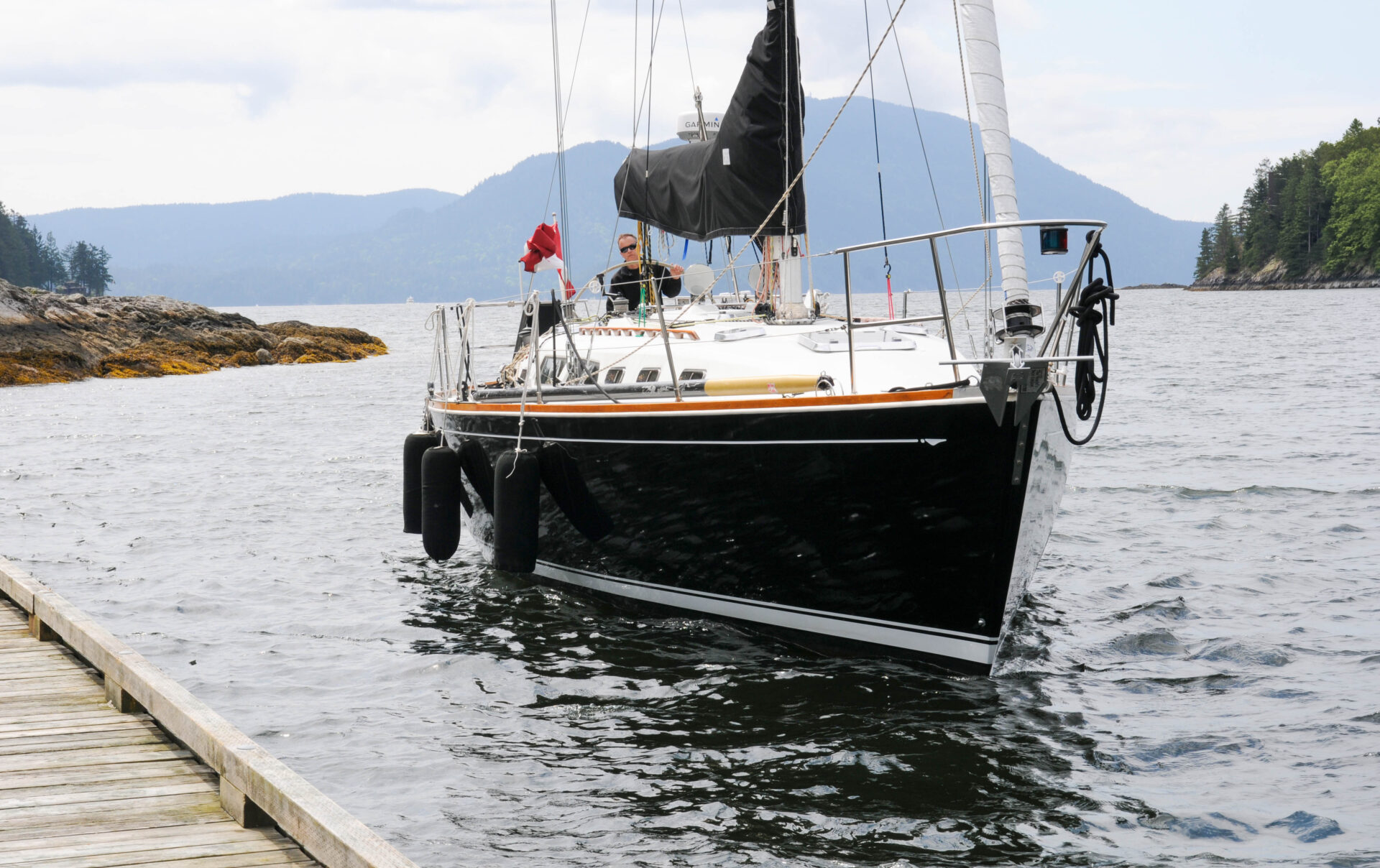

Every season I take time to cruise alone on Willpower, my Ericson 32 sailboat. Though there are challenges, there are also occasions when I ease into a tranquil rhythm that I can’t achieve with crew on board. It’s me, my boat and the ocean.
In his seminal book, Cruising Under Sail, Eric Hiscock wrote, “Sailing alone is not to everyone’s taste, but there is nothing like it for giving one confidence in oneself and one’s ship, and a complete feeling of independence.” Bernard Moitessier wrote more poetically in The Long Way, “I feel my being and joy soars so high that nothing can disturb it.” Although these famous sailors describe blue water cruising, coastal cruisers feel the same. I asked four local sailors why they embrace singlehanded sailing.
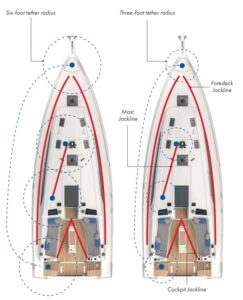 This diagram illustrates the difference in radius between a six-foot tether and a three-foot tether. A six-foot tether provides greater freedom of movement, but it also significantly increases the risk of a person going over the lifelines.
John Dixon says, “To most people it is incomprehensible that a single person can navigate, operate, anchor, dock and actually sail a large and complicated vessel.” Dixon has sailed his Beneteau 37, Tantramar, as far as the north end of Vancouver Island. “I enjoy the challenge and the personal fulfilment of the accomplishment—in part because I do it all myself.”
Jaimie McPherson has taken his C&C 29, Renewal, to the central coast and circumnavigated Vancouver Island four times, occasionally with crew but often alone. He describes the sense of empowerment that singlehanded sailing builds: “It acknowledges that you know what you’re doing.”
Martin Suo now sails Astera, a Vancouver 27. Previously he built Pilgrim’s Wake, a 20-foot canoe yawl and sailed it himself to Haida Gwaii. Suo likes the respect he gets for his accomplishments. Once, when he was turning south from Ogden Channel into Grenville Channel, a tug motoring much faster than his five knots overtook him. The tug’s six-man crew lined up on deck and doffed their hats in salute as they passed.
I rounded out my research by chatting with Robert Sinkus who has singlehanded Reality, his Beneteau 32, as far as the Broughtons. Robert, in fact, cruised with an enthusiastic crew for years—Buck, his faithful dog, was always at his side before passing away in 2021.
These sailors collectively have logged thousands of miles of sailing all alone. I asked them to share tips on making singlehanded sailing successful and safe. This is what they said.
BOAT PREPARATION IS key to safety. To begin, lines must lead aft to the cockpit, including reefing lines if possible. This can be awkward as they tend to bind, but I have seen this problem overcome by threading the lines through blocks. You’re never forced to reef when the wind is calm and the sea settled. It happens when the bow is pitching in a steep chop and scrambling to the mast to secure a reef becomes risky.
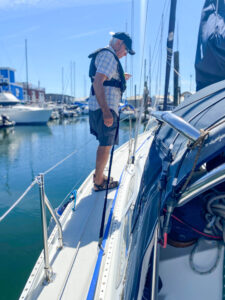 Use flat webbing for jacklines as it won’t roll under your feet like a round rope. Reflective jacklines increase visibility at night if you’re wearing a head lamp.
To reduce the risk, install jacklines and a wear a tether. This allows you to move freely fore and aft without worry. Jacklines are made of webbing with a minimum breaking strength of 2,040 kilograms (4,500 pounds) and lay flat on the deck. On Reality, Sinkus has an alternative system with wires permanently installed to shrouds that rise above the deck. Some experts are against this arrangement because it’s necessary to clip off and on again amidships, but it does reduce clutter and may stop you from going over the sides. Jacklines should run up to the bow but must stop well short of the stern so a skipper who has fallen overboard stays close against the transom and is not dragged behind the boat.
Another essential piece of equipment for the singlehanded sailor is a reliable autohelm. It’s more than just a labour-saving device. It provides a respite from constant steering and gives you an opportunity to attend to other tasks that take your attention away from the helm for a minute or two. An autohelm is also valuable when coming about, leaving you free to wrestle the sheets.
FALLING OVERBOARD IS the greatest risk of death for singlehanded sailors. Safety begins by wearing a well fitted and equipped PFD. McPherson permanently attaches a flare, an EPIRP and a knife to his PFD. It is also wise to carry a small portable VHF handheld radio such as an Icom-F51.
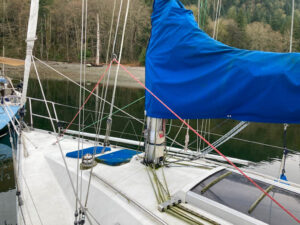 Alternative jackline setup with wires permanently installed to shrouds that rise above the deck.
If you land in the water, a PFD may prevent you from drowning but it will not get you back in the cockpit. In a scene from the movie All Is Lost, Robert Redford’s character fell overboard and was dragged through the water at the end of a tether. Magically he shifted to the safety of the deck. We mortals don’t have that strength and need to take concrete steps to prevent drowning or hypothermia. Even if you have a swim platform, hoisting yourself on board is still difficult. A widespread practice is to rig a swim ladder so that it can be released and pulled down with a line that dangles over the stern. I have a light plastic swim ladder fitted on the transom with simple clothes pegs to hold it above the waterline. A person overboard can free it with a sharp tug. Suo has steps permanently attached to his transom and rudder.
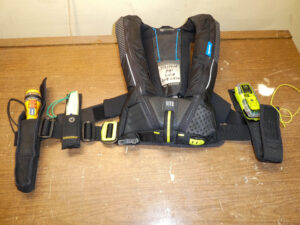 Consider attaching a flare, an EPIRP and a knife to your PFD.
PASSAGE PREPARATION IS standard seamanship and crucial for singlehanded sailors. McPherson recommends a checklist. “Remember, no one will be there to clean up simple oversights.” Also, before you depart, get out paper charts and review the intended course. Jaimie says, “Become aware of potential hazards and make sure you have a safe hole to duck into if the weather suddenly turns threatening.” It’s also important to let someone know where you are going. Ensure there is someone on shore who knows your sail plan before you depart.
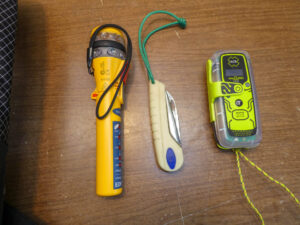 It is also wise to carry a small portable VHF handheld radio at all times.
So, you’ve set up your boat and planned your route, but there are a few more tasks before casting off. First, ask yourself, should I reef? It’s easier to shake out a reef when you’re underway than put one in. Make a sandwich. Gnawing hunger takes the glow off a beautiful day. Put cold drinks in a small cooler and keep it handy in the cockpit. Don’t include beer. Alcohol and singlehanded sailing are a bad combination. It’s illegal and if the wind comes up you may suddenly be physically and mentally taxed. If it’s a chilly day, a thermos of hot coffee or tea is a welcome addition.
Now you’re ready to cast off.
UNDERWAY, CONTINUE TO monitor the weather forecast. Also, keep those paper charts at the ready. I spread mine on the galley table and hold them in place with a bungy cord. Ensure the chart plotter is on and zoomed in so that rocks and drying reefs are clearly visible. Finally, be conservative on sail selection. Dixon says, “don’t be shy about putting that reef in early or thinking twice before hoisting the spinnaker.”
Flexibility is important. According to McPherson, singlehanded sailors must be mindful of energy level. “Even on a sunny day with a fair breeze, long passages sap your strength. If it gets windy, you really get tired fast.” Switch your plans and seek shelter early if you get a feeling in your gut that the weather is changing for the worse.
In the next part of this story, Doug Macleod touches on the difficulties of docking singlehanded. Check back in for part two, coming soon, or read the whole story in the July issue of Pacific Yachting Magazine.