
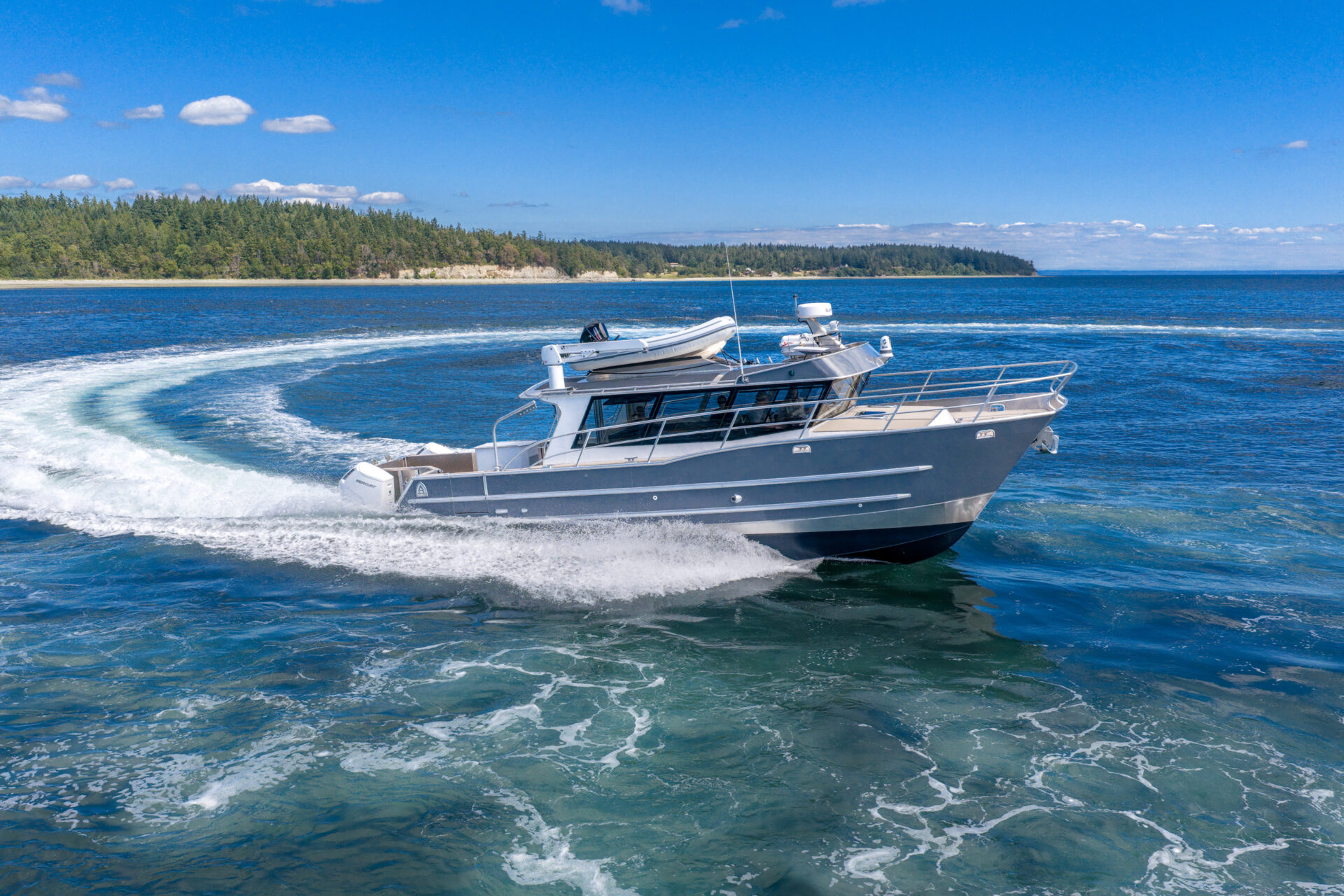

AT 20 knots into the sloppy chop, the ACI 42 Lumacat was doing exactly what its builder intended: very little. I’d met the boat in Pender Harbour and we headed out into the whitecapped waters of Malaspina Strait. The Lumacat was being delivered from ACI’s Port Townsend facility to its new owner in Sitka, Alaska. Aboard were ACI owner, Cory Armstrong, and sales and marketing coordinator, Mia Reade Baylor.
There was no pounding, no drama and little sense the 42-foot aluminum catamaran was working particularly hard. Push the throttles forward and the twin 600-horsepower Mercury V12s could drive it past 40 knots, but outright speed was only part of the equation. The boat’s real character is the way it combines commercial toughness and practicality with the comfort, finish and performance of a high-end recreational yacht.
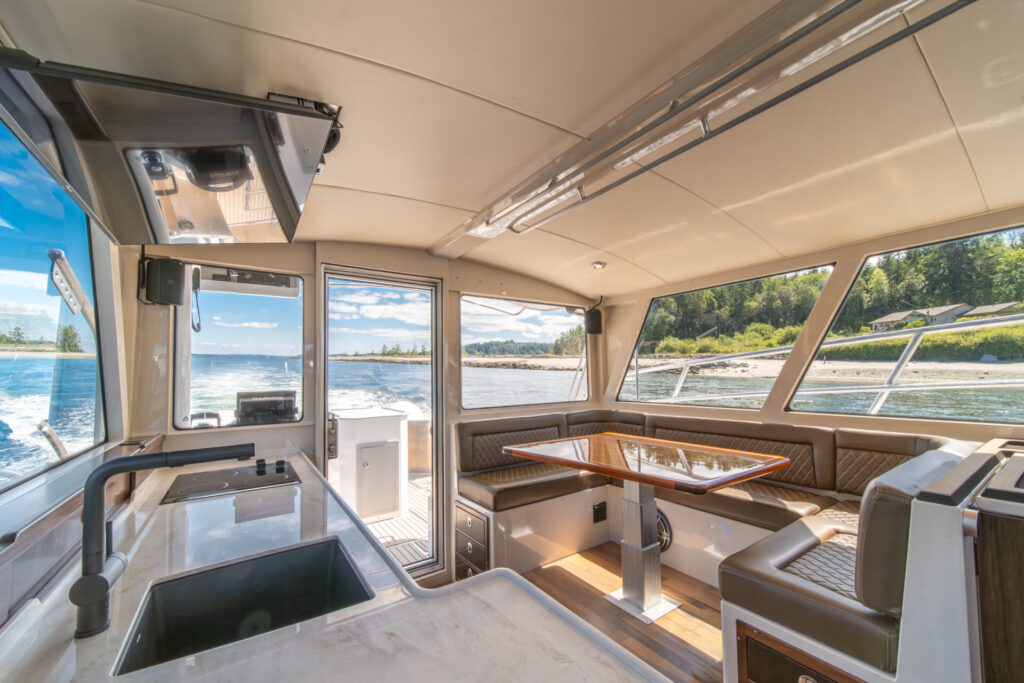 Large expanses of glass make for a bright interior and excellent sightlines underway.
That combination is hardly accidental. Commercial boats are the backbone of ACI’s business, including passenger vessels, ecotourism boats and even a 48-passenger school boat for Metlakatla currently under construction.
Armstrong was born on Cortes Island, where his parents arrived by sailboat shortly before his birth. He grew up in Surge Narrows, living off-grid and traveling to school with his siblings by wooden rowboat. From an early age, his life revolved around the water.
Armstrong eventually relocated to the United States, where he helped establish Moose Boats before reuniting with his brother at Armstrong Marine in Port Angeles, Washington.
In 2015, he launched ACI Boats in Port Townsend, continuing the emphasis on commercial aluminum vessels while gradually expanding into the recreational market. Now 11 years in, ACI has built more than 100 hulls under Armstrong’s leadership.
Although the recreational and commercial models share essentially the same hull form, the private version has a more styled sheer line and a higher level of interior finish.
DESIGN AND CONSTRUCTION
The hull form has evolved through years of construction experience, sea trials and experimentation with hull proportions, tunnel width, tunnel height and overall length, with the 42 intended to strike a middle ground between efficiency and ride comfort.
Each hull has a deep entry—approximately 50 degrees at the bow—and a pronounced reverse chine. The chines provide lift and throw spray away from the boat, helping produce a relatively dry ride while retaining the fine entry needed to soften the impact in a chop. Spray foam insulation helps reduce interior noise and condensation.
The widely spaced hulls give the boat a stable platform and the feel of a larger vessel. A V-shaped wave breaker beneath the tunnel helps divide and deflect water rising between the hulls.
As with most power catamarans, tunnel impact can occur in certain sea conditions and is generally reduced by slowing down or quartering the seas.
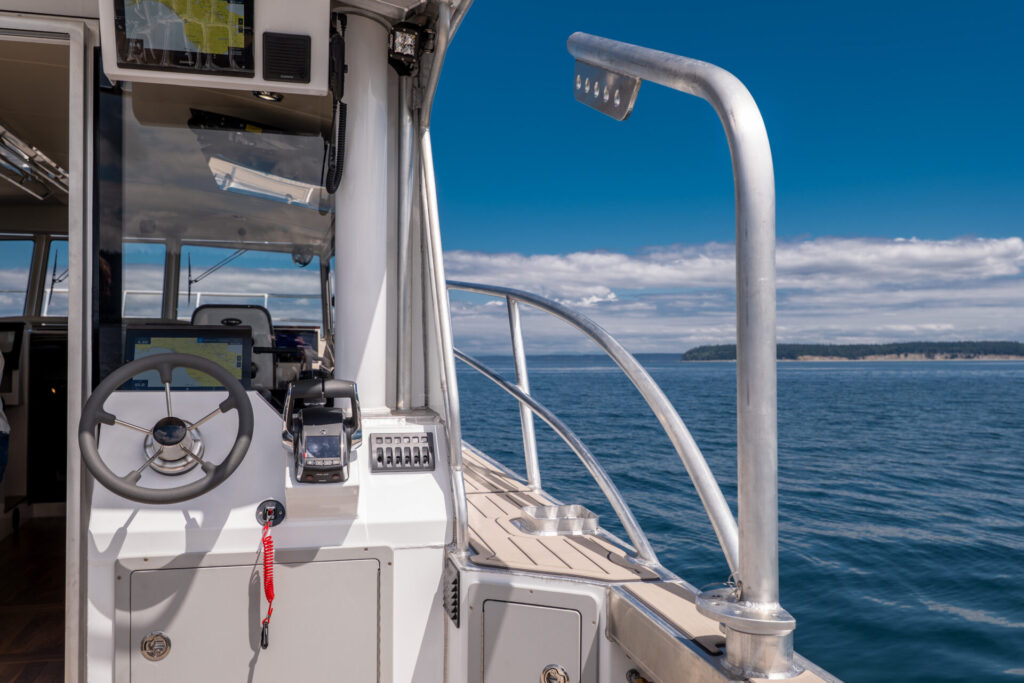 The aft helm station is particularly handy when docking or fishing.
The cabin is framed with lightweight two-by-four-inch aluminum box-section tubing. The windows are directly bonded to the exterior, eliminating bulky frames and allowing extensive glazing and excellent sightlines from the helm. Two of the saloon windows slide open for extra ventilation.
The hulls are finished with Sharkhide protective coating while Awlgrip is used in the main cabin. The accommodation areas are finished in Zolatone Marble Stone paint. The substantial aluminum keels are approximately half an inch thick and six inches deep. The hull itself draws less than two feet. Total draft with the outboards down is just 30 inches (0.76 metres).
ON DECK
Commercial influences are particularly apparent in the broad, uncluttered cockpit.
A four-foot (1.22-metre) hinged aluminum door between the two outboards provides access. Rubber bumpers on the transom protect the stern when the boat is lying stern-to. I especially liked the well-cushioned Raptor Deck foam decking on the cockpit sole and gunwales.
An aft steering station on the starboard side provides a second set of controls for docking and fishing.
The central cockpit island can be configured in many ways, including as a live bait well. On our boat it held freshwater and saltwater sinks for fish cleaning and bait preparation, plus a garbage bin and several drawers. Doors and hatches are made from StarBoard, a durable marine-grade polyethylene, and fitted with gaskets for all-weather protection.
An insulated fish locker built around a commercial fish tote can reportedly hold ice for about a week in summer. There is more storage beneath the sole and aft seat, while a prawn puller and numerous Burnewiin rod holders underline the boat’s fishing focus.
An optional bulkhead window hinges upward, and with the saloon door open it creates a wide, uninterrupted connection between the saloon and cockpit.
Wide, 14-inch side decks lead forward, protected by substantial aluminum safety rails. Rod holders line the portside cabin top. At the bow, the ground tackle includes a 66-pound claw anchor on an under-deck bow roller with 60 feet (18.3 metres) of chain and 600 feet (182.9 metres) of rode handled by a heavy-duty, recessed, Savwinch drum-style electric windlass.
Access to the cabin top is by a fixed aluminum ladder. On top is a six-person life raft and a folding mast that carries the radar, lights and antennas. A dinghy cradle and Steelhead davit accommodate the tender.
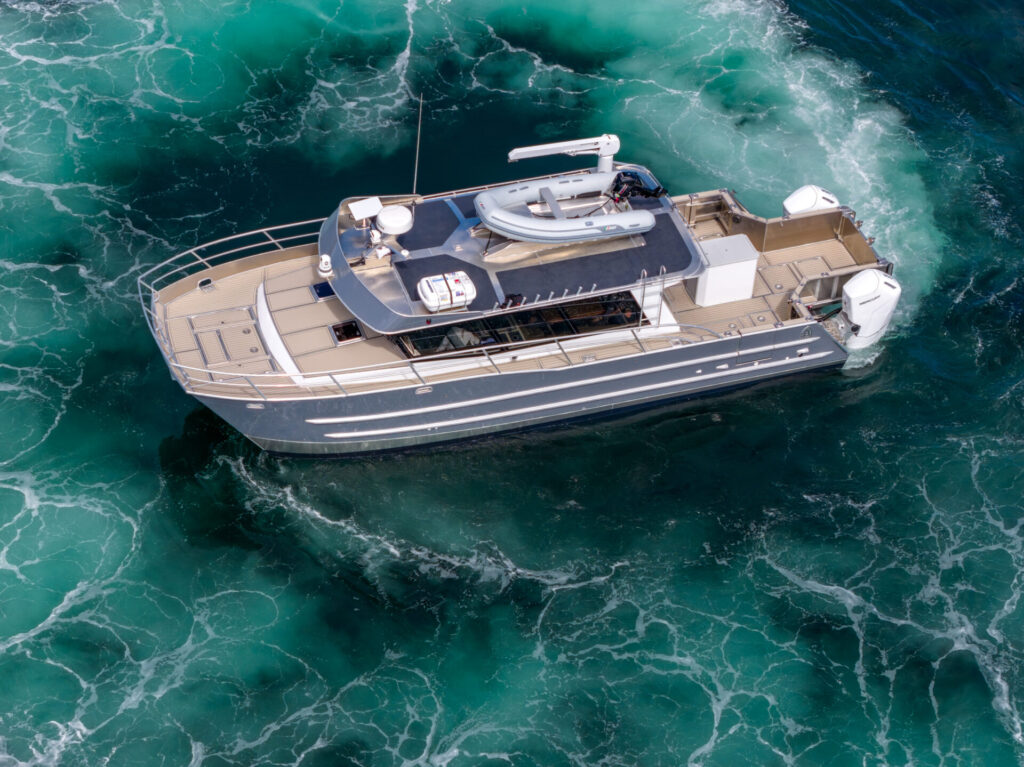 The working-boat layout includes a large cockpit, central island, cabin-top dinghy storage and wide transom door.
INTERIOR
The saloon is bright and open, with large windows and generous 86-inch (2.18-metre) headroom. The helm is forward to starboard. Opposite is passenger seating and a dinette with storage and a Mariteak hardwood table that lowers to create an additional berth.
Despite its commercial roots, the reviewed boat’s interior was anything but utilitarian. Vinyl-wrapped overhead panels, Ultraleather diamond-stitched upholstery, dark walnut cabinetry and an acrylic-infused hardwood floor give the cabin a much more finished, upscale feel.
The galley is fitted out for extended cruising, with Corian countertops, laminate cabinetry, an electric stove and oven, microwave and stainless-steel sink. Refrigeration includes two refrigerator/freezer drawers supplemented by a separate slide-out freezer beneath the dinette.
Above the galley is a 43-inch flat screen TV that hinges up flush to the headliner.
The helm has excellent all-round visibility through large windows. Twin 16-inch Garmin multifunction displays dominate the dash, supported by radar, VHF, FLIR thermal imaging and Starlink. A Llebroc helm seat on a Shockwave suspension base will assure a comfortable ride for the driver in all conditions.
The saloon also includes a clever, heated, horizontal bar mounted forward of the helm that doubles as a handhold, defroster and a warm surface for cold hands. It is powered by the Webasto hydronic heater.
Overhead handrails assure safe passage though the saloon regardless of conditions.
Accommodation is surprisingly generous for a boat with such a strong working-boat pedigree. A forward cuddy contains a king size berth, while a quarter berth is tucked below on the starboard side. To port are separate and spacious head and shower compartments.
ENGINE AND SYSTEMS
The 42 is powered by twin 600-horsepower Mercury V12 Verados—among the most powerful production outboards available. The 7.6-litre engines incorporate unique two-speed gearboxes and independently steered lower units. Rather than turning the entire engine, only the gearcase rotates, allowing the engines to be mounted relatively close together and freeing up valuable space across the transom.
Armstrong acknowledged that the engines are sophisticated and expensive, but said they have performed well and have proved quiet, reasonably fuel-efficient and reliable.
The large counter-rotating propellers provide substantial grip, particularly during acceleration and close-quarters manoeuvres.
Electrical power is supplied by a substantial AGM battery bank, backed by a 3,000-watt inverter/charger, 30-amp shore power and a nine kW Northern Lights generator. Each outboard has a high-output 150-amp alternator.
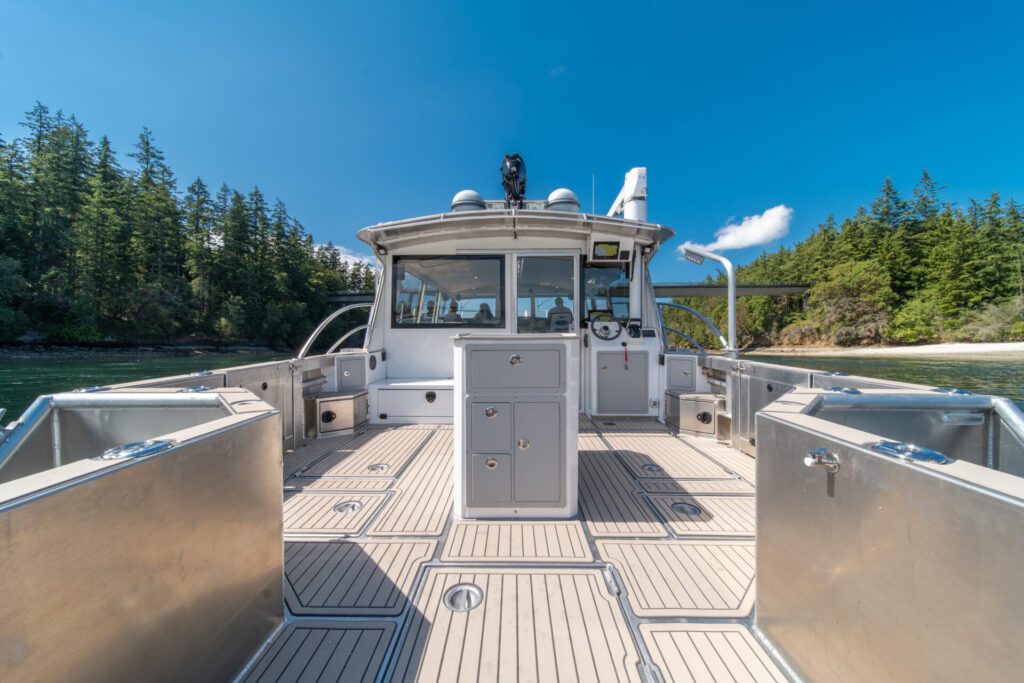 The broad, uncluttered cockpit provides plenty of working space, while Raptor Deck foam decking is comfortable underfoot.
UNDERWAY
Mercury joysticks are fitted at both the main helm and aft steering station, the latter particularly useful when docking or fishing. Mercury’s Skyhook (position hold) function proved its worth as we spent about 30 minutes crosswise to current and wind in the protected harbour while reviewing the 42’s features. As expected, it kept us pointing the same direction with no lateral movement.
The 42 accelerated onto the plane with almost no bow rise, lifting almost level rather than adopting the pronounced bow-up attitude common to many monohulls. The boat remained comfortable through tight turns, displaying only a slight outward lean typical of many catamarans. Steering was quick and predictable.
Conditions during the trial were choppy and not ideal for precise performance measurements. Most of the figures were gathered informally and were not corrected through controlled reciprocal runs that would improve numbers running down stream versus driving into the chop.
At 10 knots (2,500 rpm), fuel burn was 13 gph, a little more than one gallon per mile. Armstrong considers roughly 27 to 33 knots the preferred cruising range.
At 4,000 rpm and 27 knots our fuel burn was 42 gph, or about 0.65 gallons per mile. Wide open throttle (6,200 rpm) brought us up to 42.7 knots. Armstrong said the 42 should top out at about 44 knots.
The widely separated twin hulls contributed to a stable feel both at speed and while manoeuvring.
CONCLUDING REMARKS
The 42 targets owners who want commercial durability and load-carrying ability without giving up comfort, finish or speed. It is still very much a working boat at heart, but one that has been refined into a capable cruising and fishing platform with impressive performance and a surprising level of comfort.
Price as tested was approximately US$1.65 million. ACI sell its vessels in Canada through Custom Yacht Sales in Sidney.
SPECS
LOA 14.63 m / 48′
Length 12.8 m / 42′
Beam 4.27 m / 14′
Draft 0.76 m / 30″
Disp. (light) 12,247 kg / 27,000 lbs
Fuel 3,028 L / 800 USG
Diesel 190 L / 50 USG
Water 568 L / 150 USG
Holding 132.5 L / 35 USG
Built by ACI Boats Port Townsend Washington
aciboats.com
Sold in Canada by Custom Yacht Sales North Saanich, BC
250-656-8771