
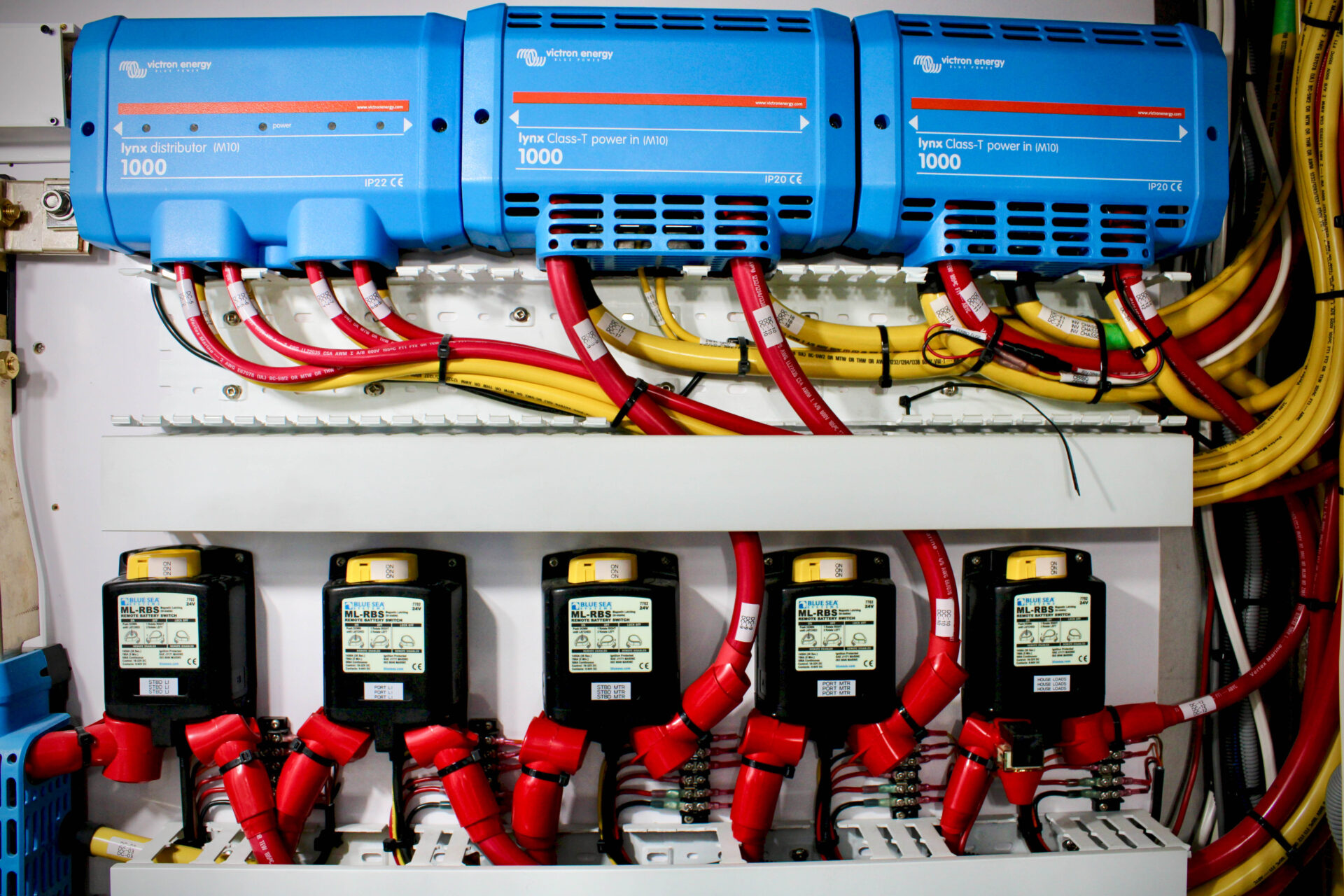

Most boats have more than one battery or battery bank. While a simple runabout or tender may have just one battery, most boats have at least two, and many will have three or more batteries. In the case where there are multiple batteries, or battery banks, keeping them all charged means maintaining the right battery isolator.
In this article we will look at some of the different configurations and devices that are used to maintain multi-bank charging. There are several kinds of charging devices with multiple outputs. Battery chargers are the most common example, but they require a connection to an AC source (shore power or generator). There are also charge distributors that work in conjunction with an alternator, like diode-based battery isolators (which have an inherent voltage drop). Then there are “no-voltage drop” battery isolators which charge multiple batteries that underway. To build the right system, first think about how you’re going to use it.
VOLTAGE SENSITIVE RELAY CHARGING – ‘IDENTICAL TWINS’
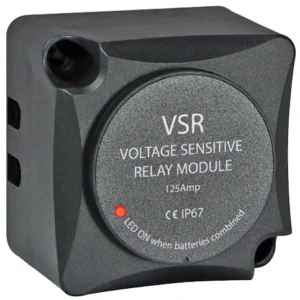 A common configuration on smaller boats is to have a pair of batteries: one battery for the starter and another for the ship loads, often called the house battery. The simplest configuration would be two identical batteries installed at the same time in the same location. This is a typical configuration on boats in the seven to 11-metre range. In this case, use a Voltage Sensitive Relay (VSR) to combine the batteries into a single bank for charging. The relay will disconnect the batteries when the voltage is nominal (in a non-charging voltage range) to isolate the batteries during discharge. A VSR works well in this simple scenario, but not if the batteries are a different type, installed in different locations or have different voltage like for a bow thruster.
BATTERY TO BATTERY CHARGING – ‘DISTANT COUSINS’
The next configuration involves a similar two-bank system, but each battery bank is designed specifically for its application. In this scenario we have a starter battery designed to offer high amperage for short periods of time and a ship’s bank of batteries suited to deliver variable load rates over a longer period of time. A VSR will not be efficient for charging these batteries, although we commonly see VSRs installed with dissimilar battery types and sizes. The pitfall is, depending on where the VSR is installed in the system, the batteries can be over-charged or under-charged during a normal cycle. Imagine the starter battery is a single Group 24 (like the one in most cars) being combined with six GC2s (aka golf cart batteries) for the ship’s battery bank with the alternator charging through the starter circuit. If there is a VSR in the system, then the smaller start battery will quickly reach full capacity. This could result in over charging the starter or under charging the ship bank if the charge cycle is ended early by the starter battery’s voltage.
The solution to charging dissimilar batteries or battery banks is to “tap” power from one bank to charge another. Battery-to-battery chargers come in varying degrees of charge rates and sophistication.
BATTERY-TO-BATTERY OPTIONS
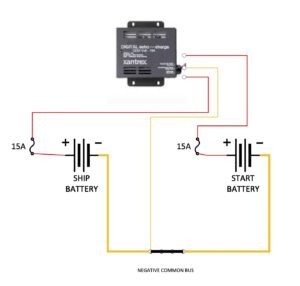
THE ECHO CHARGE
The Echo Charge is an easy, three lead connection that requires no fiddling. The device is limited to 15 amps of power transfer, and the charge profile to the battery receiving the charge is going to be the same as the charging profile of the battery that is being charged. This device works best if the batteries are the same type but not the same size.
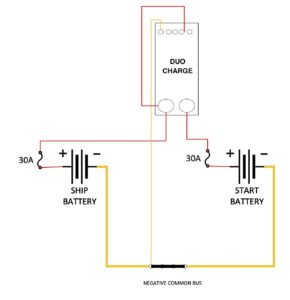
THE DUO CHARGE
A step up in power and sophistication is the Duo Charge. This device will allow for 30 amps of charge distribution, and the charge profile is configurable. This would allow for a flooded lead acid starter battery and an AGM ship battery bank to be charged simultaneously without issue.
MORE OPTIONS
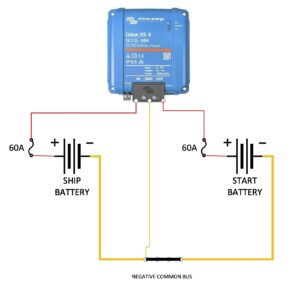
Victron Energy also has a range of battery-to-battery chargers that offer even more configuration options. The VE Orion chargers can be set up for many standard charging profiles, custom charging profiles, step-up or step-down voltages and act as a power supply in either isolated or non-isolated formats. This can handle charging a 24VDC battery bank that is supporting a 24VDC bow thruster from a 12VDC battery or battery bank. The VE Orion battery-to-battery chargers can also be operated in a parallel configuration to deliver higher rates of power transfer as required.
WITH THE WIDE range of options available for charging multiple connected batteries, having the right device for the right application is only a matter of research. Making the right choice will ensure that your batteries are well charged and ready for service when called upon, and it maximizes the life cycles of the batteries by making sure they are being charged correctly.