

In last month’s issue we looked at some easily identifiable birds along the West Coast. Now it’s time to explore some of the more challenging species. But don’t get discouraged. True, many of the birds described here look very much like their cousins, making a positive ID difficult. Thankfully, we have a secret weapon: a cell phone.
There are many birding apps that offer images and descriptions of local birds, but it’s an app’s audio ID function that turns them into a must-have companion. The app listens to bird calls and identifies the species in real-time. It’s a game changer, and if you haven’t got one on your phone, now is the time to download one.
Most folk in the Pacific Northwest seem to use Cornell University’s free app, Merlin. It has terrific audio ID success in North America—less so elsewhere in the world (though it’s being upgraded constantly). The only criticism of Merlin is that it doesn’t provide dimensions of the bird species—body length, wingspan and weight. Those can be very useful when trying to compare two similar looking but different sized species.
Alternative sound ID apps are Larkwire, Smart Bird, PictureBird and Chirpomatic. They are subscription based and offer better bells and whistles (no pun intended), notably in audio recognition.
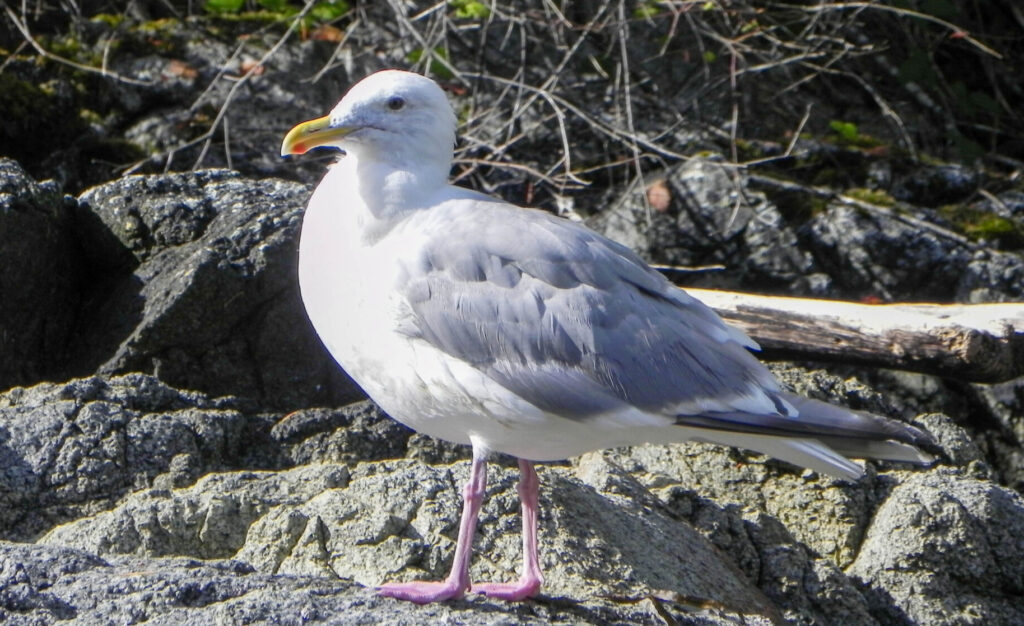
GLAUCOUS-WINGED GULL
FIRST OUT OF the box are gulls. You see them everywhere: in urban areas, garbage dumps and out on the water. They’re all mostly white with black bits, right? Well, there’s bad news and good news. The bad news is at least 18 different species have been recorded in the Salish Sea, and they all look mostly the same. The good news is that about three quarters of the time, what you’re looking at is a glaucous-winged gull.
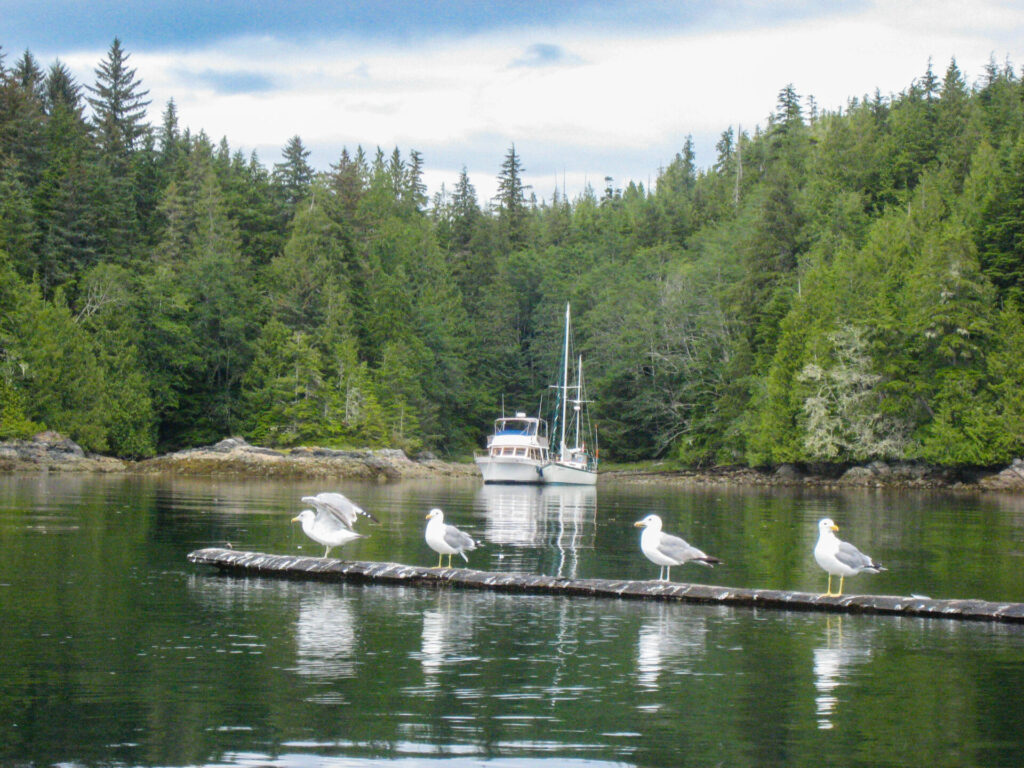 Gulls can drink seawater thanks to specialized salt glands above their eyes that filter out excess salt, allowing them to stay hydrated at sea.
Glaucous means a dull, pale, bluish-gray colour. When perched, the folded wings and back are glaucous, as opposed to white or black. Their wing tips are also glaucous, as opposed to most other gulls with black tips.
One of the easiest ways to recognize a glaucous-winged is its large size, but that doesn’t help when it’s flying. When perched, the size difference between it and other gulls should be obvious. They are 60 centimetres (two feet) long and their wingspan is 120 to 150 centimetres (four to five feet). Plus, they have pink legs. Many gulls have grey, yellow or red legs.
But sometimes those markings aren’t obvious. Gulls take several years to mature, so first and second-year juveniles don’t look quite like their parents. They are about the same size, just with scruffier plumage.
Gulls are social, highly intelligent and can eat almost anything. And they do, including your sandwich if you leave it lying around. “Flying garbage thieves” is a phrase one hears a lot. But gulls are neat. They can drink seawater using a specialized gland near their eye, they can “mob” enemies even when they’re smaller than the attacker and they understand cause and effect—if they drop a clam from a certain height onto a hard surface, the shell will crack. They nest in large colonies for safety, have adapted to many varied habitats (not just the seashore) and they have a clever flight when under attack, making it hard for predators to lock onto them.
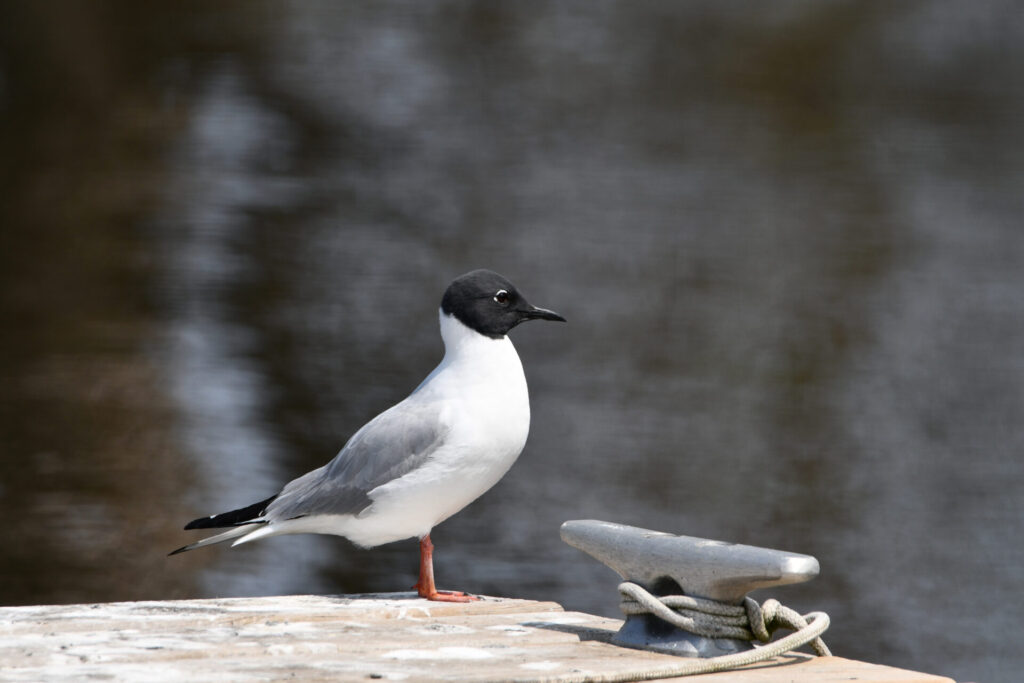
THE BONAPARTE’S GULL
ANOTHER COMMON GULL to identify is Bonaparte’s gull, which is smaller than the glaucous-winged and has thin, pointy wings like a tern (more on terns later). Unlike most gulls that encircle the world, Bonaparte’s are unique to North America, and they nest almost exclusively in Canada. They aren’t named for Emperor Napolean, but for a cousin or nephew (the genealogy is bit confusing there) who was a well-known naturalist in France. In spring, they are dead-easy to identify because, apart from having a very different shape from most other gulls, they have a slate grey or black head.
The Bonaparte’s gull has a few unique habits not common among other gulls: They eat insects that they catch in flight and they can hover just above the sea picking small critters off the surface.
Identifying a Bonaparte’s can be difficult when the breeding season ends as its head turns white again. There’s usually a pale gray curve just behind the eye hinting at the black hood it had earlier in the year. Bonaparte’s, like glaucous-winged, hunt in large flocks and favour tidal rapids and other active zones where upwelling brings tidbits to the surface.
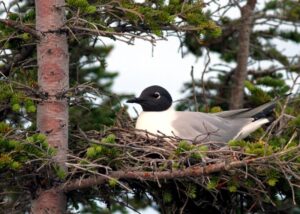 Bonaparte’s gulls are the only gull that builds its nest in trees.
Another curious thing about Bonaparte’s is they’re the only gull to nest in trees. Other gulls just throw a bit of seaweed and guano together on a cliff edge and make do, but Bonaparte’s are fussy and build a real stick nest.
Apart from Bonaparte’s and glaucous-winged, the other more common gulls are mew (seen in large flocks in spring and fall), California (a medium-sized gull with yellow legs that appears in the summer and fall), Thayer’s (which overwinters in the Salish Sea and tends to hang around salmon river deltas), Heerman’s (which is dead-easy to ID because it’s sooty gray with a red bill and arrives from Mexico in the fall), ring-billed (which has, surprisingly, a noticeable ring around its bill and likes to hang around farmland) and the herring gull which isn’t very common in the Salish Sea but are found on the Pacific Coast.
Responsible Birding
Like the rules that apply to watching marine mammals, the same applies when approaching bird colonies. Keep 100 metres clear of any nesting area and don’t let pets disturb them. Remember, a lot of marine birds nest on the ground amid dunes or grass, and a dog on the loose can do a lot of damage, often with the owner unaware there are even nests in the area. Spring and summer are particularly sensitive times.
Some seabird colonies on small islands in the Salish Sea have formal protection under Washington and BC designations, while others come under the jurisdiction of local parks. In theory, access within parks is restricted, but in reality unless a warden is present there’s minimal real protection in busy areas. This applies to ecological reserves as well.
Nesting colonies of double-crested and pelagic cormorants, as well as glaucous-winged gulls are found in urban environments and unfortunately often have no protection at all or are “managed” by local municipalities by actively discouraging the birds to nest there. Nobody wants the mess and smell of an active fish-eating colony, so nests are often destroyed or areas closed off with mesh.
While most birds aren’t on track to get sympathy from municipal authorities (or the general public) any time soon, offshore islets should be vigorously protected for the benefit of these struggling species.
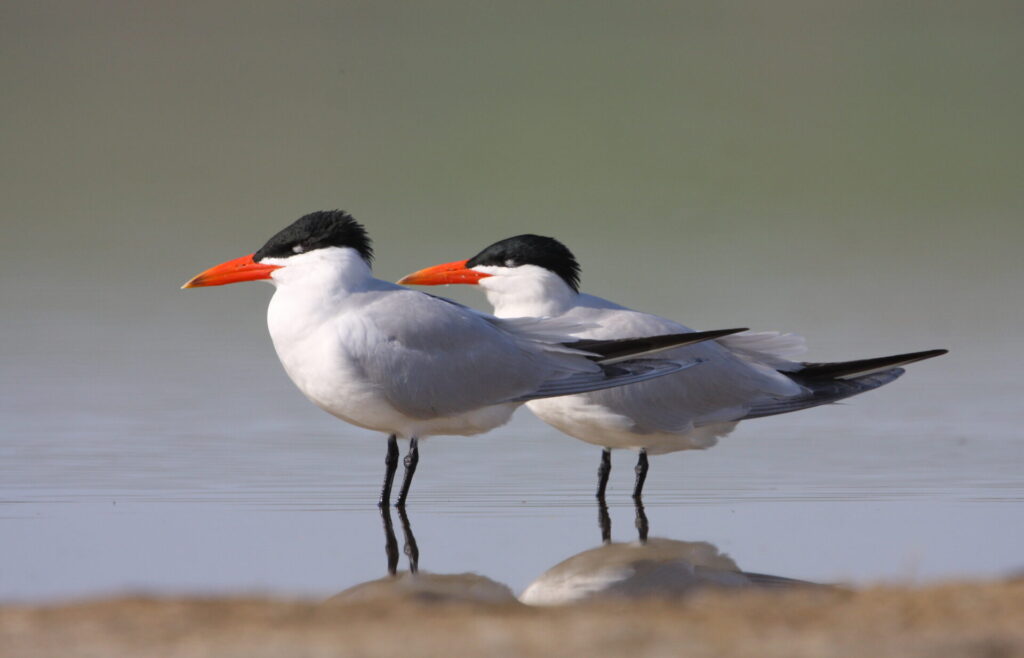 The Caspian tern (above) is much larger with a thick red bill and powerful build.
TERN
TERNS ARE SMALLER and more delicate than gulls. But like gulls there are a number of species, and sorting them out takes practice. At our level, it’s good enough just to say, “That’s a tern” (as opposed to a chicken, for example). Caspian terns (which were named for the Caspian Sea in Asia) breed around the Salish Sea. They are larger than other terns, which is handy as
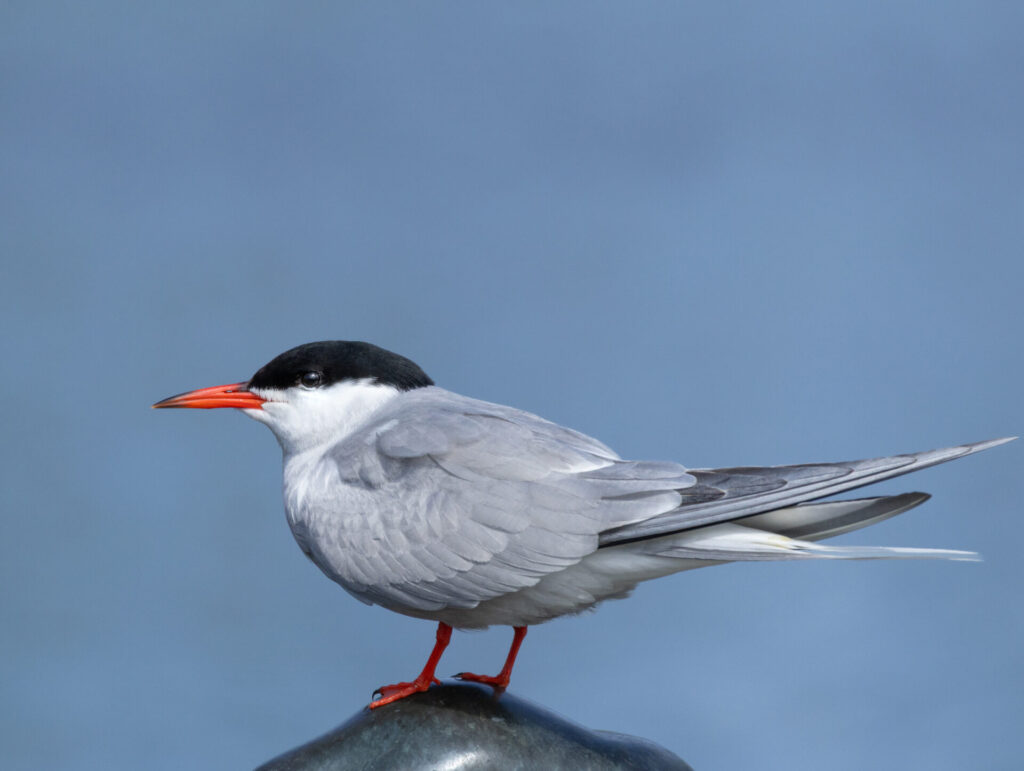 The common tern (above) is smaller, more slender and has a graceful appearance with a finer bill and deeply forked tail.
you often see mixed flocks, so size comparisons are possible. The Caspian’s beak-to-tail length is 50 centimetres (20 inches). They have bright red bills, a white body and a black crown, which you would think makes them easy to ID, but sadly most other terns follow the same fashion rules.
The common tern for example also has a red bill and black topknot, but it’s much smaller, with a body length of just 30 centimetres (12 inches). They lose their red bill out of the breeding season—the bill goes dark gray or even black.
The only other likely tern is the Arctic tern which, as the name suggests, summers in the Arctic. It overwinters here, although more commonly on the open ocean than in the Salish Sea. It too has a red bill and black crown with the bill going dark in the winter. Confusing. But most of the time, the terns you’ll see are the Caspian and, less often, the common.
OYSTERCATCHER
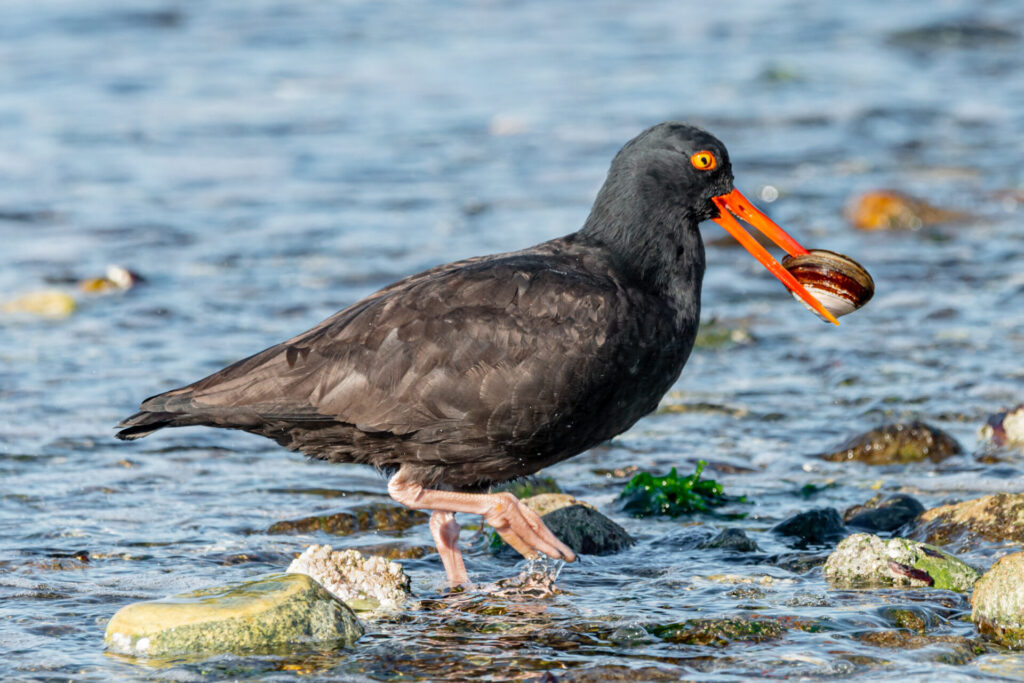
THESE SHOREBIRDS ARE distinctive with their jet-black bodies and bright red, long bills. You’ll hear them before you see them—their loud peeping carries downwind. They favour weed-infested, rocky headlands where they poke and probe among the intertidal zone, hunting small creatures and shellfish. Despite their name, they don’t just eat oysters.
The shape of their bill depends on their diet. Those feeding on molluscs and bivalves often have blunt tips, caused by hammering on hard shells. Those that feed on sea worms have very pointy tips. Either way, the bill’s edge is razor sharp—capable of severing the main muscle in a bivalve and opening it quickly.
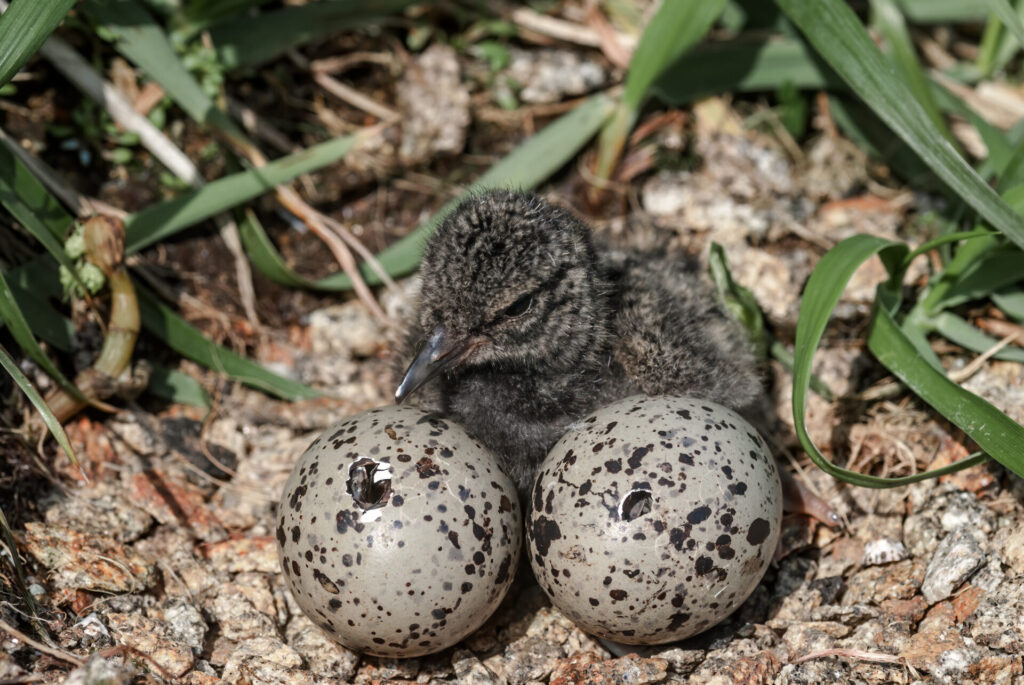 Oystercatchers are found around most of the world’s coastlines. Here on the West Coast, we only have the black oystercatcher. Further south, there’s the American oystercatcher with a handsome white waistcoat, but ours are plain black. Black oystercatchers make a scrape on a rock or in the sand for a nest, drop some pebbles around it for décor and lay two to three wonderfully speckled eggs.
The shells are very hard and can withstand being submerged in a high tide, which makes sense given the parents’ limited nest-building skills and the fact the eggs take a month to hatch (so, they may have to survive a few high tides). The chicks hatch out using an “egg tooth,” a sharp nubbin on the bill that allows them to crack that hard shell.
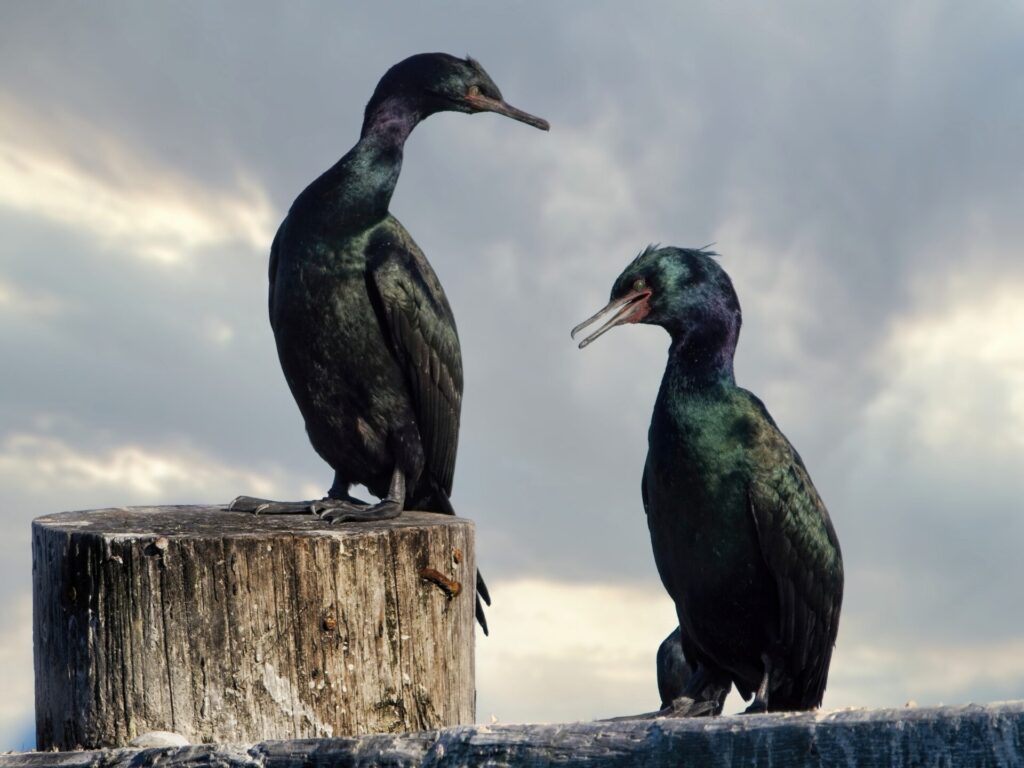 The ubiquitous pelagic cormorant has a green sheen during the mating season.
CORMORANT
THESE DARK, LONG-NECKED birds are seen anywhere coastal—on dock pilings, rocky outcrops and bobbing on the sea. Their major adaptation is they have wettable feathers due to a lack of preening oil. Being more waterlogged, they can dive deeper than many other sea birds, reaching depths of 70 metres (200 feet) where the fishing, it’s rumoured, is better. The downside of getting soaked with every dive is they can suffer from hypothermia.
As a result, you often see them roosting on pilings, wings spread, drying in the sun or wind. It’s a trade-off. Incidentally, because their wings are adapted for underwater, they are poor flyers in the air. Notice how long it takes them to get airborne from the sea’s surface, webbed feet pumping and wings flapping. And once airborne, they favour flying close to the surface, where they get the best push on each wing’s downbeat.
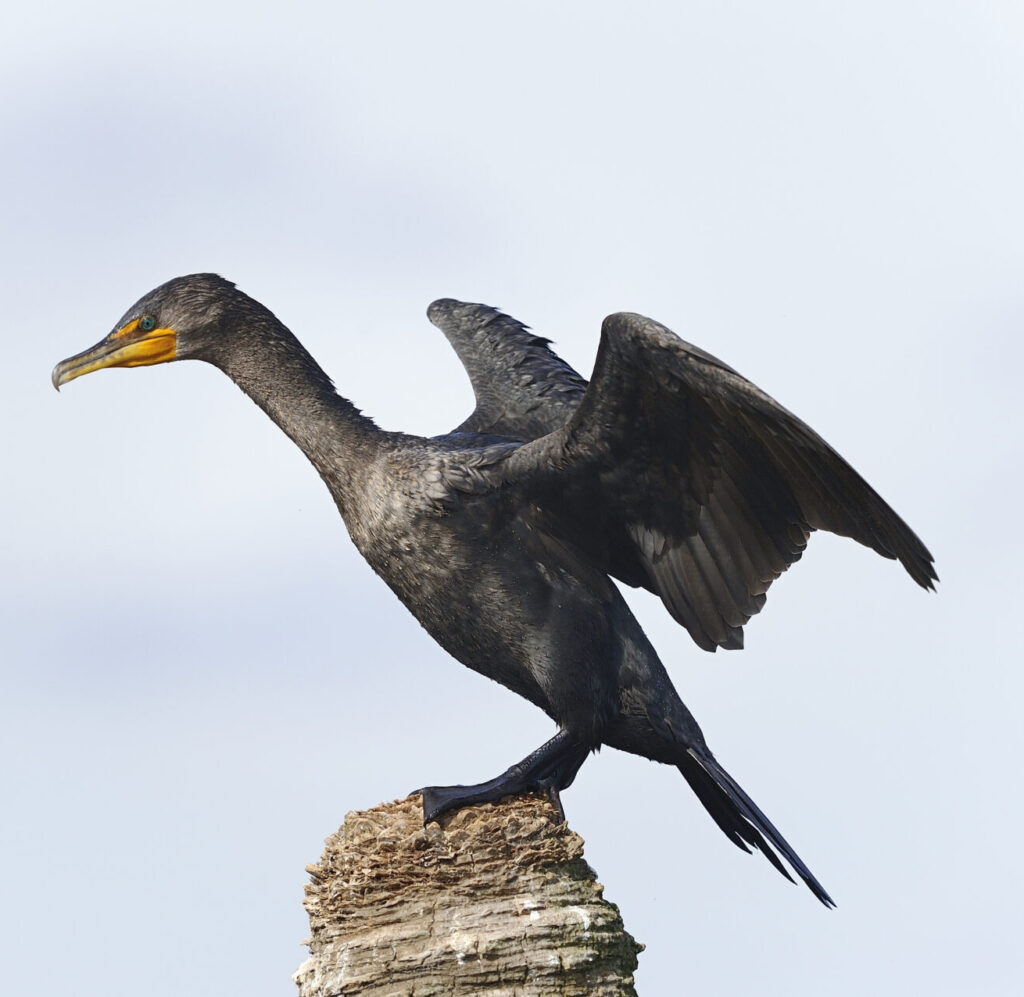 The double-crested cormorant has black feathers and a yellowish orange face, and is the largest cormorant found in BC.
The Salish Sea has three cormorant species: the Brandt’s, pelagic and double-crested. Like terns, they vary in size, but unless you see two species next to each other it’s hard to estimate if the one you’re looking at is big or small, so other field marks are needed. The Brandt’s and double-crested are about the same size, with a body length of 86 centimetres (34 inches). To confuse things more, both juveniles have a pale brown breast for the first year. But as adults, the Brandt’s has a greenish tinge in sunlight and the double-crested is dark with quite a bit of bright yellow around its bill. That’s the easiest way to tell them apart.
The pelagic is easier to distinguish. It has a thinner body, neck and bill with a body length of 70 centimetres (28 inches) and in the breeding season it has a white rump that’s a total giveaway. All three nest on rocky islands and cliffs in large social colonies, which are marked by the white streaks on the rocks below the nests and are easily found when you are downwind of them. Cormorants are not fastidious housekeepers. The official collective noun for a group of cormorants is a “gulp.”
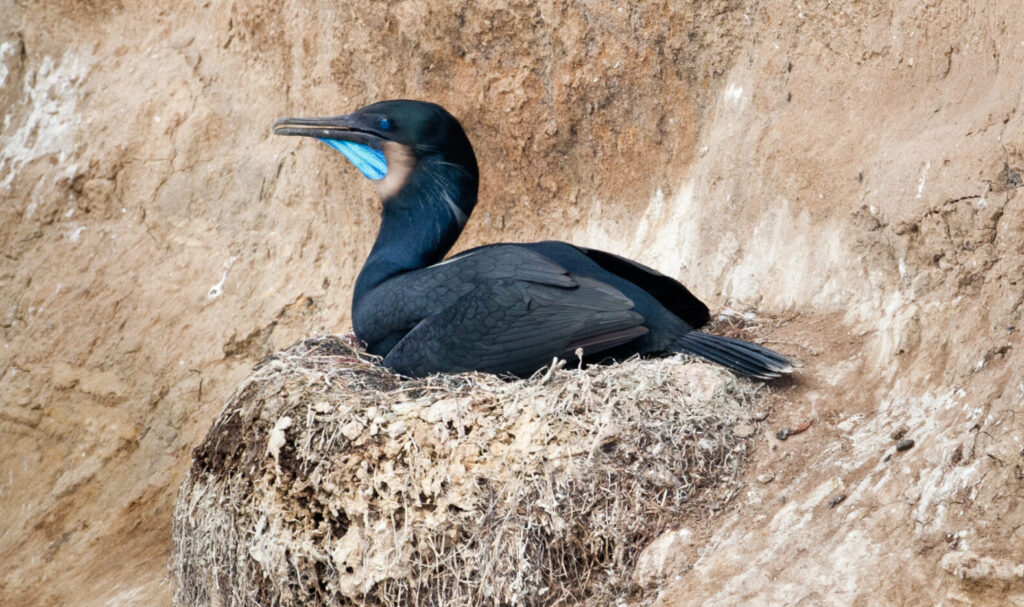 A Brandt’s cormorant showing its breeding season colours while sitting on its nest.