

You’ve had that bird book sitting above the chart table for years and always meant to study it—somehow, it just never happened. But this year—this year you’re going to do it. I mean, how hard can it be? There aren’t that many local species, and they all look different, which makes it easy, right? Welcome to the wonderful world of birding.
Since there are about 11,000 bird species in the world (and hundreds on the BC Coast), we’ll begin with the easy-to-spots ones and save the tricky ones for parts II and III.
BALD EAGLE
PERHAPS THE MOST iconic bird on the West Coast is the bald eagle—a large, powerful raptor weighing up to five kilograms (10 pounds) and boasting a massive two-metre (seven-foot) wingspan. They’re so common here that many take them for granted, but to the uninitiated they form a cherished memory on a West Coast holiday. The name “bald,” by the way, comes from Old English, meaning “white,” not “bare headed.”

The white head alerts us to the bird, often perched on cedar snags above the water, where it scans the surface for prey. Its swooping dive with wings spread, feathers fluttering for stability, legs extending to align eyes, claws and prey in a momentary straight line is something that stays with you. It’s a powerful reminder of the power of these birds. In a dive, they can reach speeds of 150 km/h.
The eagle’s eyesight is legendary. Some estimates suggest they may see eight times better than humans. While fish is their preferred diet, they’ll scavenge and even steal from other birds. They particularly target osprey, a small raptor that often shares their territory (see below).
They’re also known to catch birds in flight—gulls are a favourite, if they’re far from land and can’t duck for cover. Out on the water a gull can only weave as the eagle swoops, but that only lasts for so long before the gull tires. In the air, the eagle’s speed will outrun a gull quickly. The same applies to small ducks, though they are better at diving and tend to pop up in unpredictable places, making a harder catch for the eagle.
Eagle nests, known as aeries, usually accumulate over successive breeding seasons and can become truly massive. Usually found close to food (water), they are a jumble of sticks and debris that can weigh several tons and sometimes end up bringing the tree down due to the added weight. Over its lifetime, a female eagle may lay about 40 eggs. Both adults take turns to incubate them for 35 days before hatching.
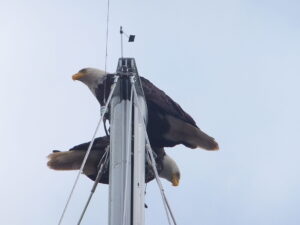 While bald eagles will winter apart, they are among the few birds that mate for life.
Young bald eagles take four or five years to develop that iconic white head, which explains why there are so many false golden eagles sightings. Once mature, they mate for life, which is about 25-30 years in the wild, up to 50 years in captivity. Fishing is a high impact occupation, and this writer has seen eagles dragged underwater by large fish or just becoming exhausted by a medium-sized one that they couldn’t pull clear of the water.
Contrary to popular belief, an eagle can release a fish that’s too big, but it often won’t because the catch is too valuable. What they generally try to do is swim to shore using their wings as paddles, then drag the reluctant fish out of the water with one claw, while grasping the rocks in the other. Then a swift blow from the beak ends the battle.
One of the more surprising characteristics of bald eagle is its voice—a high-pitched warbling whistle that might seems out of character for the stoic bird. In movies featuring bald eagles, the red-tailed hawk often does the voice-over because it sounds more aggressive.
Bald eagles can be spotted all along the BC coast from nests overlooking busy Vanier Park in Vancouver to the remote beaches of Vancouver Island’s west coast and beyond.
OSPREY
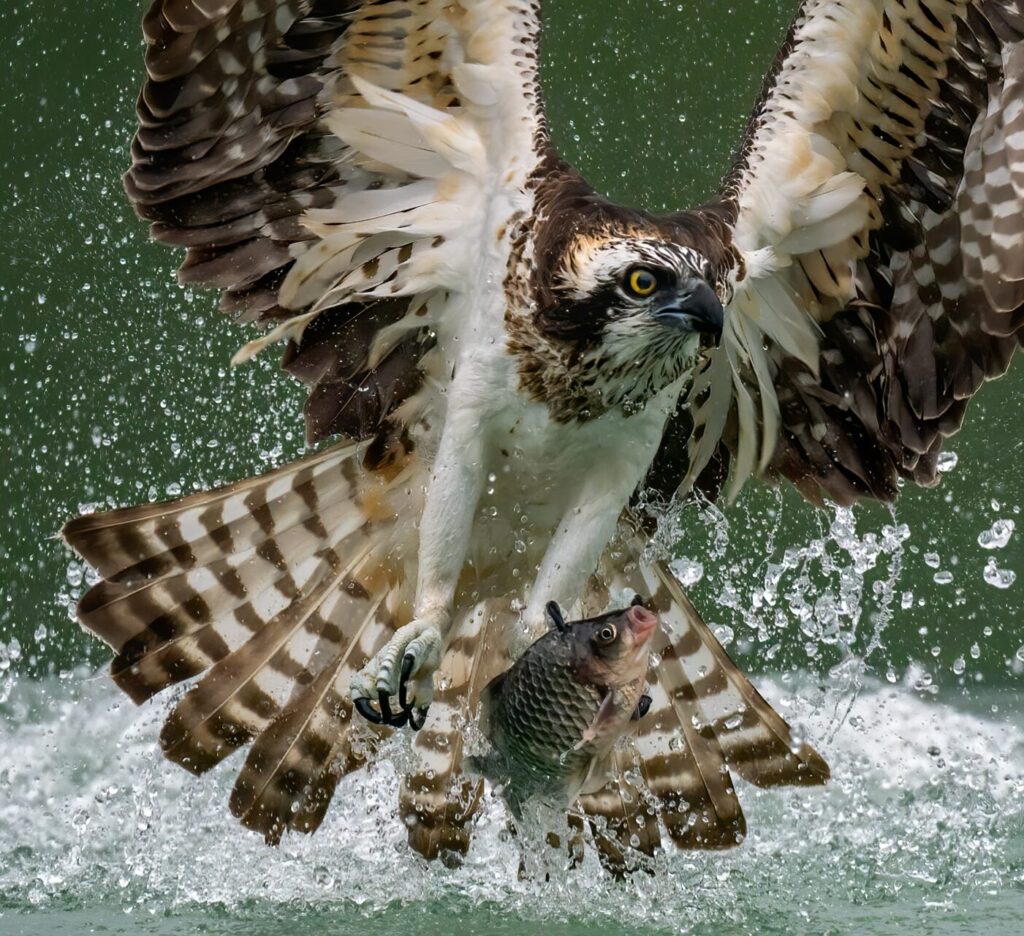 An amazing picture of an osprey or sea hawk hunting a fish from the water
NOT AS EASY TO spot as the bald eagle, ospreys are equally impressive. Because they live almost exclusively on fish, they are sometimes called “fish hawks”—and they are good at what they do. Osprey success rates when hunting are around 70 percent. They hover high above a target and then drop at an impressive rate. Unlike other raptors that flare out at the surface, the osprey swings its claws into line with its eyes, furls its wings behind its back and plunges into the water to seize the prey. It’s impressive to watch.
Small adaptations set the osprey apart from other raptors. The most notable example are its claws. The outer toe can reverse to make a two-toes-forward, two-toes-backward clamp that’s better for hanging onto slippery, wriggling targets. The undersides of those claws also have spiked scales that improve their grasp. Another adaptation is both their eyes and nostrils have covers that close for underwater action.
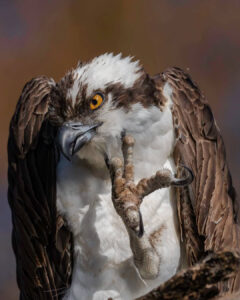 The osprey’s reversible outer toe allows it to lock onto slippery fish with a specialized two-forward, two-backward grip.
Ospreys are smaller than bald eagles (1.5 kg) and getting a protesting fish out of the water requires a lot of lift. Long, hooked wings allow them to gain maximum thrust to jerk the fish clear of the water. They also align the fish’s head forward to reduce air drag as they fly. It’s fascinating to watch.
Osprey mate for life and perform an impressive “sky dance” when courting. Like crows, they are one of the world’s most wide-spread birds. They are big travellers, and cover huge distances over their lifetime, yet often return to the same nest each year. In deserts where there are no trees, ospreys balance nests atop power poles (the only tall structure around), which makes you wonder how they get the first few sticks to stay in place, given that many poles are just a post with a small crossbar. Summer is the best time to spot an osprey as many will head south in the fall. Look for a predominately white undercarriage with dark brown or black spots and an M-shaped silhouette in flight.
GREAT BLUE HERON
GREAT BLUE HERONS are all over the West Coast. Easy to identify (other herons are rare this far north, and those who make the trip are much smaller), the heron is almost pre-historic in appearance. Always solitary, they stand motionless, apparently passive, but don’t be fooled. They have a voracious appetite, excellent eyesight and a long, sharp bill they use to spear anything edible: frogs, voles, mice, fish, chicks and more. The speed of their strike is legendary, and that narrow neck can expand to swallow surprisingly large prey.
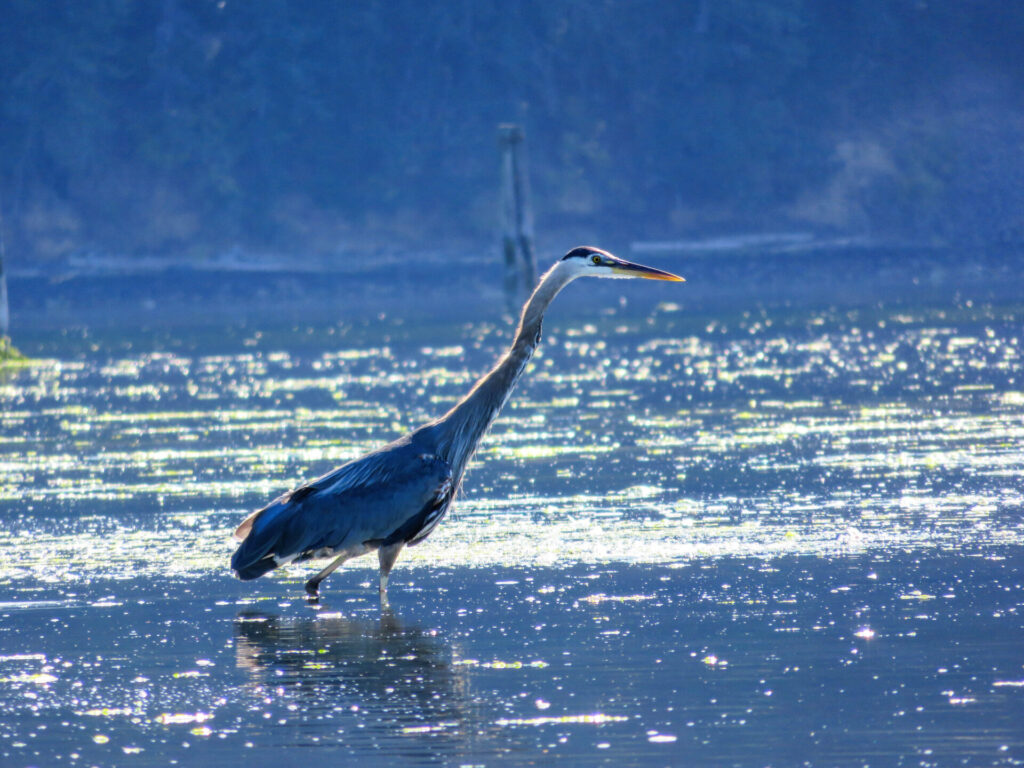
Great blue herons stand up to 120 cm (four feet) tall with a two-metre (six-foot) wingspan. Still, they weigh barely 2.5 kg (five pounds) on account of their hollow bones. When they fly, they curve their neck into an “S.” Why? When any bird (or plane) flies, the weight in front of the wing must balance the weight of the tail. Look at a flying stork—its head is fully extended to offset its large butt. Not so with herons, which have more slender bodies. To achieve balance in flight, herons need to bring their head closer to the wing and stick their feet far out behind to stay balanced.
By and large, herons are solitary. You’ll see them dotted along a shoreline where the fishing is good, but they rarely hang out together. About the only time that happens is when they breed. Then, they build rough stick nests close to each other in sprawling heronries high up in trees. Bald eagles have been known to terrorize heronries, but the prospect of facing scores of spear-like bills often deters repeated attacks.
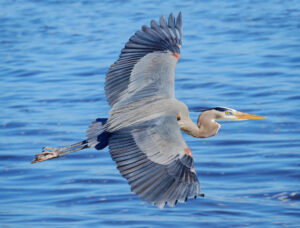 Herons curve their neck into an “S” to bring their head closer to their wings to achieve balanced flight.
Great blue herons have excellent night vision (fewer cones and more rods in their eyes) and are comfortable hunting in the dark when the shoreline comes alive with different potential food. They also aren’t fussy eaters. You can find them on freshwater lakes, municipal parks and rivers just as often as along the tideline. If you come near one, they have a deep, almost prehistoric croaking call. It’s their way of saying they aren’t happy being moved along.
Fun Fact: Look closely at the front of a great blue heron and you’ll notice its fluffy breast feathers. There’s something special about them. These feathers slowly disintegrate, forming a powder the heron uses (with the help of a specially adapted middle toe) to wipe the slime or oil off its prey, such as toads or fish.
BUFFLEHEAD
BUFFLEHEADS ARE UNLIKE any other duck. With their large, bulbous heads and short bodies they look like everyone’s favourite rubber duckie, though they’re black and white rather than yellow. They’re the smallest diving duck in North America. The females are the same shape as the male but the males have a large white patch on the back of the head.
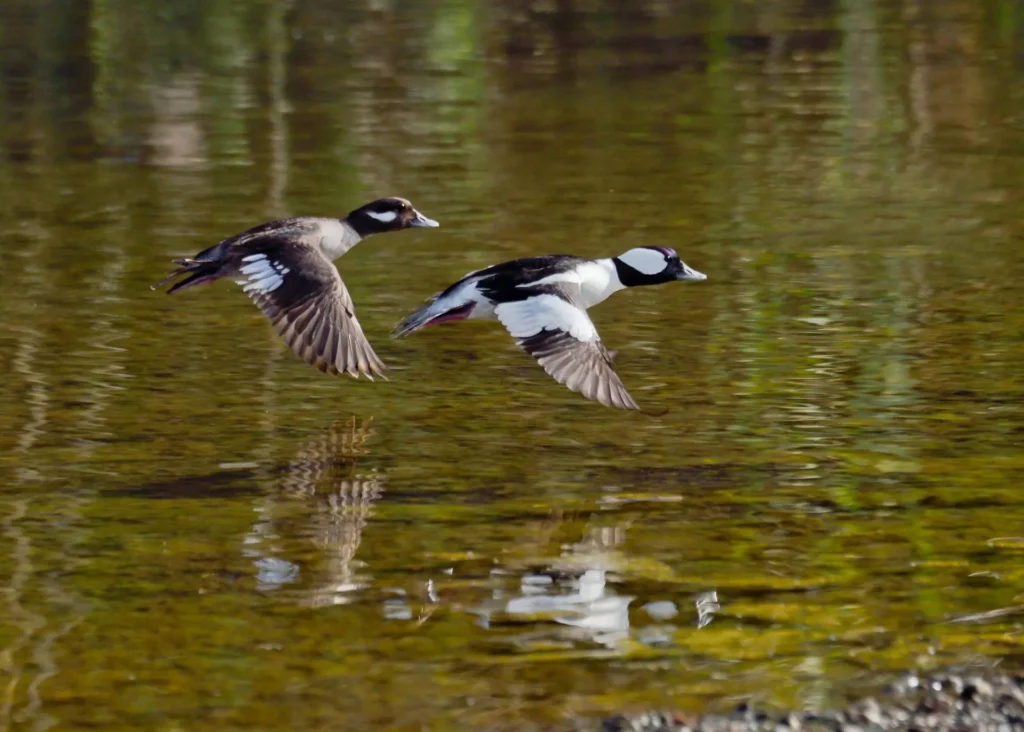 The male bufflehead (right) is easily identified by the large white patch on the back of its head, while the female (left) has a smaller white cheek patch and darker plumage.
Buffleheads have a symbiotic relationship with Northern Flickers (a type of woodpecker) because they nearly always nest in abandoned Flicker-made holes in trees. That’s the advantage of being small. Unlike most ducks, Buffleheads form monogamous pairs for many years.
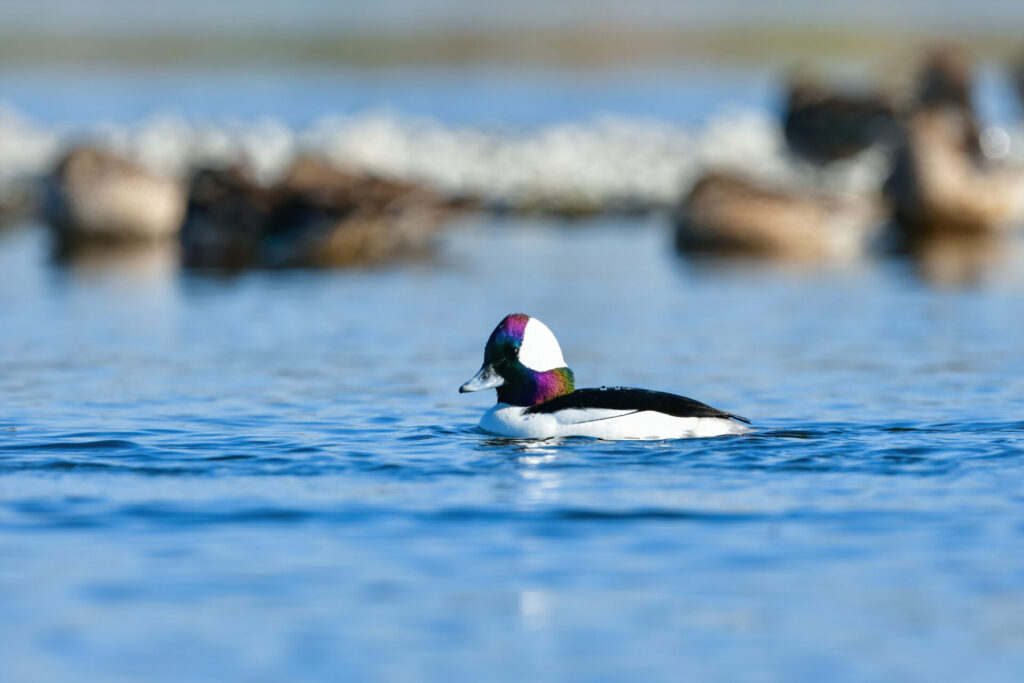
They feed on molluscs, aquatic insects and crustacea. Unlike many waterfowl, they can even swallow underwater. Rapid feeders, they add 25 percent of their body weight in fat before their spring or fall migration. During the summer they breed in the boreal forests inland but overwinter in protected inland lakes or marine bays, which is when they are most common around the Salish Sea.
BASIC TIPS FOR BOATING BIRDERS
Use Quiet Watercraft: Kayaks, dinghies and paddleboards will minimize the likelihood of disturbing the birds, giving you a better vantage.
Pack Optics Wisely: Waterproof binoculars and a dry bag are recommended. Keep your equipment handy so you aren’t scrambling when you spot that rare bird on your list.
Stay Back From Nesting Sites: Birds are sensitive, especially during the summer breeding season. Give them space.
Record Sightings: Using an app like eBird not only helps identify what you see, it also helps contribute to conservation.
LOON
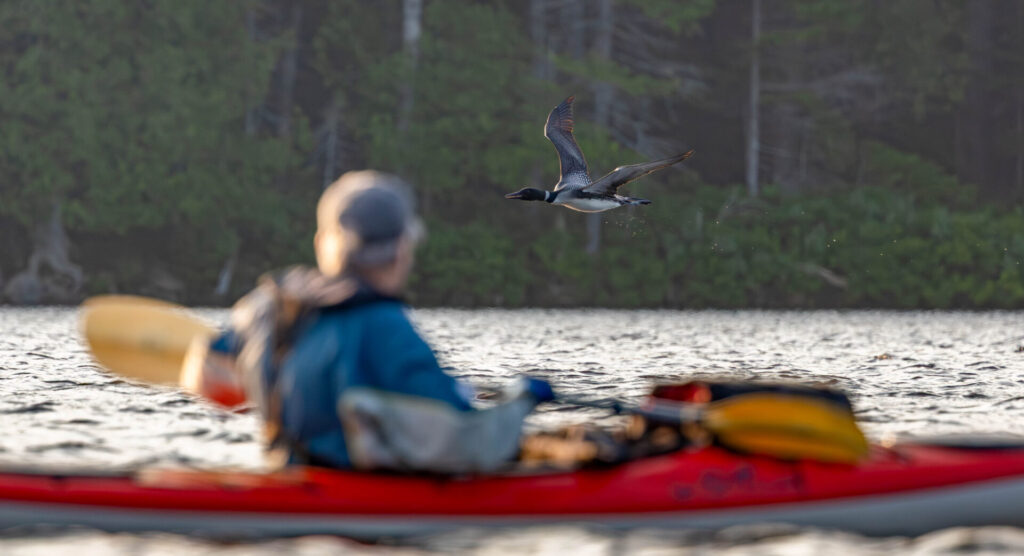
LOONS ARE LARGE, heavy birds that sit low in the water and have thick bills. They also have solid bones making flying difficult but diving easier. Underwater, they feed on crustacea, small fish and molluscs. Despite their skeleton, loons are powerful flyers. Slow to get airborne, once in the sky they have been clocked at over 100 km/h during migrations.
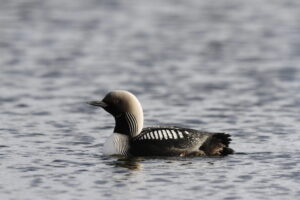 Pacific Loon.
Loons are clumsy on land because their legs are set far back on their body. While this is ideal for diving, it’s not so good for walking. As a result, they seldom come ashore except to nest, when they waddle awkwardly. When hatched, the chicks often ride on their parents’ backs,
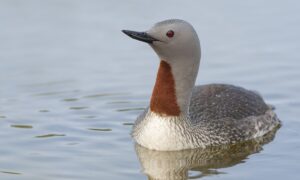 Red-throated Loon.
which keeps them warm and safe and makes for cool photographs. In the ornithological world, they are considered one of the ancient lines in taxonomy, which is why they always appear at the beginning of bird guidebooks.
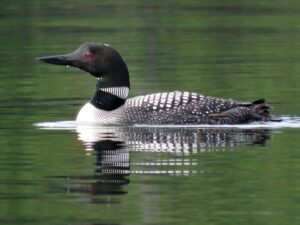 Common Loon.
Three species are found along our coast: common, red-throated and Pacific. Since they are all about the same size (about 62 cm or 25 inches long) the easiest way to distinguish them is by their summer plumage. The red-throated has, of course, a red throat (male and female) that’s hard to see if the light is poor or it’s not spring (when breeding plumages are most obvious). The common and Pacific loons both have dark bodies with white flecks on their backs, but the Pacific has a pale back of the head while the common has a dark head. The common also has a thicker bill. Further, the common tends to be solitary, while the Pacific is often seen in small flocks. In winter, all three species morph into a gray-and-white mix making ID difficult.