

IN TRANSITION
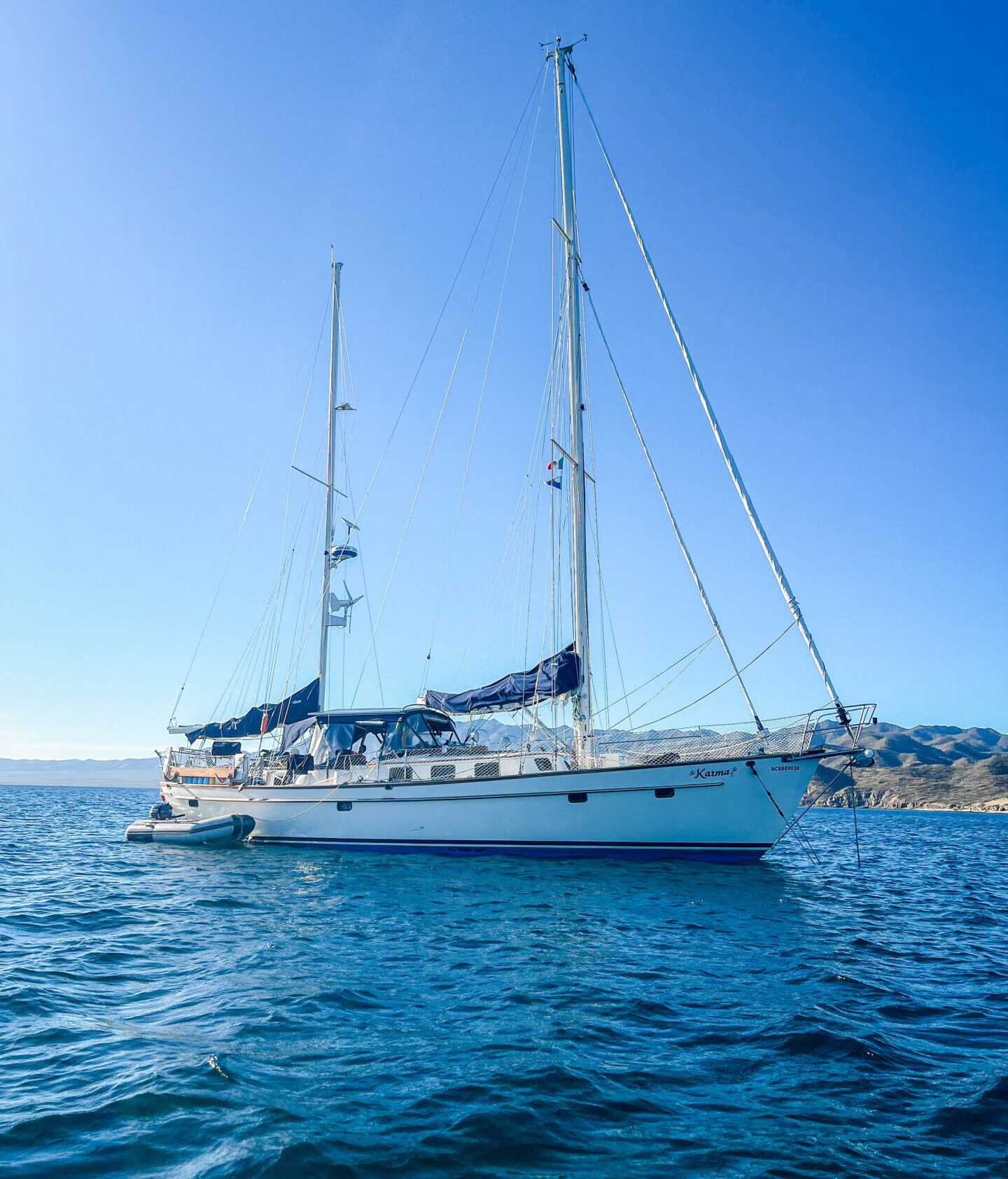
Brent Perry is tired of office life. He’s tired of the city. That’s why he and his family moved aboard Karma, a 1983 Sparkman & Stephens Sunward 48. Perry says, “I didn’t want to be 75 and say, ‘I wish I’d gone sailing.’”
Perry used to race and deliver sailboats professionally. But a career in boat building brought him inside, and for the last 15 years he’s worked adapting marine battery kits for commercial vessels. Now, he wants to breathe the sea air every day.
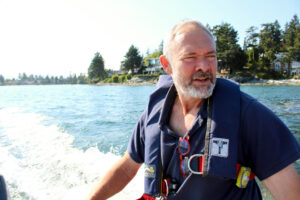 “I’m a ship builder. I’ve been building boats for a long time,” says Brent Perry. Before running his own companies, Perry worked for brands like Waterline Yachts and Grand Banks.
Karma had a working engine when he bought it—working is a stretch, but it turned on and the boat could move. Perry knew it would need a lot of work, but the dream was worth any effort. So, he limped it along for a while. The transmission was the first big problem. Perry’s son, Ryder, remembers it was either all go or full stop, “He had to keep pouring transmission fluid into it as he was going, which was a fun time to be alone.”
The only remedy was a complete rebuild of the old diesel engine. As Perry looked to save Karma, he remembered another dream he once had: sailing his own electric boat. He built plenty for the commercial market as CEO of Corvus Energy and Shift Clean Energy Solutions. When he first looked into his own hybrid back in 2009, however, the price wasn’t realistic and the dream took a backseat. But now?
“When I checked the price of a new engine and a new generator against the cost of an electric conversion, it was the same,” said Perry. Already having a reputation as the battery guy, he figured, “if I’m gonna do it, I would be kind of a hypocrite if I didn’t walk the walk and talk the talk.”
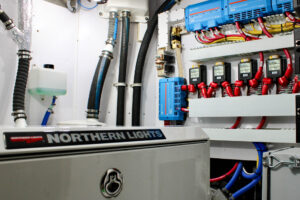 With a hybrid engine room, Perry was able to remove inches of lead sound-proofing from the walls. Even with the generator running, Karma hardly makes a peep.
POTENTIAL ENERGY
In 2006, Royal Huisman was supposedly building the first boat to run on lithium-iron-phosphate batteries. Supply companies wanted to know whether lithium had a future in marine tech, so 14 companies hired Perry to audit the build. He visited factories in Taiwan and China before finally inspecting the anticipated Ethereal.
It had a battery capacity of 400 kilowatts. When Perry finally saw the energy storage, he was shocked. “Don’t ever turn these on,” he told the owner. “They’re dangerous. Your boat will blow up.”
Ethereal did not achieve 400 kilowatts of storage with a purpose-built battery. Instead, Perry said, it was built using small electric scooter batteries. Perry remembers some 900 tied together in a mess of cables and wiring, “It was crazy.”
The build had problems. But the batteries had potential. After the financial crash of 2008, Perry considered the direction his career could take. Boat building was cyclical work, he thought. There would always be highs and lows, and he wanted consistency. Taking a leap of faith, Perry joined fellow Vancouver-based entrepreneurs in founding Corvus Energy.
Since few existing lithium battery manufacturers wanted to collaborate, Perry and his team built their own. Before they knew it, Perry said, Corvus was working with Siemens and became the only business selling operational lithium marine-batteries.
Still, the technology wasn’t widely accepted. Perry remembers speaking at industry events and watching roomfuls of potential clients brush him off: “I started talking about the environment and how we were going to save the world—and all I did was put people to sleep.”
Except for Scandlines, a German and Danish ferry company operating on the Baltic Sea and an early adopter of Corvus’s hybrid-electric designs. Once its team reported how well Corvus’s batteries performed, the industry caught on.
Perry remembers Scandlines representatives joining him at industry events. They didn’t talk about saving the world, they talked about all the money they were making while saving the world. Perry says they looked at the audience and told them, “I can be more competitive than all of you bidding for routes anywhere in the world. If you don’t do this, you’re gonna go out of business.”
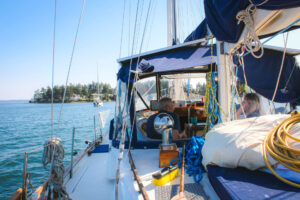 The Perrys live on Karma year-round now. The battery storage on board means luxuries like wifi, air conditioning and laundry don’t have to be sacrificed.
SHOCK PROOF
It’s been 15 years since Perry first sought an electric boat and now Karma is ready for open water.
Karma is 48 feet long with a 40-foot waterline. Before the Perrys bought it, Karma had already circumnavigated the world three times and been renamed once. It weighs 55,000 pounds, and now it is officially a hybrid electric yacht. After years of renovations and refits, done mostly by members of the family, Karma has kept its quiet elegance. Perry likes that, “It looks like a classic 1983 boat. It’s not a superyacht.”
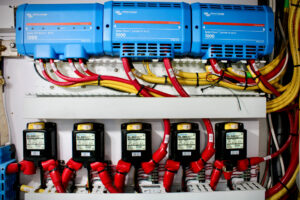
But it’s a facade. For all the stained wood and cosy décor on this liveaboard, Karma is a marvel of modern engineering. Popping the hood—crawling into the engine room—you’re transported into some kind of advanced laboratory. It’s clean. Everything is neatly arranged in sharp lines with glossy white and blue finish, complemented by shiny, reflective tubing running along the walls.
The room is arranged around a sleek, white chest, no bigger than an average drinks cooler that serves as the sound-enclosure for a Northern Lights 20-kilowatt diesel generator. On the wall above it is the 10-kilowatt inverter and across from that are four battery chargers directing power from the generator.
On the ceiling rest two large white batteries that give Karma 60 kWh of electricity—small devices like an iPhone only use about one kWh of electricity a year. At 12 volts, they offer 4,800 amps of power.
“If I have no wind and no solar,” says Perry, and without turning the generator on, “I have four days of running my boat like it’s a house—so, air conditioning, cooking. I’ve got a washer/dryer on board, all my plumbing and I don’t even have to worry about leaving a light on.”
As a diesel hybrid, Karma can go farther on a single tank than it ever could before. Fully electric, Perry says it can go 24 miles at seven knots and 50 at five. With the generator running, the 400 gallons of fuel on board will run Karma for 1,700 miles.
SILENT SEAS
 For its inaugural sail, the Perrys have taken Karma down to Mexico. “They’re footloose and fancy free,” says Silvie Votrubova, a friend and colleague. They might stay anywhere on the coast, then wind their way up to the Northwest Passage or continue south toward French Polynesia.
“The world is full of people to tell you how bad whatever you’re doing is not going to work. Always,” said Perry. “And so this trip will put that to bed.”
Back in Sidney, Perry started the motor and a subtle whirr joined the Pacific symphony. With a raised anchor, Karma was off. The interview continued as Perry manned the helm, and it took a good second before I noticed we were moving. There was no vibration or hum of a combustion engine. There was no guttural startup. The sails were down and yet all was quiet—save for the waves lapping against the bow and a barely-detectable whirr of the propellor.
“This hum—we’re going to do one more realignment.” Perry still wants it quieter. Along the cruise, the Perrys’ cat, T’Challa stepped out of the cabin below, quietly—but audibly—pacing on the deck.
Of course, the real test is happening along 2,000 kilometres of ocean to Mexico. At the time of writing, the Perrys’ journey is well underway. On October 1, the family shared they made it to California. The solar panels have helped Karma charge, and the motor’s e-assist while under sail has allowed for a conservative energy drain and smooth passage even during stormy seas. It’s exactly what Perry was hoping for, the chance to see what Karma can really do.
PUSH-TO-START
What started as a passion project is now the template for OSEA, Perry’s newest company selling hybrid engine packages based on Karma’s. It’s an exciting change of pace, says Perry. Instead of convincing commercial buyers that electric can help meet everyone’s bottom line, now Perry says he can meet the needs of real people.
“I think the future and survival of boating depend on making it an easier to use, better for the world solution,” said Perry.
Ironically, says Votrubova, “the place where (Perry’s) technology was born has actually been the slowest to adopt it.” Votrubova is director of marketing and communications for OSEA. She has worked with Perry for 14 years and the two have seen through the electrification of about 600 ships around the world—mostly outside of Canadian waters.
She says, “I think we just need to expose more people to the possibility of hybridizing a pleasure craft.”
OSEA has already sold two kits right at home in Vancouver. The kits arrive in a 10-foot container and come with every part needed to complete the installation, including an OSEA technician. Perry estimates once the container and technician are on site, the project will “go from raw boat to finished product in less than a month.”
HYBRIDIZATION ISN’T JUST about the noise or emissions. For Perry, it’s about making a system that’s ready at the push of a button, easy to maintain and can support the needs of daily life so users can spend more time on the water.
“It makes my life better every single minute I am out here,” says Perry. “I am going to take away as many excuses as I can for going out on the boat every weekend and convert you to an anti-office personality who never wants to go back.”
FIRST SPARK
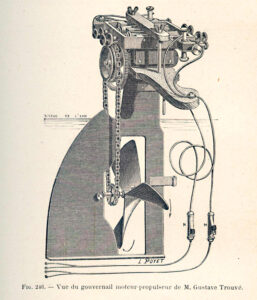 Gustave Trouvé electric outboard and boat.
A BRIEF HISTORY OF E-BOATING
Electric boats aren’t a new invention. During the late 1800s there were dozens silently drifting along the River Thames in England. At the time, electric propulsion emerged as a competitor to steam engines. Moritz Hermann Jacobi, a German physicist, has the honour of designing the first electric motor in 1834 and the first electric powered motorboat in 1839, funded by Tsar Nicholas I of Russia.
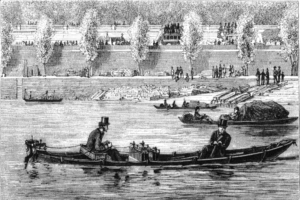 Gustave Trouvé electric outboard and boat.
Over the coming decades the battery and the marine motor faced a slew of upgrades. Propellers weren’t used at the time of Jacobi’s test run, so that boat was an electrified paddle-wheeler. In 1880, French electrical engineer Gustave Trouvé designed his own electric motor and tinkered with his patented device until in 1881 he had a rudder, motor and propeller system. The landmark invention combined each piece into one easily removable system—the world’s first outboard motor.
Trouvé’s design enjoyed some international acclaim. On racecourses his outboard shocked and amazed spectators—sometimes going as fast as seven miles per hour. In 1888 a Trouvé boat went to China to help suppress opium smuggling—the 49-foot steel-hulled vessel weighed 8 tons, and its propeller was 20 inches across.
There were at least 100 Trouvé boats made in 15 years, and its success spawned a host of electric companies manufacturing electric marine engines. The demise of the electric engine, along with any last hopes for steam, came with the hasty adoption of oil and gas, particularly due to the First World War. Electric couldn’t outpace gas at the filling station and diesel engines proved much more powerful. By 1930, hardly any interest remained in electric boats.