
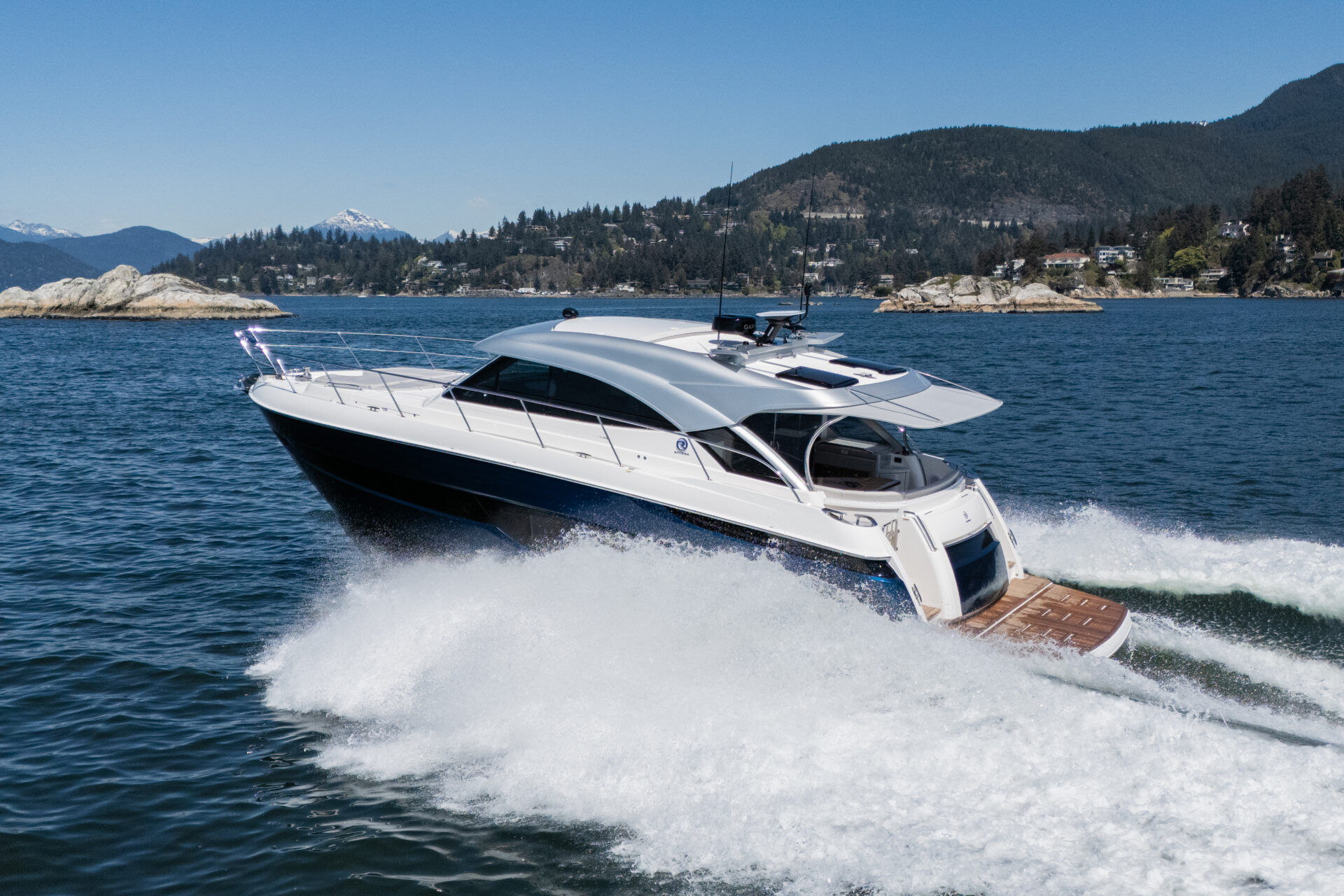

A 15 to 20-knot westerly had thrown up short, steep seas as we powered our way out past the Lion’s Gate Bridge. It was not the sort of day normally associated with luxury cruising. Between the chop and the ever-present driftwood, note-taking quickly became a challenge, however the conditions were ideal for evaluating some of the yacht’s key handling and stabilization systems.
The Riviera 4600 Sport Yacht combines contemporary styling with the rugged practicality that has become a hallmark of Australian boatbuilding. Founded in 1980, Riviera is Australia’s best-known luxury motor yacht manufacturer, with more than 6,300 yachts launched to date. The company’s reputation has been built on combining offshore capability, robust construction, the latest technology and modern accommodations.
With its sleek profile, expansive indoor-outdoor living spaces and three-cabin layout, the 4600 is aimed at owners seeking luxury coastal cruising without moving into flybridge-yacht territory. While it’s the smallest model in Riviera’s five-boat Sport Yacht series, it offers the space, amenities and offshore capability expected of a much larger yacht.
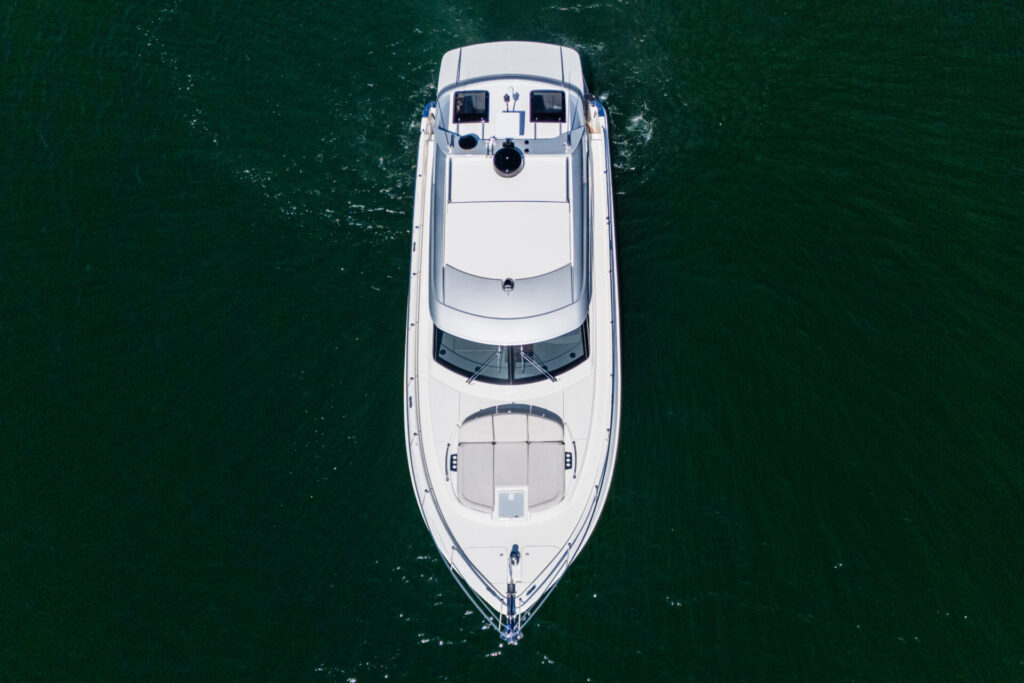
DESIGN AND CONSTRUCTION
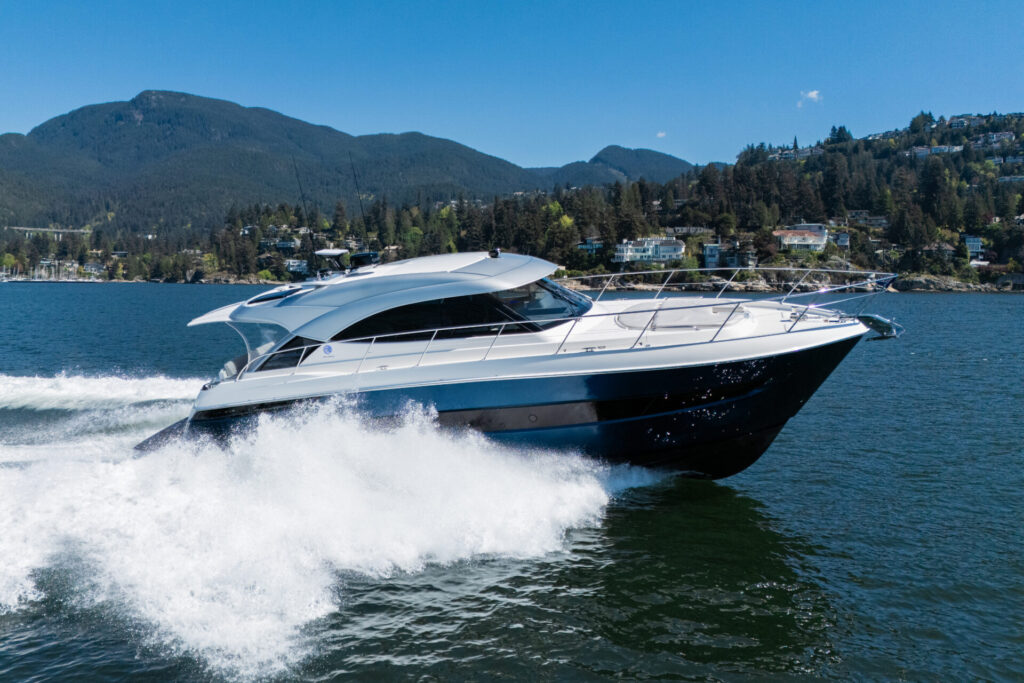
The 4600 Sport Yacht is characterized by its sleek profile, sculpted hardtop, striking deep-blue hull and its reverse transom. While its styling is contemporary, its construction philosophy remains intentionally conservative.
A solid fibreglass hull, substantial structural grid and offshore-oriented engineering underscore Riviera’s reputation for building boats capable of handling demanding sea conditions. Cored composite construction in the hull sides, deck and superstructure improves stiffness and efficiency without compromising strength, while a watertight collision bulkhead adds an extra measure of security.
At more than 19,200 kilograms (42,000 pounds) dry, the Riviera is no lightweight and its substantial displacement reflects the builder’s emphasis on robust construction and offshore capability.
ON DECK
The spacious cockpit is entered via a wide teak-laid hydraulic swim platform and a starboard-side transom door. A second transom door to port bypasses the cockpit and provides direct access to the side deck and bow.
The transom garage, complete with audio speakers, offers ample room for water toys and cruising gear, although not for a dinghy. Add a couple of folding chairs and the swim platform becomes a comfortable waterfront seating area.
The central feature of the cockpit is a fixed high-gloss teak-and-holly table that fronts a curvaceous L-shaped settee. Opposite is an outdoor galley complete with refrigerator, dedicated ice maker, sink and grill. Just aft is a secondary control station equipped with a joystick for docking duties.
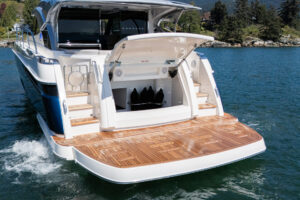 The swim platform doubles as a spacious waterfront patio.
The cockpit is protected by a hardtop and optional canvas extension, while two opening skylights provide additional light and ventilation. The test boat was equipped with removable Strataglass side panels and a screen panel aft, allowing the cockpit to be configured for weather protection, insect control or maximum ventilation depending on conditions. A hatch in the teak sole provides access to the engines.
The side decks are 25 centimetres (10 inches) wide, with raised bulwarks and substantial handrails that make moving forward secure and comfortable. While there is no dedicated cabin-side handrail, the lower edge of the cabin top serves the purpose nicely.
The bow is highlighted by a large circular three-section sunpad with adjustable backrests. The starboard bow locker not only houses the anchor chain but also provides an impressive amount of storage. The port-side locker contains washdown facilities along with controls for the windlass and anchor roller, all nicely laid out.
SALOON
The saloon is entered through a heavy smoked-glass sliding door. As with other Rivieras, a large, hinged glass bulkhead window lifts to connect the cockpit and interior into a single entertaining space.
The test boat featured a high-gloss oak finish that gave the interior a bright, contemporary feel. Large windows and soft neutral tones create an airy atmosphere, while the flat-black helm, solid-surface countertops, quality joinery and wide-plank vinyl flooring contribute to an elegant residential feel.
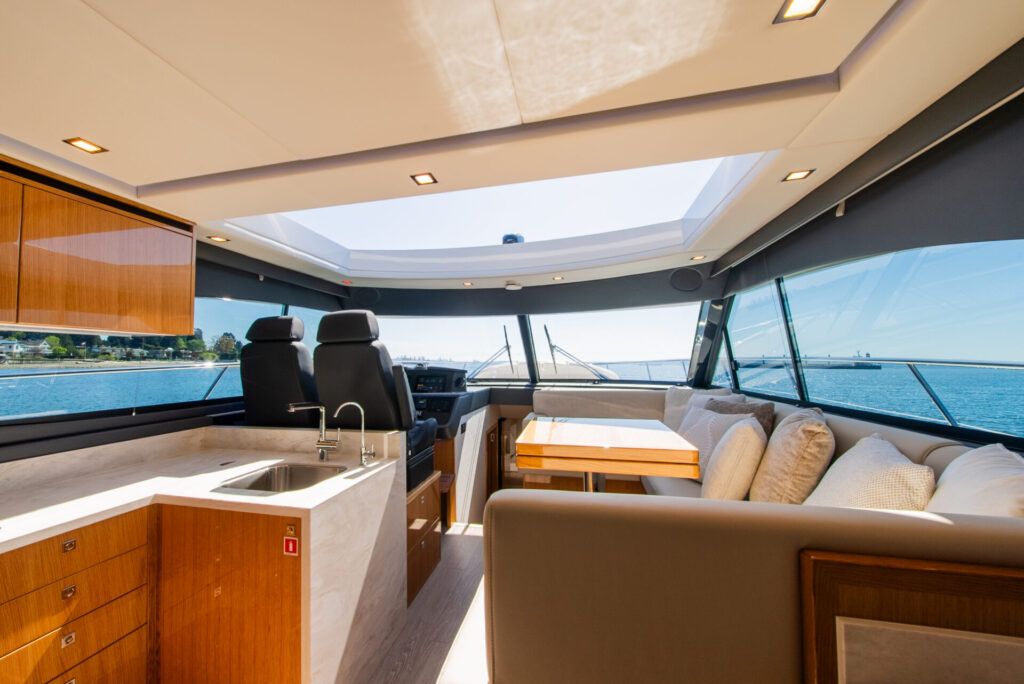 The waterfall galley is a standout feature of the open saloon.
The saloon is configured with a galley to port and twin leather helm seats opposite a raised U-shaped settee and folding-leaf table. Together with just over two metres (seven feet) of headroom, the arrangement creates an open living area that works equally well underway or at anchor.
The U-shaped galley is a particular highlight, thanks in large part to its waterfall-style countertops. The aft end opens directly to the hinged bulkhead window, making it easy to serve food and drinks into the cockpit. Equipment includes a sink with standard and filtered-water taps, a two-burner cooktop, combination microwave and convection oven, dishwasher, pull-out pantry shelving and abundant storage in drawers and overhead cabinets.
Across to starboard, separate refrigerator and freezer cabinets are integrated beneath the countertop, providing more usable volume than many drawer-style installations. The test boat was even supplied with Riviera-branded kitchenware, part of a package designed to allow owners to step aboard and begin cruising immediately.
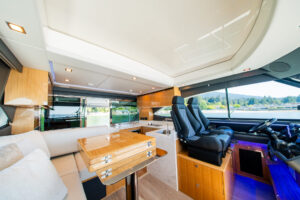 The port-side helm features premium fully adjustable Recaro leather seats. The dashboard is refreshingly uncluttered, dominated by twin 12-inch Garmin multifunction displays, Volvo engine instrumentation and a C-Zone vessel monitoring and control system.
Particularly useful are the Garmin controls mounted beside the helm. When conditions become too rough for touch-screen operation, physical buttons and knobs remain far easier to use. I also appreciated thoughtful details such as the backlit switches and labels illuminated in soft blue lighting.
A Starlink satellite communications system was included on the test boat, reflecting how quickly reliable offshore internet connectivity has moved from luxury to expectation.
To starboard of the helm, a 43-inch television rises from the cabinetry at the touch of a button, while overhead a massive sliding glass sunroof floods the saloon with natural light and fresh air.
The raised U-shaped dining area is well positioned for both dining and entertaining, with the added benefit of keeping guests close to the helmsperson while underway.
ACCOMMODATION
Below decks there is a respectable 1.93 metres (6’4”) of headroom throughout. High-gloss oak cabinetry continues throughout the accommodation spaces, while fabric-covered wall panels help absorb sound and contribute to the quiet, residential atmosphere. Like the branded kitchenware, the test boat was also supplied with a complete soft-furnishings package including towels, bathrobes, cushions and bedding.
The full-beam master stateroom is the standout accommodation space. The island berth is flanked by twin full-length dressers, complete with integrated laundry hampers, while large hull windows bring in abundant natural light.
Hanging lockers, side tables and additional cabinetry further enhance the room’s functionality.
A 32-inch television faces the berth, while the ensuite includes a separate shower with seat, raised sink and VacuFlush toilet. The overall impression is one of comfort, space and thoughtful design.
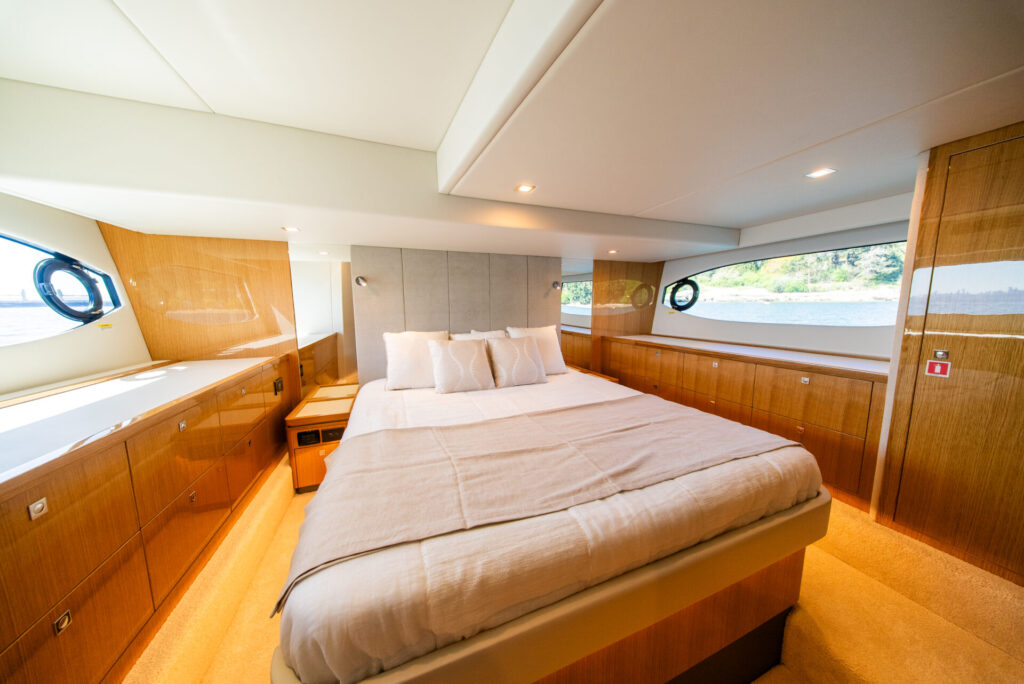 The bright, full-beam owners’ suite.
Forward, the VIP stateroom features a step-up island berth, dual hanging lockers, overhead cabinetry—known in Australia as pigeon lockers—and generous side shelving.
Hull windows and an overhead hatch bring in plenty of light, helping the space feel larger than its dimensions might suggest.
A door provides direct access to the day head and separate shower compartment shared with the guest cabin.
The inclusion of a third cabin with upper and lower berths distinguishes the 4600 from many sport yachts of similar size. The arrangement allows the yacht to comfortably accommodate larger families or visiting guests, making it particularly well suited to extended cruising.
A full-size washer and dryer tucked into the companionway further reinforce the yacht’s long-range cruising credentials.
SYSTEMS
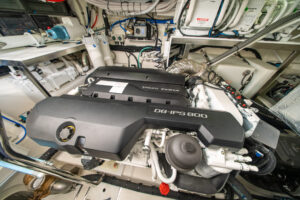 There is standing headroom at the base of the engine-room ladder, although the machinery space is necessarily compact given the amount of equipment installed. That’s unlikely to concern many owners, who are more apt to leave major servicing to trained technicians while using the space primarily for routine inspections and checks.
Power comes from twin 600-horsepower Volvo Penta D8 diesels coupled to IPS 800 pod drives. The test boat was also fitted with a Kohler 14 kW generator, 95 litre per hour (25 USG) watermaker, reverse-cycle air conditioning and an upgraded lithium-ion battery bank.
UNDERWAY
The Riviera’s Volvo Penta IPS package and Dynamic Positioning System quickly proved their worth after Freedom Marine broker Greg Andrew eased us out of an extremely tight berth at Coal Harbour Marina. Once in the fairway, the DPS held the yacht securely in position while fenders and docklines were retrieved.
There was some bow rise as the 4600 accelerated onto plane, partially blocking the view forward until the yacht settled. Once underway, the Humphree interceptor system continuously managed both pitch and roll, helping maintain a flatter running attitude and improving both visibility and comfort in the steep chop.
Complementing the Humphree system was a Seakeeper 6 gyro stabilizer. While the interceptors optimized the yacht’s running attitude, the Seakeeper noticeably reduced roll in the harsh beam seas encountered during our trial.
After evaluating the yacht in the rougher conditions outside the harbour, we returned to sheltered waters to complete the remainder of the performance testing. In calmer conditions, sound levels measured just 67 dB at seven knots. At a leisurely displacement speed of 9.2 knots and 1,400 rpm, fuel burn was approximately 38 litres (10 gallons) per hour—close to a mile per gallon. Once on a plane at 16.5 knots and 2,200 rpm, consumption increased to 140 lph (37 gph), rising to 178 lph (47 gph) at 21.5 knots and 2,500 rpm.
Wide-open throttle produced 30.3 knots at 3,020 rpm from the twin Volvo Penta IPS diesels.
Despite its substantial displacement, acceleration was impressive. Even at top speed, the yacht remained planted and comfortable, making it easy to underestimate how quickly we were moving.
Volvo’s Coordinated Turn system delivered smooth, predictable handling and helped the yacht carve confident turns without excessive heel.
CONCLUDING REMARKS
The Riviera 4600 Sport Yacht delivers more than impressive styling. It combines high-quality fit and finish with thoughtful accommodations, proven offshore capability and an extensive suite of modern technology.
The bright contemporary interior, three-cabin layout and abundance of owner-oriented features make it equally suited to entertaining at the dock or extended cruising along the coast.
For owners seeking a premium cruising yacht that blends luxury, practicality and offshore capability, the Riviera 4600 deserves serious consideration. Price as tested: $2,995,900.
LOA 15.31 m / 50′ 3″
Hull 13.16 m / 43′ 2″
Beam 4.7 m / 15′ 5″
Weight (Dry) 19,200 kg / 42,329 lbs
Fuel 2,100 L / 555 USG
Water 620 L / 164 USG
Holding 151 L / 40 USG
Std Pwr Twin Volvo Penta 600 hp D8 IPS 800 diesels
Sold in Western Canada by
Freedom Marine, Vancouver and Sidney
604-609-0985