

Finding a new dinghy can be daunting. There are plenty of things to consider, including size, design, construction materials, propulsion and brand.
The options are almost endless, and asking other boaters for advice will likely produce just as many opinions. So where should you start?
Start with size. Most tenders range from eight to 12 feet long. A good starting point is a dinghy slightly shorter than the beam of your main boat.
Anything larger can be difficult to carry on deck or store on davits. Anything smaller may compromise performance or carrying capacity.
If you plan to store the dinghy on the foredeck, consider the available space. Think about what you’ll be carrying, too, whether that’s passengers, crab pots or other gear.
Choosing a length is the easy part. The following guide breaks down the different dinghy types, along with their advantages, disadvantages and approximate costs.
Inflatables

Inflatables are popular for their safety and stability. However, choosing one often means balancing portability against performance.
Modern materials, high-pressure tubes and improved floor designs have helped narrow that gap.
Inflatables are difficult to sink or capsize thanks to their buoyant, compartmentalized tubes. This makes them popular with cruisers, divers, search-and-rescue crews and military operators.
Their biggest drawback is rowing. The tubes make it difficult to get good leverage, so an outboard motor is often a worthwhile investment.
The floor and hull construction have the biggest influence on performance. A rigid, V-shaped hull generally handles better than a soft, flat-bottomed design.
It will cut through chop, get on plane more easily and track better through turns. The trade-off is added weight and reduced portability.
Soft Sterns

Soft sterns are the simplest and smallest inflatable tenders.
They’re affordable, easy to assemble and suitable for one or two people. Their compact size also makes them ideal for boats where storage space is limited.
Some modern packrafts are surprisingly capable, but most soft sterns are best suited to protected waters. They struggle in chop, cannot plane and lack a transom for mounting an outboard.
Their main advantage is simplicity.
Approximate prices:
-
Basic soft stern or quality inflatable kayak: under $1,000.
-
Quality packraft: around $1,500.
-
Be cautious of models under $500, as durability may be questionable.
Roll-Ups
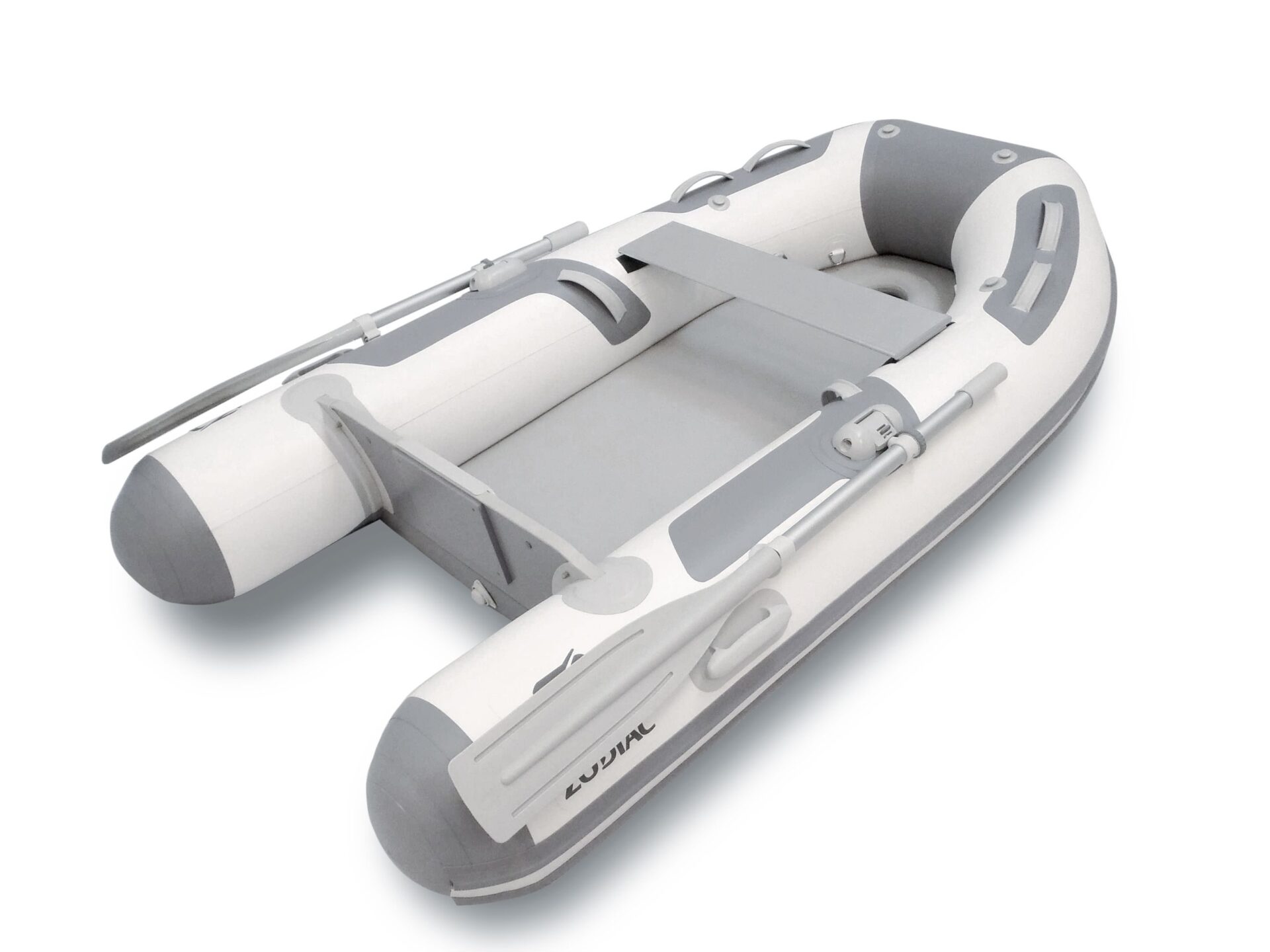
Roll-up dinghies offer a little more capability while remaining easy to store.
They have inflatable floors rather than removable floorboards. Simply unroll, inflate and launch.
Their lightweight construction and flat bottoms make them easy to handle, but they tend to be sluggish and cannot plane.
Unlike soft sterns, roll-ups have a transom and can accommodate an outboard of up to four horsepower.
They’re a good option for owners of smaller boats who value affordability and portability over speed.
Approximate price: $1,000–$2,000.
Soft-Bottomed Sport Boats

Soft-bottomed sport boats offer a significant performance improvement over soft sterns and roll-ups.
They feature rigid floor systems made from plywood, plastic, aluminum or high-pressure inflatable panels. The added stiffness allows manufacturers to incorporate inflatable keels and shallow V-shaped hulls.
These boats can accommodate outboards of up to approximately 20 horsepower.
The downside is weight and setup time. They’re more complicated to assemble than roll-ups and aren’t ideal for frequent inflation and deflation.
If left inflated, they should be covered to protect against UV damage.
These boats are particularly appealing to sailors who have some deck or davit space but still want the option of deflating and storing their tender.
Choosing a floor system
There are four common options:
-
Plywood: The least expensive, averaging around $2,000 for a 10-foot boat. It looks good but requires maintenance and can deteriorate with prolonged exposure.
-
Plastic: Easier to install and requires little maintenance. Typically costs $300–$500 more than comparable plywood models.
-
Aluminum: Durable and relatively easy to maintain, but slightly heavier. A 10-foot model weighs approximately 59 kilograms (130 pounds).
-
High-pressure air floor: Offers an excellent balance of weight and performance. These floors inflate to around 19 psi, eliminating removable floorboards while providing good rigidity.
High-pressure air-floor boats can be 13–18 kilograms (30–40 pounds) lighter than comparable rigid-floor models.
Approximate prices: $2,500–$4,000 for high-pressure sport boats.
Rigid Inflatable Boats (RIBs)

RIBs are the top performers in the yacht tender category.
They combine a rigid aluminum or fibreglass hull with inflatable tubes around the sides and bow. The result is the handling and speed of a traditional hard dinghy with the buoyancy and stability of an inflatable.
Their main disadvantages are weight, bulk, poor rowing performance and cost.
Unlike other inflatables, RIBs cannot be collapsed beyond the size of their rigid hull. This makes them better suited to powerboats with ample deck space or davits.
A folding transom is one option for owners with limited storage height.
Hull materials
Fibreglass RIBs are generally more affordable and widely available.
Aluminum hulls are more durable and can weigh up to 25 per cent less. Some newer ultralight models weigh less than 100 pounds for a 10-foot boat.
A lighter dinghy also requires less horsepower to get on plane.
RIBs are available with single V-shaped hulls or double-hull designs with flat floors. Flat floors provide additional room for passengers and equipment without increasing the waterline.
Approximate prices: $3,000–$30,000, depending on size, construction and equipment.
Final Thoughts

Choosing the right inflatable comes down to matching its construction and features to your boating needs.
Check the construction. Inspect the seams, joints and glued sections carefully. Look for bubbling, separation or poorly finished areas. Small problems can become expensive repairs.
Consider where you’ll use it. If you regularly beach your dinghy, look for additional protection. RIBs with aluminum or fibreglass hulls offer the best protection, but some soft-bottomed inflatables feature rub strakes along the tubes, keel and underside.
These can help prevent damage from rocks, barnacles and rough shorelines.
Remember that no dinghy is indestructible. Aluminum can dent, fibreglass can crack and inflatable tubes can puncture.
Think about rowing. If you expect to row regularly, make sure the oars are long enough and the oarlocks are sturdy. The supplied oars on many inflatables are too short, so look for something longer than seven feet.
Even if you primarily use an outboard, always carry oars as a backup.