
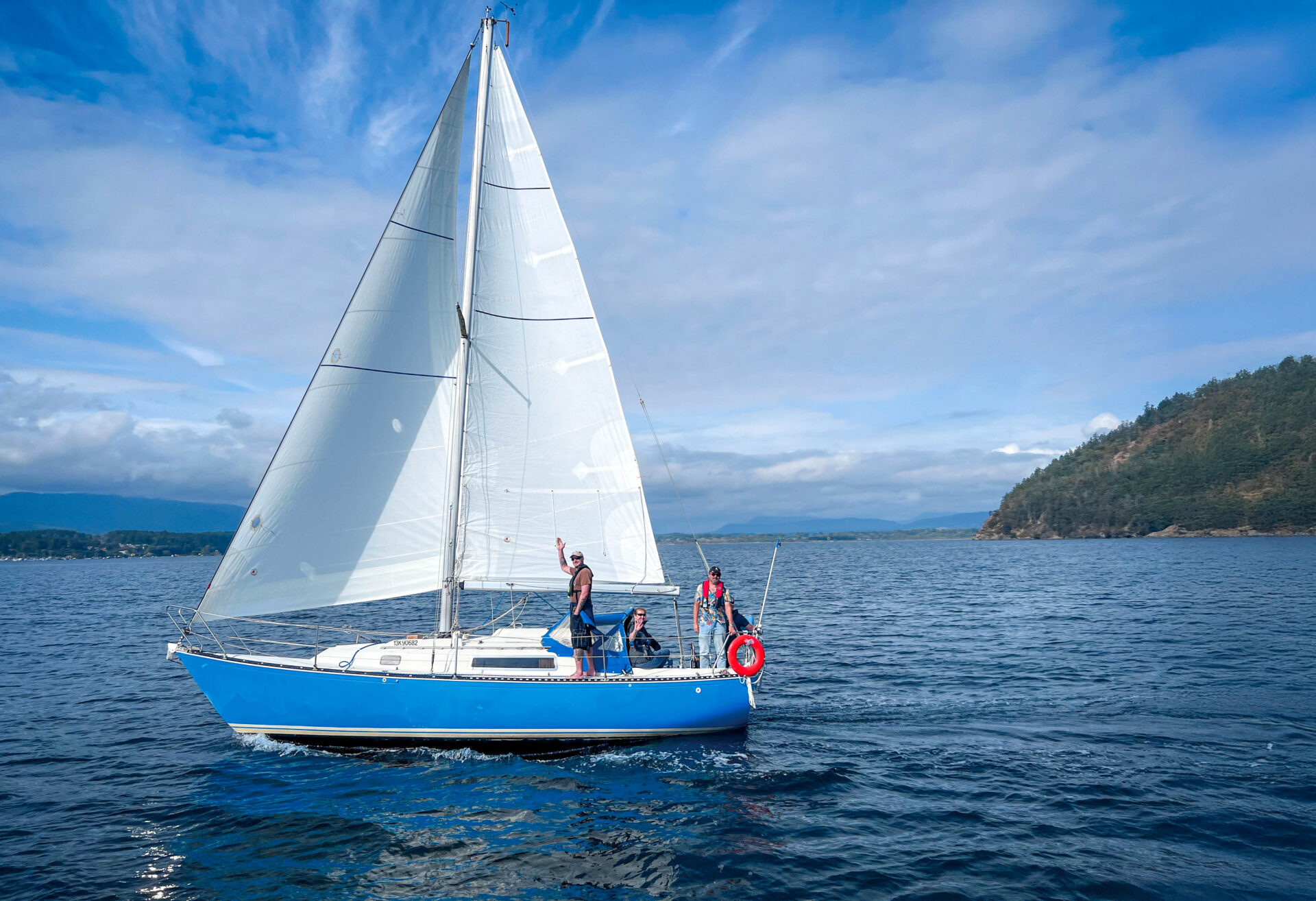

A group of Vancouver Island boaters have banded together to reduce the costs of boating. It started with a dock walk in 2018. Mariner Doug Johnson was antsy; he wanted another boat. He’d retired his sailing charter business and for the first time in over 60 years was without a vessel of any kind. The trouble was the cost of owning a boat was becoming prohibitive. While out walking the docks in Maple Bay, though, inspiration struck: why not form a society and share a boat? He called up two seafaring friends, and the Warm Land Sailing Association was born.
SHARING THE EXPENSES of ownership helps solve the cost-versus-us age conundrum that plagues many boaters. It can be difficult to justify the costs of sole ownership when you can’t get off the dock as often as you’d like.
The group functions as a not-for-profit society. This model sees money come from members, not fundraising. Financials are straight-forward this way. Dave, WLSA treasurer says, “Being in the association is meant to be economical. The club strives for this.”
Individuals own equal shares in the association rather than shares in the boat. Membership fees and monthly dues are then based on the purchase price of each boat and running costs: taxes, maintenance, commercial insurance, moorage, etc.
 WLSA’s first powerboat, Grand Adventure, is a 36-foot Grand Mariner.
PRESIDENT CEARA AND her husband said they’d been searching for their first boat. “We never imagined we’d be co-owners of a 36-foot Grand Mariner. Cost-sharing has been a really good way to go; we can still enjoy other kinds of holidays without feeling the pressure of maximizing our boat usage.”
The couple also appreciates that the boat is moored in Maple Bay, with access to “some of the most fantastic boating on the coast.” The bulk of Warm Land’s members live on Vancouver Island with others in Prince George, the Lower Mainland, Salt Spring Island, Prince George, Alberta, even Denver, Colorado and Portland, Oregon.
The three original members divvied up tasks according to their skills and put a call out for interested parties to join. Using personal networks, a Craigslist post and a new website, they received enough applications that a waitlist was warranted. “A waitlist is important,” says Dave. “Members move away, pass away, age out with health problems or physical limitations or just lose interest.” The club needs to stay viable.
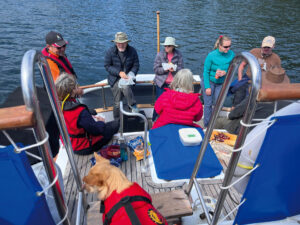 Club outings are a chance to socialize with friends and get to know new members.
Secretary Mike says, “Under this model, all members have an equal vote in the direction and operation of the association. If a member leaves, they’re welcome to sell their share or have the WLSA sell it on their behalf. Either way, members have typically reimbursed their costs.” He adds that “if the WLSA were to disband, total assets would be divided equally among current members of each division.”
THE WARM LAND Sailing Association is a sound entity with its own set of bylaws and established roles for members. A board of directors even invests extra funds in short-term Guaranteed Investment Certificates. The association pays close attention to the state of each boat so members always have a reliable vessel at the dock. There are detailed maintenance schedules and tracking-sheets for usage. Members can also access information including how to start the engines, location of insurance papers, processes for reimbursement and so on. Members come and go, so making the boats accessible is vital.
Member David says, “My motivation for buying in was having annual running costs and operational expenses defrayed.” He says that joining still has “small inconveniences, such as not being able to leave personal belongings on board,” but he also feels that the cost to buy in gives the members a sense of “ownership” that translates into caring about the boat personally.
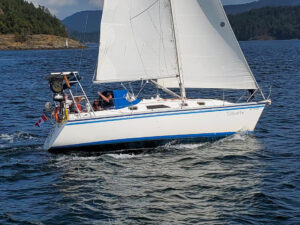 Kikatla, a 31-foot Hunter was the second boat to join the sailing division.
TEN MEMBERS WAS enough to buy the first boat in the sailing division, a 30-foot C&C called Blue Belle. With each additional vessel purchased, membership shares are offered up. The sailing division now has a second boat, a 31-foot Hunter, Kitkatla, and 20 members. A power division was added later with a 36-foot Grand Mariner, Grand Adventure, added to the fleet. The power division has 12 members, but with a growing waitlist, the purchase of a second power boat is being considered.
Those inquiring about membership are given an opportunity to view and inspect club vessels. The club needs to ensure that each person is fully informed of its policies as well as the rights, privileges, responsibilities and costs of a membership. The membership process begins by filling out an application and sending in a boating resume with proof of a Pleasure Craft Operator Card. This card is mandatory and additional certification is highly valued. Senior members of the association vet backgrounds and experience.
New members can checkout boats in one or two-hour intervals in local waters. These are friendly and informative jaunts, allowing the directors to confirm that the member has the knowledge and skill level to safely operate the vessel. It also allows the member to get a feel for the boat in the division they’ve joined (there are two members who belong to both divisions). Any member who wishes to operate a boat must become a “club-qualified skipper,” which keeps everyone happy, including the insurer. Club-qualified skippers can reserve vessels for their exclusive use using the WLSA’s online booking system.
The club does not provide boating instruction but can refer beginner boaters to training facilitators. That said, experienced club members will often assist new members with the various onboard systems as well as handling the boat in tight quarters.
“I appreciated that an experienced member offered his time to help me,” says David. “The Grand Mariner was larger than what I was used to. We had a small issue once while we were out for a cruise and fixing it gave me a greater understanding of the boat’s systems.”
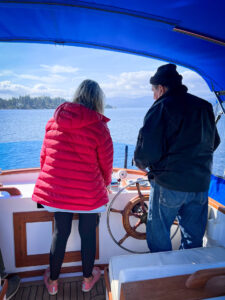 As in any not-for-profit group, volunteering in the Warm Land Sailing Association is encouraged: it helps keep costs down and strengthens the community and mission of the club. Members can contribute in many ways. “We like to help during haul-outs, scraping and painting,” says president Ceara. “Tim and I both feel that it’s a way to give back, aside from helping the club economically. And since we can do the physical work, we do.”
Treasurer Dave says when it comes to volunteers, “individual strengths of members create a strong synergism.” In other words, when the group is working toward common goals, it’s smooth sailing. Dave adds that some members cannot volunteer due to disabilities or location, or they do not want to and contribute extra monthly cash on their own initiative in lieu.
DOUG SAYS THE club has exceeded expectations, “I didn’t imagine this kind of expansion; I was really just thinking of a good boat and about 10 of my friends, that kind of thing. But look at it now, 31 members!” He added the club also hosts outings for members who like to socialize. “My favourite get-together is the annual cruise down to Deep Bay with all three boats. We have burgers, soups, desserts and we tell stories and swap lies. There’s lots of boating stories at that event—we’ve all got plenty.”