
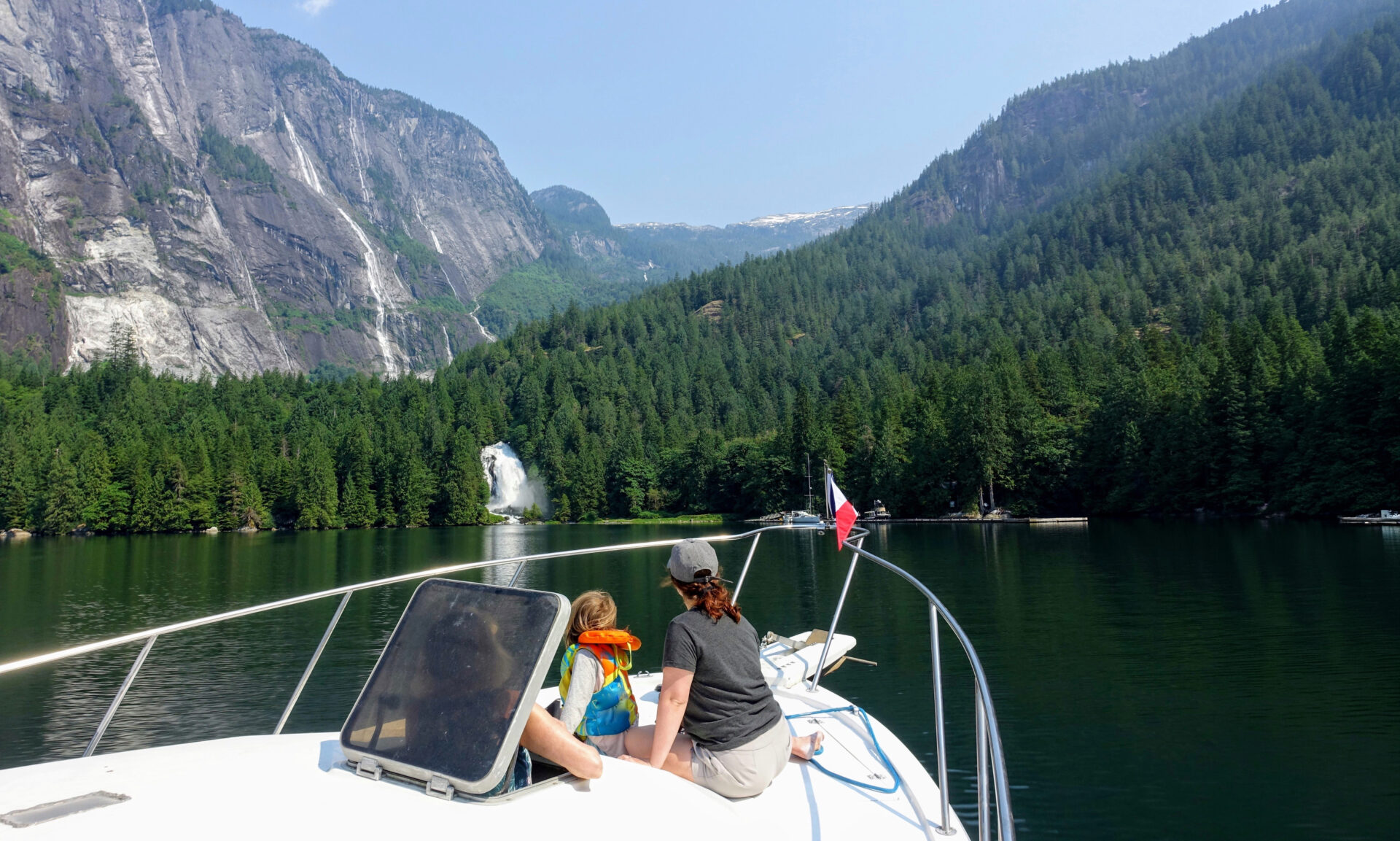

“I’m sitting up on the deck of my boat and I’m looking at waterfalls. There’s mergansers going by with chicks on their backs. There’s a bunch of geese standing on the dock,” said Jim Phillips. He’s the president of the BC Marine Parks Forever Society (BCMPFS), an arm of the Council of B.C. Yacht Clubs. From the tranquility of Princess Louisa Inlet, he answered my call to talk about the state of marine parks in BC.
SHOULDER TO SHOULDER AT THE DOCKS
For residents of BC’s coast, the waterfront isn’t just a part of the scenery. A 2024 survey by Fisheries and Oceans Canada found that 67 percent of the coastal community regularly seeks out the ocean for leisure and 16 percent depend on it for work.
With hundreds of thousands of boaters in BC, the coast gets a lot of love. That’s why marine parks are so important: to keep the West Coast wild and to allow access for present and future generations. A park offers a safe space for people to interact with the coast while protecting it from overuse. There are washrooms and sometimes pump-out facilities, mooring buoys, dinghy docks, boardwalks, fences and diligent stewards to preserve these delicate, natural havens.
But running a park is expensive and creating one even more so. With a growing population on and off the water, some people see the parks system as overburdened. On a trail in Princess Louisa Marine Park, Phillips spoke with a local ranger: “They’re concerned that if they get more boaters, if they get too many customers, they aren’t able to serve them properly because they don’t have the resources.”
If parks can’t support the number of people using them, something will break. Parks could be closed, like Cabbage Island, which closed to manage the eroding coastline. More people will be forced to overnight outside of mooring sites, meaning more anchors to potentially stir up sensitive eelgrass zones.
“We need to be proactive. In my view we need to establish new key parks and protected areas,” said Phillips. “It can be anything from a class A marine park through a couple variations on conservancies to a protected area to a recreational reserve. These are all categories that could be useful, but the idea is: yes, we should have more.”
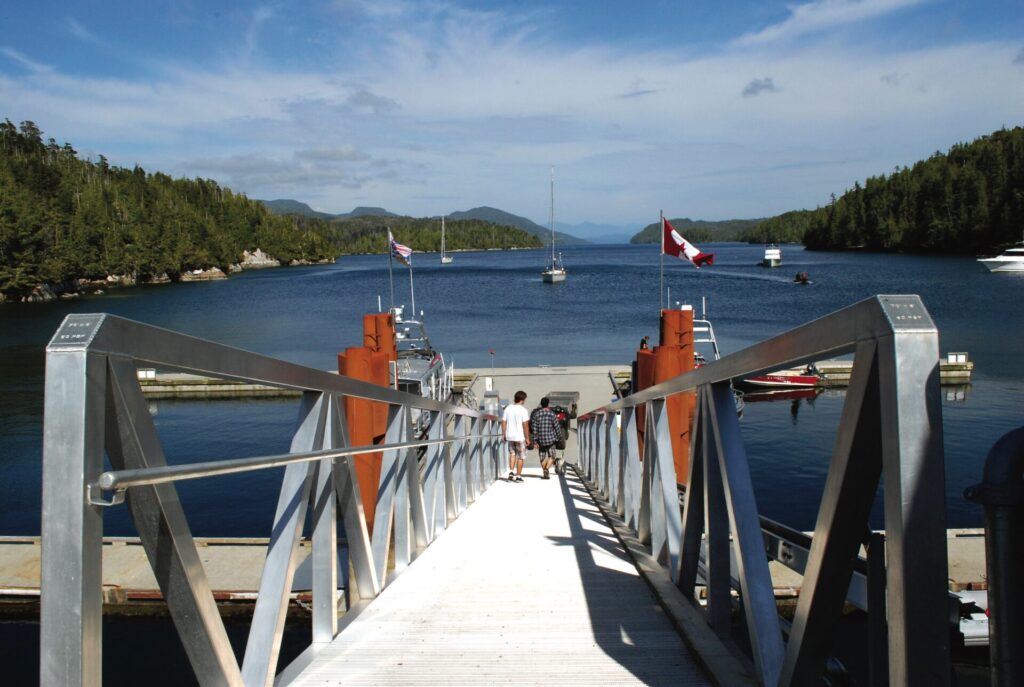 The Hakai Institute on Calvert Island offers a friendly stopping point for travellers preparing to cross Queen Charlotte Sound.
100 BOAT HAVENS
The current network of marine parks traces its roots back 100 years to Strathcona Provincial Park. While it was not founded for the explicit use of boaters, Minister Price Ellison’s 1911 designation of Strathcona Park marked the first example of marine protections in BC. Since then, the parks system has been shaped by countless hands devoted to sharing the province’s beauty with travellers near and far.
One of the earliest de facto marine parks in BC was Princess Louisa Inlet. It was purchased in 1927 by James “Mac” Macdonald after he earned a fortune prospecting in Nevada. “This beautiful, peaceful haven should never belong to one individual,” Macdonald said. “I have felt that I was only the custodian of the property for Nature and it has been my duty to extend every courtesy.”
Macdonald hosted countless visitors over the years, happy to share this piece of paradise he called home. In 1953, he turned the land over to “the yachtsmen of the Northwest” through a non-profit, the Princess Louisa International Society. In 1964, the land was donated again to the BC government as a provincial park. Macdonald’s last visit to the park was in 1972. In recent years, groups like the BCMPFS continue the work of expanding the marine park network with practical upgrades and land acquisitions. One of the more prominent projects of the last 30 years was the Council of B.C. Yacht Clubs’s goal to document “Boat Havens” around the province—places where boaters could find safety in a storm.
“These are what we considered important anchorages—some of them for safety, because these are relatively small boats, and on this coast you need to be able to get out of the weather every now and again,” said Phillips. “That became the basis for many of the parks that have been established over the last 20, 30 years.”
The project identified 126 havens up and down the coast. Not all of them have become official parks—some even host commercial activity—but all of them represent safe places to hole up and wait out a storm or call for help. While this is a helpful resource for boaters, it doesn’t totally solve the problem. So why aren’t there more parks?
CHALLENGES
Creating a park isn’t as easy as waving a pen and calling it a day. Even when advocates purchase suitable park land, there’s only so much they can do before the process is muddled with government bureaucracy—the tar pit where momentum dies.
“The time frame is very elastic. There are islands that we have bought and formally handed over to BC Parks or the BC government—and this was done maybe 15 years ago—and they’re still in the hands of the government waiting to be legislated as a park,” said Phillips.
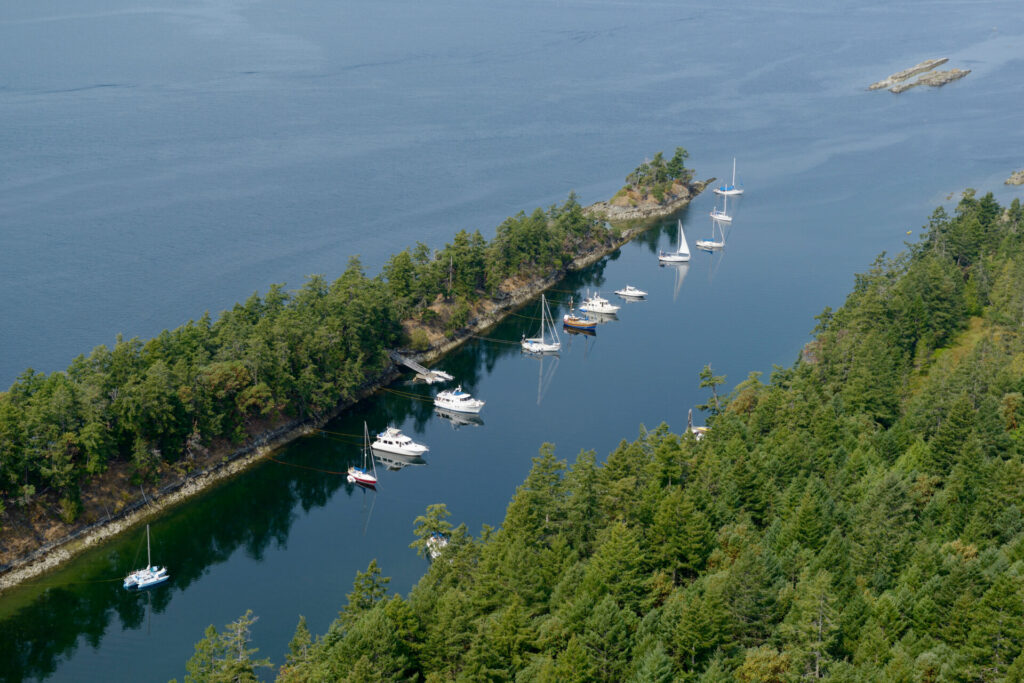 At Wallace Island, BCMPFS has funded 18 stern tie pins within reach of the waterline.
BCMPFS has contributed $2.6 million to acquire new land for boaters on the West Coast. Its most recent acquisition is Elworthy Island, an undeveloped island in Waddington Channel off West Redonda Island.
In a letter to the Minister of Water, Land and Resource Stewardship Randene Neill, Phillips said: “Coastal forests, bird nesting sites and a healthy shoreline ecosystem would all be preserved for future generations. The island provides a natural sheltered anchorage for small boats. If protected, BCMPFS would welcome the opportunity to support and fund the installation of shore ties or mooring buoys to further protect the shoreline.”
Like with many projects BCMPFS puts forth, the discussion is ongoing. PY reached out to BC Parks for comment. In a standard reply, the Ministry of Environment and Parks said designating a park takes time and money—a difficult balance with a $2 million annual budget. Creating or expanding a park “requires working closely with First Nations, stakeholders and the public to consider the impacts and benefits of any such proposal prior to a decision.”
THE HAKAI EXAMPLE
 But there is more than one way to make a park. Eric Peterson is the founder of the Tula Foundation and Hakai Institute operating on Calvert Island. What started as an endeavour into conservation science has evolved into a base of operations for science, stewardship and tourism on the Central Coast.
“I like the idea of a healthy working landscape,” said Peterson. “I’ve boated to Alaska, boated around Haida Gwaii, boated around Vancouver Island and have really celebrated that landscape. I think it’s absolutely an important one to take care of, to keep track of and not abuse, but I’m not one who thinks the area should be entirely protected from human interaction.”
As a research centre, Hakai has published hundreds of papers across biodiversity genomics, nearshore ecology, watersheds and more. But they have another job that’s just as important: being the lone rest stop on a long, maritime highway. “It’s a year-round responsibility,” said Peterson. “I honestly feel that that’s what motivates me. I love the coast, love the idea of parks.”
To fulfill that role, Hakai’s invested into the island’s infrastructure. There are pit toilets, a trail system with boardwalks and a well-maintained protected dock. It’s a big responsibility, caring for the land while also tending to visitors, says Peterson. “People come in and have heart attacks. They might have had that same heart attack walking down the street in Vancouver, but they would have had a paramedic right there. We have to figure out how we handle those kinds of emergencies.”
THE FINAL INSPECTION
When Peterson first bought the land on Calvert Island he saw the whole area through rosy glasses. He didn’t actually know what the institute would study, but he knew the island was teeming with potential. Then he got the bad news.
They needed to dig a trench for a fuel line to the dock. In preparation, he learned the area was a registered archaeology site—something he might have known if he waited more than two weeks to buy the property. This meant expenses, red tape and every developer’s favourite word: delays.
Peterson was worried. But a friend told him, “relax. It’s gonna turn out to be a good thing. Just get hooked up with the right people and—trust me—it’ll turn out fine.”
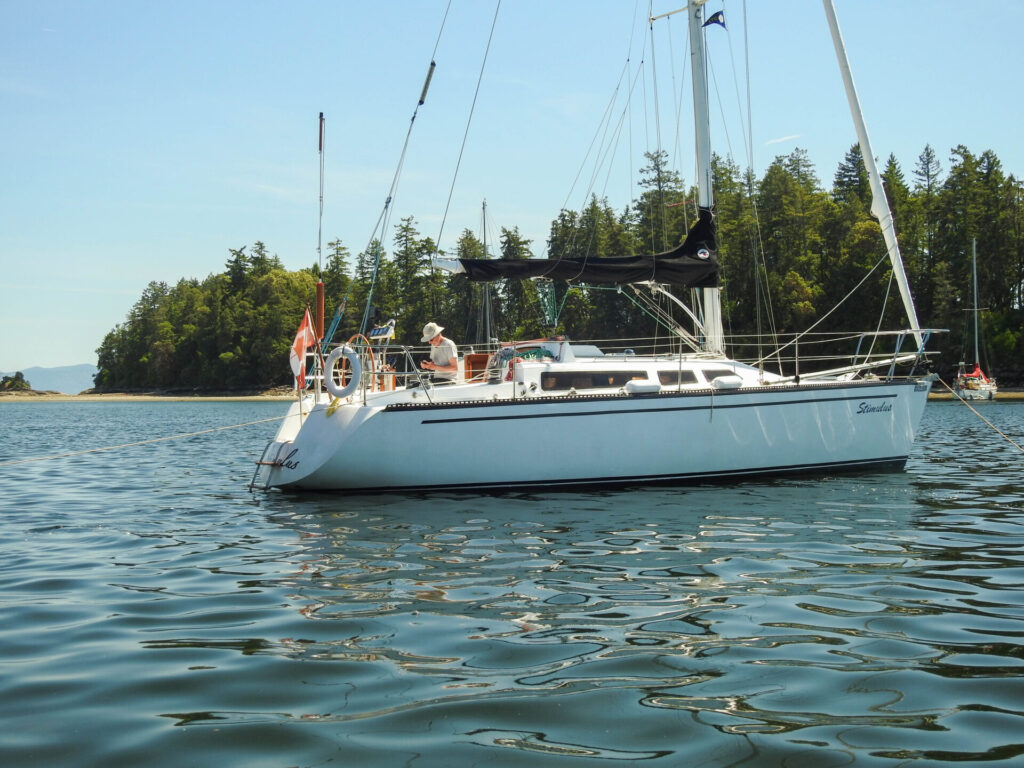 Bute Island in the CVRD is a great example of how municipalities can step up to expand the marine park network outside of provincial parks.
And it did. The archaeologists and experts from Haida Gwaii all turned into lifelong friends. They didn’t find anything in the trench, so the fuel line went in fine. “Meanwhile,” said Peterson, “the three of them got in canoes and went all over the place around the site. And they’d come back to me every evening and they’d say, ‘Do you have any idea of the opportunities for archaeology there are at this place?’”
Long story short, the archaeology site at Hakai has turned up some of the biggest headlines for the institution. Peterson says, “the number one thing that people ask me when they come is about the archaeological history of the place. ‘Where are the human footprints that are 13,000 years old?’ ‘Where’s the Island where we’ve got 14.5-thousand-year-old settlements?’”
Peterson won’t say. That’s part of the deal as a scientist and steward: you don’t tell tourists where to dig for treasure, lest they bring a shovel. But that doesn’t seem to ruin the excitement.
In the end, the important history on Calvert Island became one of its greatest assets. And it forced Peterson to connect with his neighbours—“That’s really been a door opener to engage in partnerships with First Nations,” he said. “They’ve been doing significant things on that landscape for tens of thousands of years. The science that confirms what they knew all along is great.”
It’s an important lesson for any organization hoping to form a park. While certain red tape or archaeological testing may delay a project or launch a debate around the ethicality of a park’s placement, it may also lead to the next great hotspot for science and tourism.
WHAT NOW?
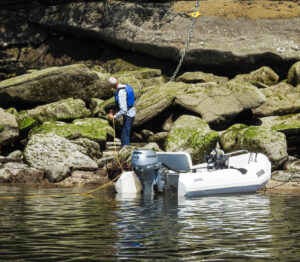 BCMPFS has installed 186 stern tie pins on the coast, including eight here on Bute Island near Ladysmith.
While the marine parks network is being expanded, the work is slow. Some sites may never see a flood of tourists, and with a culture of closed-door discussions the public may never know why. But there are more ways to create a park, and there are more parks than the South Coast alone can offer.
Cowichan Valley Regional District created a municipal marine park in 2018 on Bute Island. BCMPFS funded stern ties for it in 2023 and now it’s a fully functional park. BCMPFS continues to expand its stern tie program, making more parks along the coast accessible for more people. The organization is also working constantly to improve boating amenities, such as advocating for a better pump-out network in BC.
If you’re really sick of the crowds, Peterson says to come north. “At least up to the Broughtons. You’re going to find it an awful lot more interesting. If you know how to read a nautical chart, you can always find a place to anchor,” he said. “For safety, I welcome a little bit more traffic. Sometimes you’re out there in the middle of winter and you’re saying, ‘Oh boy, if something goes wrong out here, I’ve got no help at all.’”
The best way for boaters to help is to get involved. Donate to the BCMPFS, BC Parks Foundation or BC Marine Trails. Write letters to your MLA or city councillors. And maybe most importantly, be an exemplary park user. It’s hard to spend money on new parks when existing parks need extra maintenance or repair from visitors not following the signs and potentially damaging sensitive areas. Whatever you do, don’t be dissuaded from enjoying the coast.