
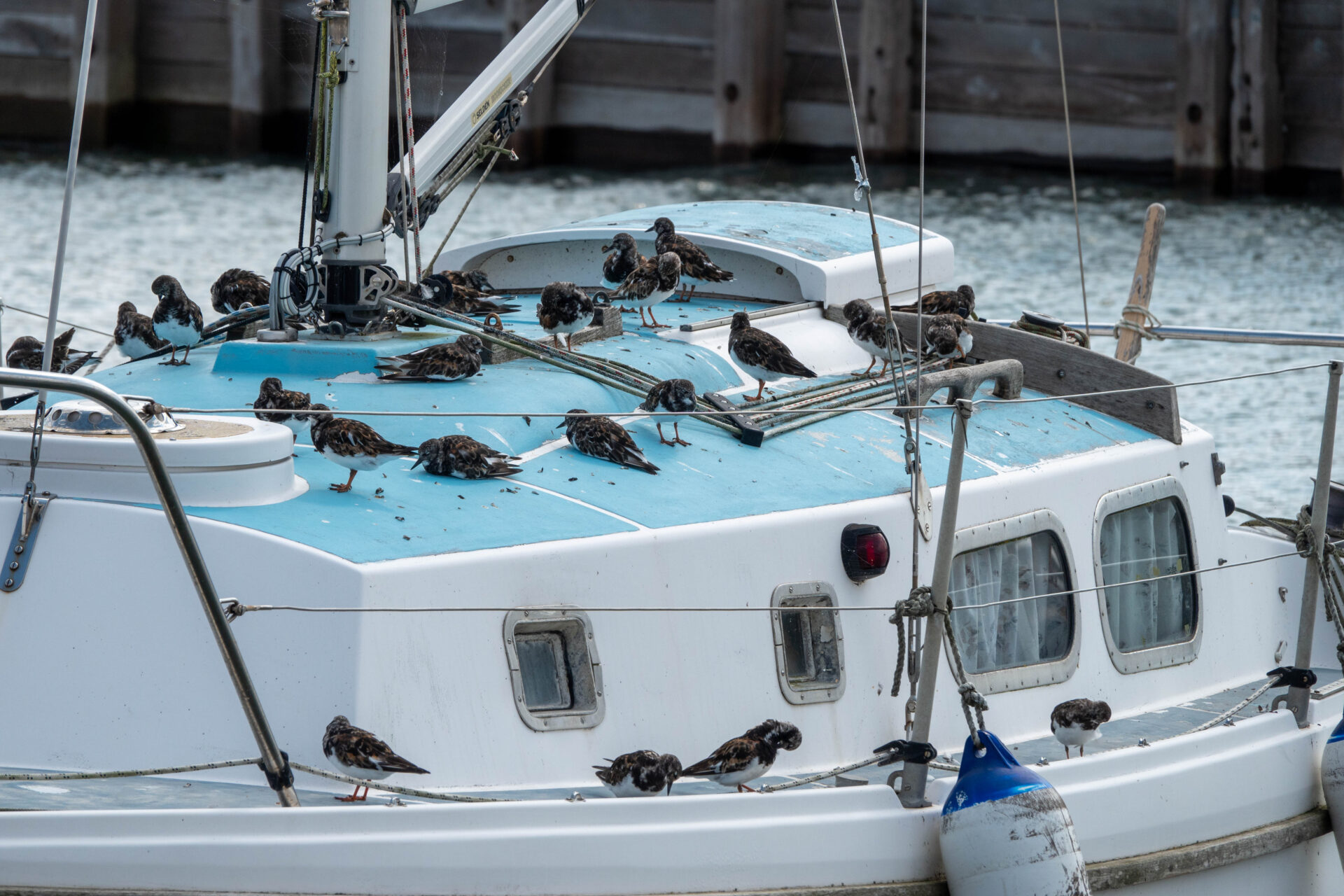

TURNSTONES
Black turnstones are small, pretty birds commonly found in the intertidal zone where they probe for invertebrates, fish, limpets and birds’ eggs. Black above and white below with dark legs and a dark, slightly upturned bill, they’re usually found in small flocks. When taking flight they show striking black-and-white patterned wings, which is one of their best field marks.
Black turnstone chicks are quick developers. Within days of hatching they begin foraging for themselves. They fledge fully and fly in 30 days.
On our wet, coastal rocks they blend wonderfully into the scenery. Often, when approaching one or two, you’ll be surprised by a flock of 20 suddenly taking off so perfectly have they been camouflaged. They are also sometimes found in mixed flocks with surfbirds, sanderlings, rock sandpipers and wandering tattlers.
They are exclusive to the Pacific coast, breeding in Alaska in the summer and wintering down the coast as far as Baja California. They nest in large colonies and return each year to the same nesting sites, with the same mate. At the nesting colony, non-breeding members often set up a security perimeter, warning the nesters of arriving predators (falcons, gulls, jaegers, foxes) and attack the intruder vigorously, a community activity that’s rare among birds.
MURRES
The common murre is part of the alcid family, which includes murrelets, auklets and puffins. They look a bit like ducks, but have short tails and necks, small pointy bills and are mostly plain black-and-white. Powerful divers, their wings allow them to “fly” quickly underwater, but they stay airborne with difficulty, beating their wings rapidly to stay aloft.
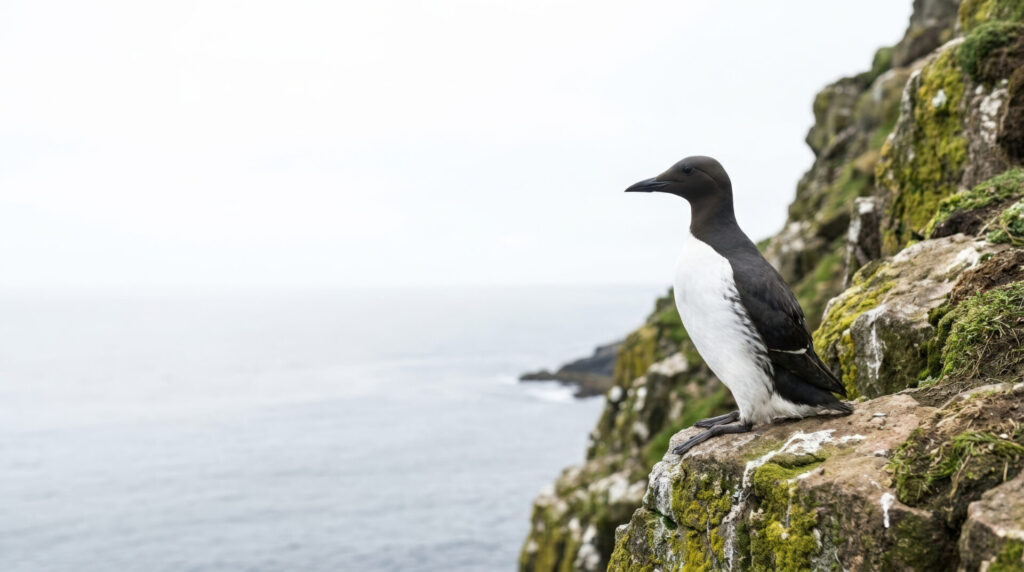
Common murres are deep divers. Next to penguins, they go the deepest of any bird—down 50 metres routinely and have been clocked as deep as 200 metres (650’). There’s still light at that depth (just), but the pressure rises to over 20 atmospheres. Think of the biological adaptations required to get down there, hunt and return to the surface without consequence. They also have sharp spikes in the roof of their mouths to grip their prey. Note: Emperor penguins have been logged to dive nearly 600 metres, but you’re unlikely to see one on our coast.
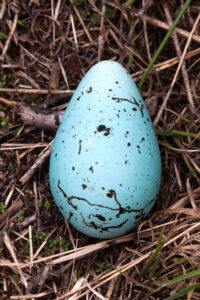 The common murre lays a distinctly pear-shaped egg that is less likely to roll off cliff ledges, instead circling in a tight arc.
Common murres breed in dense colonies, often packed so closely that they touch their neighbours. This makes for a noisy neighbourhood. The high density is in part due to the absence of a nest of any kind (think of the time they save) and partly because of the unusual, single egg they lay. Without nest walls, there’s nothing to stop an egg from rolling off a cliff ledge, except the common murre lays a curious “pyriform” egg that’s quite pointed at one end and broad at the other. The result is an egg that rolls in a tight circle when moved.
Common murres are found up and down the West Coast and across the Bering Strait, as well as in the Maritimes of Canada. Somewhat similar to pigeon guillemots (see below), they have white throats rather than white wing spots and lack the bold red feet of the pigeon guillemot. Both are common in the Gulf Islands and the Broughtons over the summer in large flocks on open water.
MERGANSERS
There are three mergansers to be found along our coast and inland lakes: the common and red-breasted, which look deceptively similar at first glance, and the hooded, which is smaller and more upright.
All of them have narrow, long bills with a serrated edge for gripping underwater prey. They spend their summers in the interior of the province, as far north as the tundra, occupying freshwater lakes.
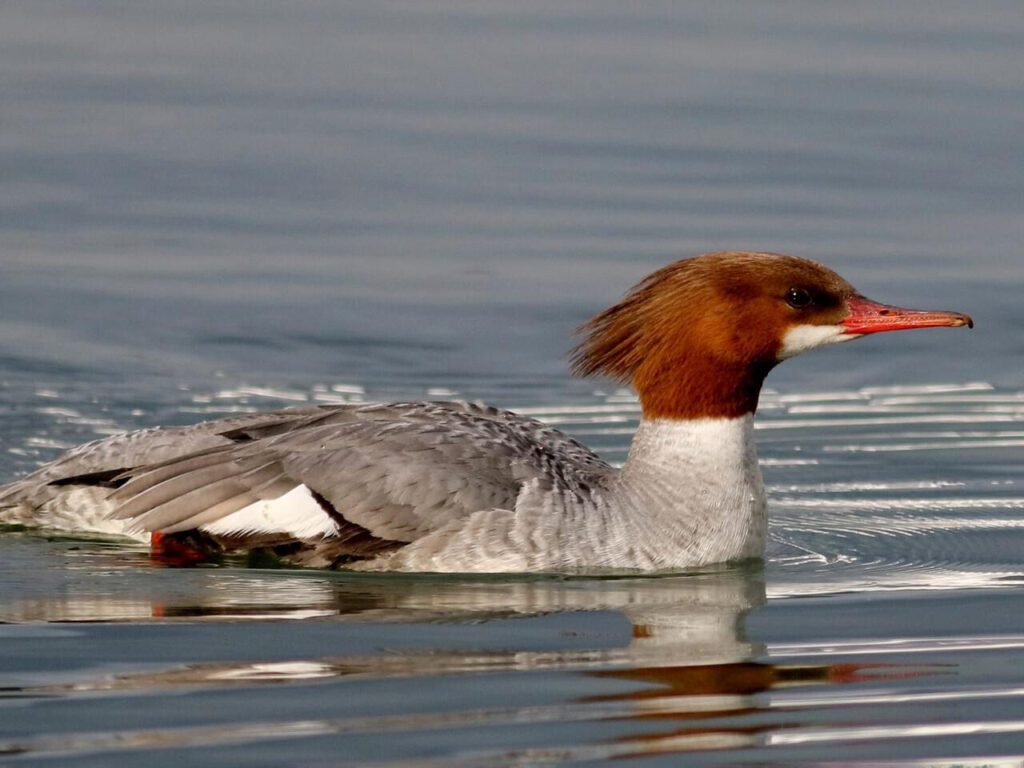 Female common merganser.
Mergansers appear in the Salish Sea in the fall and stay till spring, often forming large flocks on the sea. To tell the common from the red-breasted, look at the head—the former is smooth, the latter has spikes of feathers—and the breast—the former has a white breast, the latter a dark breast.
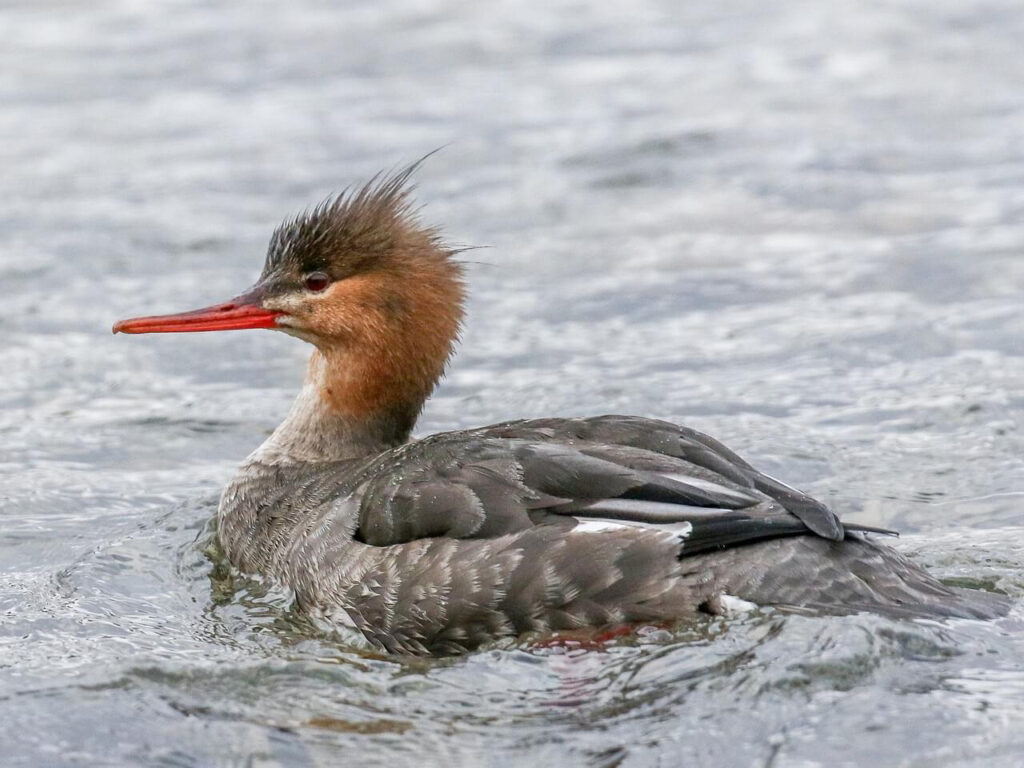 Female red-breasted merganser.
The hooded merganser is quite different looking. Smaller, the male has a stunning white crest which it shows off when trying to impress; the female has a less striking brown crest which it also raises or lowers on demand. The hooded merganser favours calm water and is most often found in sheltered bays, harbours and marinas. The common and red-breasted favour more open water. All three Mergansers have a distinctive habit of paddling along the surface with their beak and eyes submerged, scanning for food below.
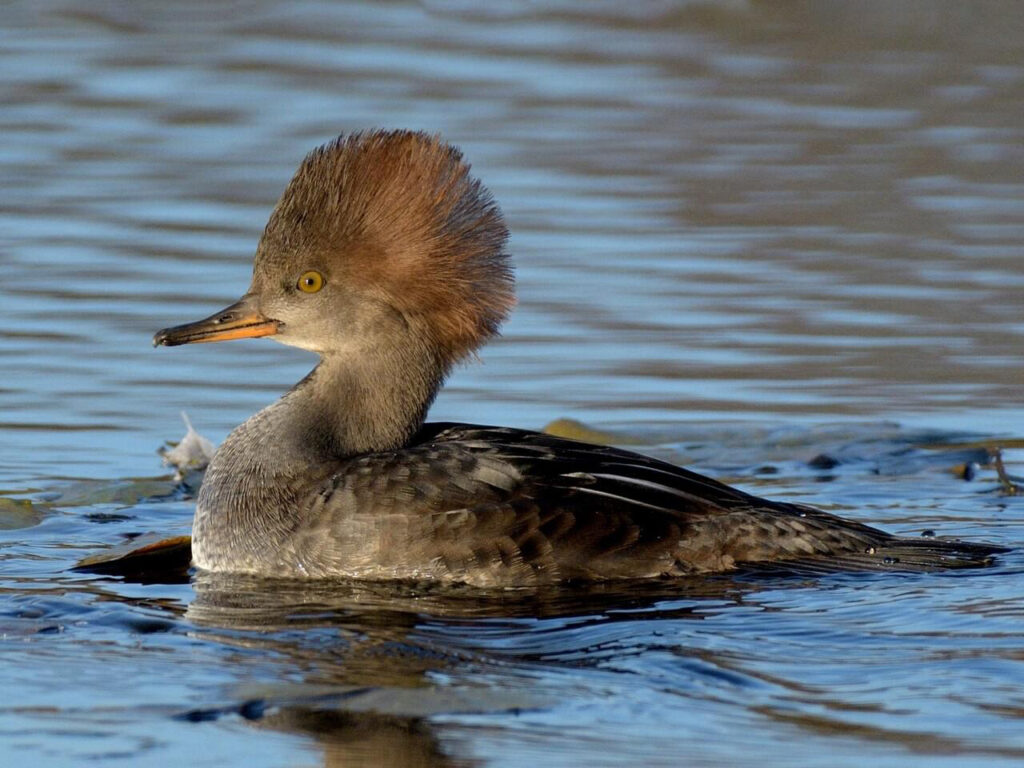 Female hooded merganser.
RHINO AUKLET
Another member of the alcid family is the rhinoceros auklet. It’s named because both genders grow a small horn on their bill, along with two white face lines, during the breeding season. The horn later falls off. Curiously, the horn glows under UV light and, since the bird is more active at night, it has been proposed the bill somehow helps with night vision or finding nests or mates.
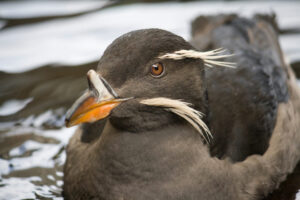 This stocky seabird is distinguished by the small horn-like projection which forms at the base of its bill during the breeding season.
Primarily nocturnal, they can still be seen in large flocks in the Salish Sea through to Queen Charlotte Strait during the day feeding on open water. On land they favour deep tunnels in the ground for nesting sites, which they prefer to visit at night when hawks, falcons and eagles are not around. Numerous ground predator-free islets in Juan de Fuca Strait, such as the well-named Protection Island, are riddled with nests. Some go five to six metres underground.
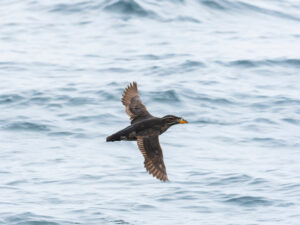 Like other alcids they swim well, but unlike their cousins they have tiny, serrated platelets (denticles) on the roof of their mouths to allow them to carry more than one fish at a time. At sea they are silent, but close to home and in the burrow they emit a strange moo sound that alerts the partner and chick to their return. They almost always lay a single egg—unless the first is lost early in the season. While their numbers have been mostly stable since the 1980s, climate change and intensifying El Niño events have caused chick die-offs in recent years.
TUFTED PUFFIN
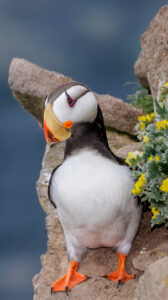 What is it about the tufted puffin everyone loves so much? They’re easy to identify and fun to watch. The white face (during breeding season), yellow feathers and a large colourful bill make them a favourite among birders.
Listed as an endangered species in Washington state, their breeding population has declined drastically. There are only a few remaining colonies on Smith and Protection islands, where the Georgia and Juan de Fuca straits meet the north end of Puget Sound. Like other alcids, they dive deep and emerge with a clutch of small fish pinched across their bill to take home for the chick. The female lays one egg per season and, like the rhino auklet, favours deep earthen burrows. Their tongue is raspy, allowing them to hold their catch against an equally rough palate while hunting for more food. Favourites are capelin, herring, anchovy, squid and even small crabs.
Out of the breeding season the colourful feathers soften to gray and white, the face loses its brilliant whiteness while the bill shrinks and loses its bright yellow base. Once grown, the chick leaves with the other season’s offspring and stays at sea for two years, growing and preparing for its turn to reproduce. Puffins mate for life and can live up to 30 years, a process that helps offset their slow reproductive cycle.
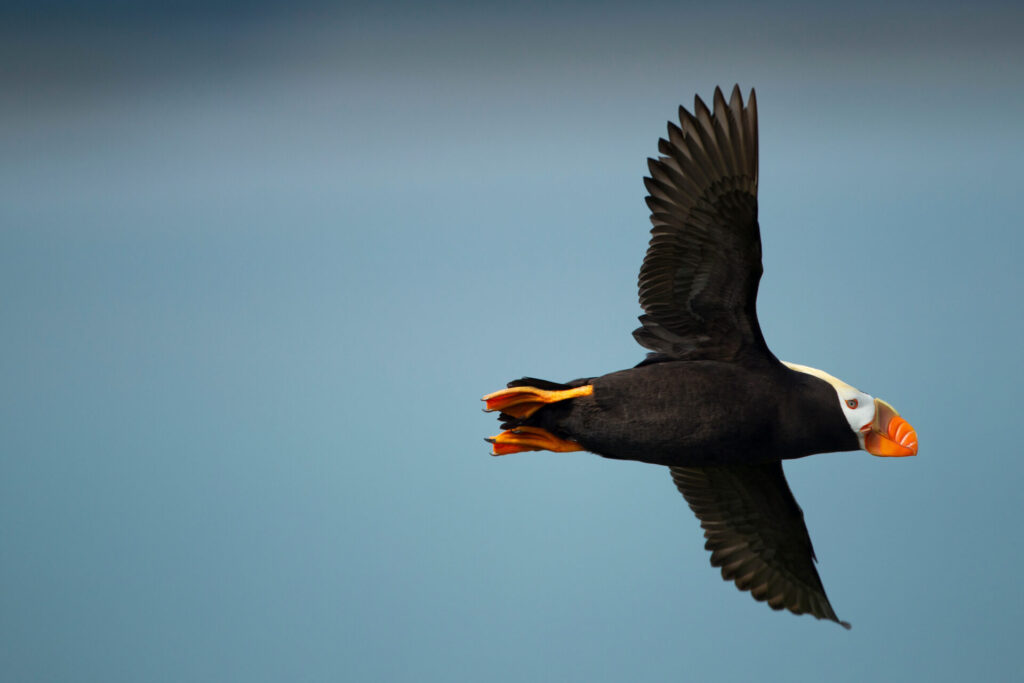 Horned puffin (right) and tufted puffin (centre). A quick way to tell them apart is by the underside—the horned puffin has a white belly, while the tufted puffin has a black belly.
A group of puffins is called a “circus.” While the tufted puffin is your Salish Sea target, the horned puffin is occasionally seen in the area too. At first glance it looks similar, but there’s a big difference when it flies: its entire underside is white, unlike the tufted, which is black. A few horned puffins are seen most years in the area but are considered rare.
PIGEON GUILLEMOT
The bird gets its name because its head looks like a city pigeon, but there the similarity ends. With jet-black plumage and a distinctive white wing patch, its bright red legs give it away as it dives.
A member of the alcid or auk family, the pigeon guillemot is unusual in that it nests in rock crevices rather than exposed cliff ledges. It usually lays two eggs, rather than a single large one like others in the alcid group. Their feet have sharp claws allowing them to climb on sheer rock—handy when you nest on an awkward cliff.
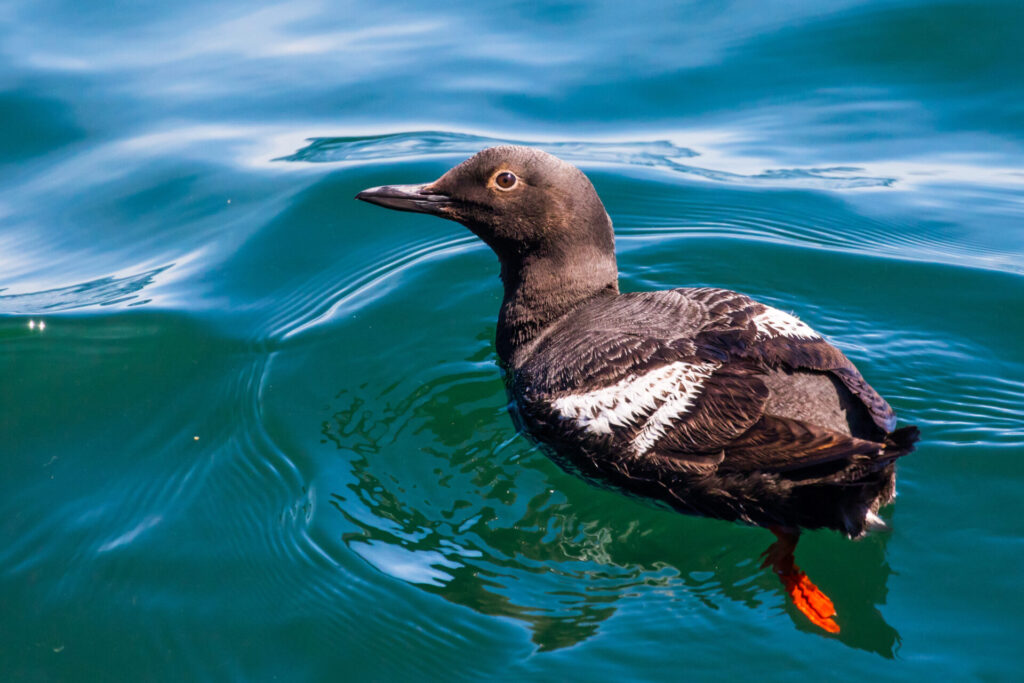
Like murres, their wings are better adapted for swimming, meaning they really have to pump those chest muscles when airborne. Especially since they are a favourite target for interceptors like gulls and crows when returning from the fishing grounds with food for their young. Under those conditions, their best defence is their speed and numbers as there are usually hundreds or even thousands of birds flying landward at the same time.
BIRDING HOTSPOTS
The reality is that birds are everywhere, and seabirds even more so, although there are certainly key locations where birds concentrate. Estuaries like the Skagit River in Puget Sound and the Fraser River around Steveston have tidal flats that are popular among birds, especially during the spring (April to May) and fall (August to September). There are also protected areas worth visiting like the Reifel Bird Sanctuary in Delta, BC, Boundary Bay on the BC-Washington border and Edmonds Marsh in Washington.
The mud flats of Tsawwassen Bay and Roberts Bank next to the BC Ferry terminal are a well-known area too, but like many of these places, timing is important. I once saw tens of thousands of American wigeons at Tsawwassen, but a week later there was barely a bird anywhere. In winter, vast flocks of snow geese descend on the fields around Delta and Anacortes, covering the fields with honking whiteness. One night in the Broughtons, our anchored boat was surrounded by hundreds of red-necked phalaropes (a tiny sandpiper-like bird with a needle bill), but by morning the bay was empty.
Protection and Mitlenatch islands are designated bird-only breeding areas making obvious hotspots for birdwatchers. The delta of the Squamish River at the head of Howe Sound, the Cowichan River near Duncan and the Comox River near Courtenay are also areas favourable for birds, but the reality is that there are pockets of habitat everywhere.
Being a boater, you have the advantage of being able to get out on the water, where flocks of seabirds are seen frequently, feeding and bobbing as you glide past. There’s a strong correlation between whales and birds too—when the humpbacks are stirring up bait balls, there are always mixed flocks on the surface seizing the opportunity to plunder the schools of fish from above (gulls, terns and eagles) and below (murres, guillemots and cormorants).
When anchored in a remote bay, use Merlin to listen to the calls in the forest nearby. Warblers, thrushes and wrens are everywhere in the summer, and on calm evenings their calls carry across the water. There’s so much to see and hear. Happy birding!